






















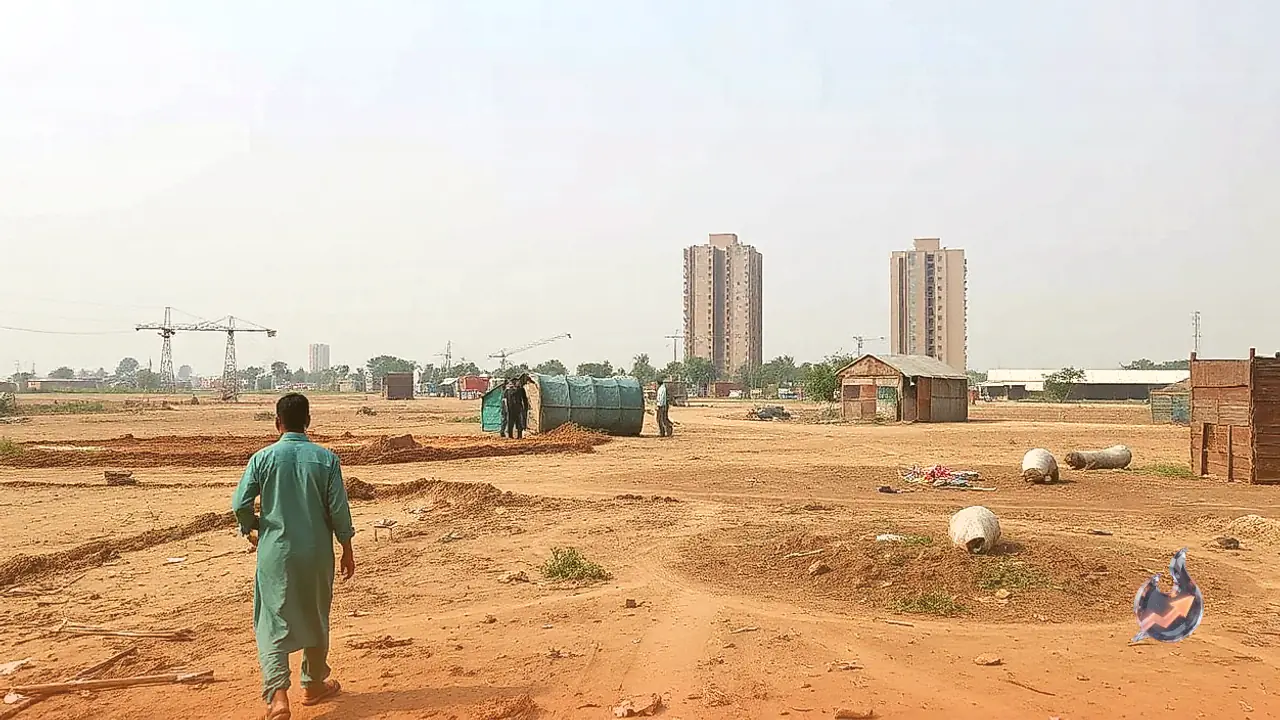

A few decades ago, the region that is now Noida was largely rural, but it has since transformed into a sprawling modern metropolis dominated by multi-storey residential complexes. In parts of Greater Noida, a rural character still remains visible, where large housing societies continue to be developed through ongoing land acquisition. The foundations of Noida itself were built on agricultural tracts acquired from local farmers. As urban expansion continues, an essential legal question frequently arises: does a farmer possess the legal right to refuse to sell or hand over their agricultural land for a housing society, and what exact protections do Indian laws provide?
The Two Legal Pathways for Acquiring Land
These legal principles are not restricted to Noida or the National Capital Region; they apply uniformly across the country whenever a developer seeks to build a project. In practice, a builder who needs land to construct a housing project must proceed through one of two distinct routes. The first approach is a direct, mutual purchase agreement negotiated straight with the landowner. The second route involves initiating formal acquisition through the state machinery or the local development body, specifically the New Okhla Industrial Development Authority.
Article 300A of the Indian Constitution firmly establishes that no individual can be deprived of their property except by authority of law. This fundamental protection means that if a builder approaches a farmer in an individual commercial capacity, the decision to part with the land rests entirely with the farmer. Without sovereign legal invocation, no private entity can compel a transaction.
Complete Autonomy in Direct Private Deals
In transactions where a private builder conducts direct negotiations with an individual farmer, the landowner holds full authority over their asset. The farmer is legally entitled to evaluate the offer and may freely choose to sell the property or turn down the offer altogether. Under this private arrangement, the farmer retains ultimate leverage and absolute ownership rights. However, the scenario shifts significantly if the project is channeled through the local authority or state administrative channels, in which case the individual property owner's autonomy becomes circumscribed by statute.
The 2013 Land Acquisition Act and Consent Thresholds
Whenever the government or the development authority is invoked to facilitate land acquisition, the proceedings fall under the Land Acquisition Act of 2013. Section 2(2) of this statute establishes stringent consent requirements for private commercial entities and public-private partnership initiatives.
Under these statutory provisions, land acquisition intended for a private company, such as a housing developer, cannot receive approval unless at least 80 percent of the affected families formally grant their consent. For public-private partnership models, commonly referred to as PPP projects, the legal requirement mandates the approval of at least 70 percent of the affected families. Consequently, when the required 70 or 80 percent threshold of collective consent is attained, an individual dissenting farmer within that designated area loses the unilateral power to halt the process.
Statutory Powers of the Development Authority and Judicial Safeguards
The administrative authority derives its power from the UP Industrial Development Act of 1976. This state legislation empowers the development body to purchase, acquire, and regulate land for planned urban development and public welfare schemes. Because of these statutory powers, if a housing project is integrated into an authorized governmental scheme, individual refusal options available to landowners become strictly limited.
Even so, the exercise of these statutory powers is bound by rigorous judicial checks. The Supreme Court has explicitly observed that administrative decisions regarding acquisition must not be rushed through under the guise of hurried development. The apex court has repeatedly underlined that authorities must scrupulously comply with all mandated statutory procedures before taking possession of agricultural land from farmers.