




















A major infrastructure overhaul is on the horizon for air passengers travelling through the national capital. To streamline passenger transfers between different flight terminals and significantly cut vehicular congestion around the airport zone, an Automated Passenger Mover (APM) system will be developed at Delhi international airport. Officials shared on Tuesday that the dedicated transit system is targeted to become operational by the year 2030. The entire project involves a planned capital outlay of roughly 3500 crore rupees.
Crucial Component of 10-Year Master Plan
Pradeep Panicker, CEO of Delhi International Airport Limited (DIAL), explained that the upcoming Automated Passenger Mover represents a core element of the operator's broader 10-year master plan extending through 2036. An APM operates as a fully driverless transit system designed to shuttle travellers swiftly from one airport precinct to another. Projections indicate that in the very first year of commercial operation, around 55,000 passengers will utilize the automated transit service every single day.
Route Alignment, 6 Stations, and Metro Connectivity
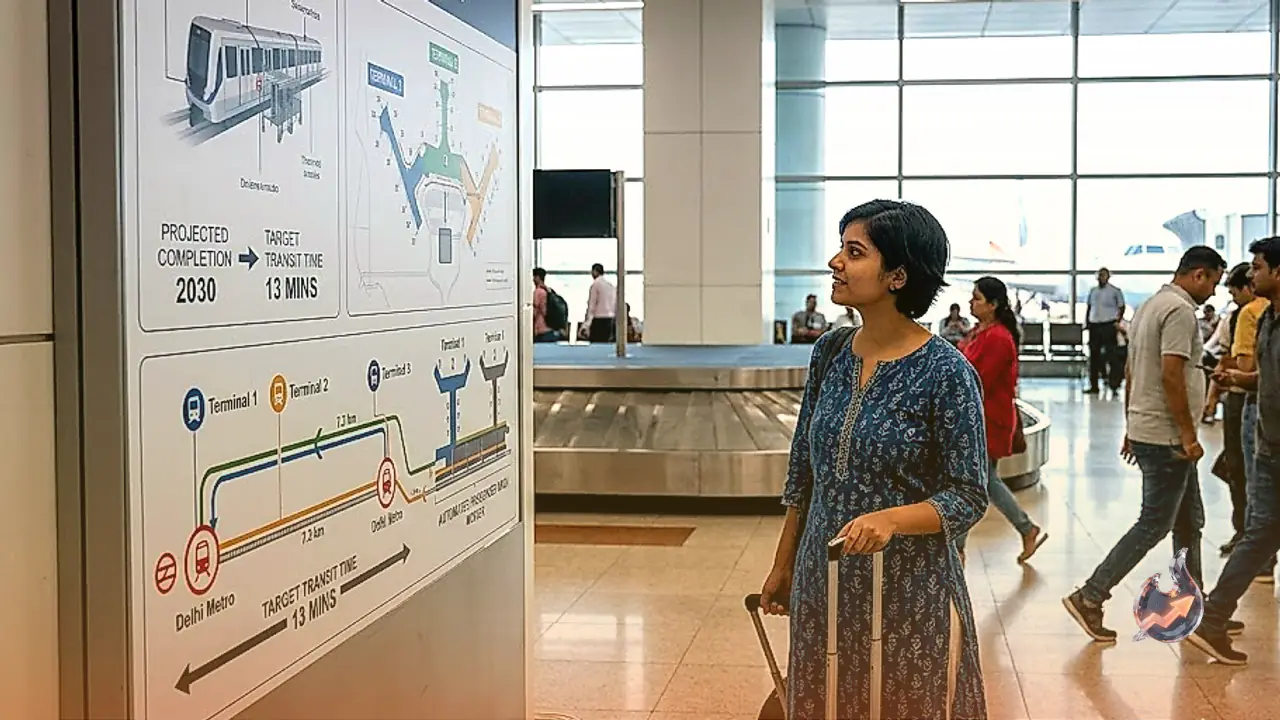
According to details disclosed by airport authorities, the APM line will span 7.3 kilometers in length and feature 6 designated stations across its route. Once running, commuters will be able to complete the journey between Terminal 1 and Terminal 3 in roughly 13 minutes. The route is laid out not just to link Terminal 1, Terminal 2, and Terminal 3, but also to bring the cargo terminal and the Aerocity hub into seamless connectivity. Furthermore, one of the stops along the corridor will provide an integrated interchange with the Delhi Metro network. At present, the combined handling capacity of all three terminals stands at 10.6 crore passengers annually.
Scaling Up Terminal Capacity to 12.5 Crore Passengers
Under DIAL's 10-year development blueprint, the annual passenger throughput of the hub will be ramped up to 12.5 crore travellers. This expanded capacity will accommodate 8.60 crore domestic passengers and 3.90 crore international flyers, with the potential to scale even further up to 12.9 crore passengers. In terms of current infrastructure limits, Terminal 1 handles 4.2 crore flyers per year, Terminal 2 manages 1.4 crore, and Terminal 3 possesses a threshold of 5 crore passengers. Within Terminal 3's existing limits, domestic transit accounts for 1.9 crore passengers while international throughput stands at 3.1 crore.
Transitioning Away From Road Transit and Adding Pier-E
As per the present layout, Terminal 2 and Terminal 3 sit close to one another, but Terminal 1 is situated several kilometers apart. Because of this physical separation, travellers arriving at Terminal 3 who need to board ongoing flights from Terminal 1 currently have no choice but to take road vehicles through external traffic. DIAL is actively awaiting permission from concerned authorities to run dedicated transfer buses within the airport's restricted airside zone between Terminal 3 and Terminal 1 as an interim measure. Addressing fare structures, Pradeep Panicker stated that no final choice has been determined yet regarding whether non-travelling visitors will be charged a fare to ride the APM. In parallel, infrastructure at Terminal 3 will be enhanced with the construction of a new Pier-E by April 2030, which serves as an elongated wing extending from the main terminal hall to facilitate boarding via aerobridges directly into aircraft.