
















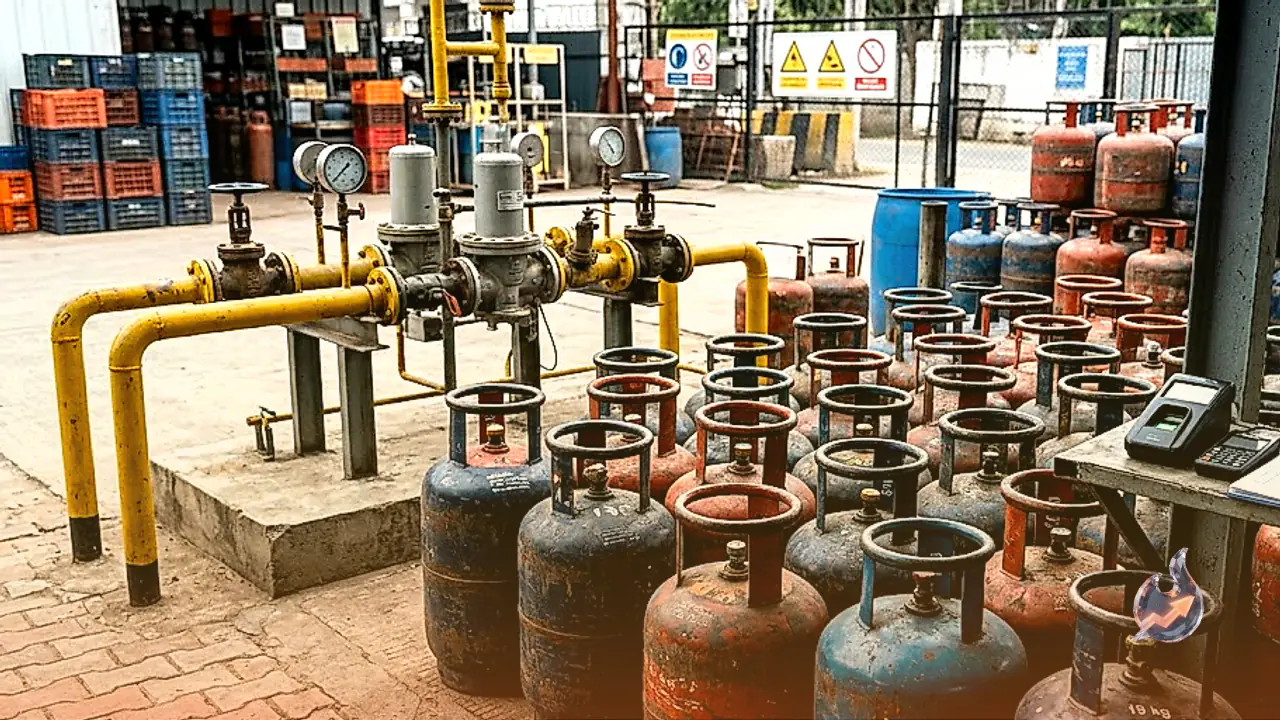

With the calendar turning to November, households and commercial establishments across India are bracing for a series of operational and pricing adjustments concerning liquefied petroleum gas and piped natural gas supplies. State-owned oil marketing companies review fuel tariffs on the first day of every month, and the upcoming cycle is overshadowed by international crude prices hovering near a four-year peak of $117 per barrel. While subsidised residential cooking gas prices are typically shielded from sudden global fluctuations, commercial 19 kg cylinders and alternative pipeline supplies remain directly exposed. Beyond retail rates, customers using Indane, HP Gas, and Bharat Gas must navigate stringent biometric identity verifications, delivery code validations, and regulated booking intervals.
Global Crude Rally and the Pressure on 19 kg Commercial LPG
The persistent geopolitical conflicts across the Middle East have disrupted key supply arteries, especially maritime transit through the Strait of Hormuz. Continuing confrontations involving the United States, Israel, and Iran, alongside regional drone and missile strikes by Iran-backed Houthi forces targeting Saudi Arabia, have sustained an intense risk premium on petroleum assets. With international crude testing $117 per barrel, oil marketing companies face escalating input costs for non-subsidised fuel. Commercial LPG rates are structured as a direct pass-through mechanism reflecting global import benchmarks, which drove sequential retail price hikes across Indian commercial markets in both September and October.
Current commercial LPG prices for 19 kg cylinders across 14 major urban centres stand as follows
- New Delhi: ₹2,810.00 (reflecting a ₹62.50 increase)
- Kolkata: ₹2,954.00 (reflecting a ₹70.00 increase)
- Mumbai: ₹2,764.50 (reflecting a ₹63.50 increase)
- Chennai: ₹2,983.00 (reflecting a ₹66.50 increase)
- Gurgaon: ₹2,828.00 (reflecting a ₹63.50 increase)
- Noida: ₹2,810.00 (reflecting a ₹62.50 increase)
- Bangalore: ₹2,898.00 (reflecting a ₹67.00 increase)
- Bhubaneswar: ₹2,988.00 (reflecting a ₹69.00 increase)
- Chandigarh: ₹2,833.00 (reflecting a ₹63.50 increase)
- Hyderabad: ₹3,065.00 (reflecting a ₹69.00 increase)
- Jaipur: ₹2,839.00 (reflecting a ₹63.00 increase)
- Lucknow: ₹2,932.50 (reflecting a ₹62.50 increase)
- Patna: ₹3,100.50 (reflecting a ₹71.50 increase)
- Thiruvananthapuram: ₹2,849.00 (reflecting a ₹65.00 increase)
Domestic Cylinder Pricing Stability for 14.2 kg Users
Unlike commercial buyers, domestic retail consumers relying on standard 14.2 kg cooking gas cylinders are protected by government market mechanisms. The Ministry of Petroleum and Natural Gas treats residential cooking fuel as an essential commodity, absorbing international volatility rather than passing cost spikes directly to families. The last countrywide tariff adjustment for domestic LPG took place on June 7, 2026. Given the policy priority to shield domestic budgets from international energy turbulence, retail prices for domestic cylinders are widely projected to hold steady entering November.
The prevailing 14.2 kg domestic LPG prices across key metropolitan markets remain unchanged
- New Delhi: ₹942.00 (unchanged)
- Kolkata: ₹968.00 (unchanged)
- Mumbai: ₹941.50 (unchanged)
- Chennai: ₹957.50 (unchanged)
- Gurgaon: ₹950.50 (unchanged)
- Noida: ₹939.50 (unchanged)
- Bangalore: ₹944.50 (unchanged)
- Bhubaneswar: ₹968.00 (unchanged)
- Chandigarh: ₹951.50 (unchanged)
- Hyderabad: ₹994.00 (unchanged)
- Jaipur: ₹945.50 (unchanged)
- Lucknow: ₹979.50 (unchanged)
- Patna: ₹1,031.50 (unchanged)
- Thiruvananthapuram: ₹951.00 (unchanged)
Piped Natural Gas Rates and City Distribution
Piped natural gas network pricing functions under a different economic formula than bottled petroleum gas. Domestic pipeline costs are governed by the balance between domestically produced field gas and higher-cost imported liquefied natural gas, alongside local transmission expenses and city gas distribution taxes. Since the flare-up of regional hostilities in late February, city distributors have enacted two minor upward tariff revisions. Despite these gradual upticks, piped gas remains an economical choice compared to bottled alternatives.
Prevailing domestic PNG rates across surveyed cities are recorded as
- New Delhi: ₹49.59
- Kolkata: ₹50.00
- Mumbai: ₹52.00
- Chennai: ₹52.00
- Gurgaon: ₹48.40
- Noida: ₹49.46
- Bangalore: ₹53.00
- Bhubaneswar: ₹49.00
- Chandigarh: ₹57.48
- Hyderabad: ₹56.00
- Jaipur: ₹51.50
- Lucknow: ₹56.50
- Patna: ₹52.50
- Thiruvananthapuram: ₹51.00
Biometric Aadhaar Authentication and Subsidy Verification
A primary procedural mandate continuing through November is the mandatory biometric Aadhaar authentication for all registered gas consumers. The Ministry of Petroleum and Natural Gas requires customers to complete this verification to maintain regular access to refills. The rule is particularly consequential for beneficiaries of the Pradhan Mantri Ujjwala Yojana. Beneficiaries who fail to execute biometric verification will see their Direct Benefit Transfer subsidy payments, typically ranging from ₹200 to ₹300 per cylinder, suspended. Normal subsidised bookings at retail selling points are reactivated only after identity records are formally cleared through the system.
Provisions for Customers Opting Out of Biometric Verification
For consumers who choose not to undergo biometric authentication or face physical difficulties completing the process, alternative purchase options are preserved under ministry protocols. Customers can declare their refusal through authorized digital customer portals, mobile applications, interactive voice response systems, or dedicated messaging services provided by their oil marketing company. Such consumers will be allowed to purchase unsubsidised cooking gas at prevailing market rates. However, their supply is restricted to compact 5 kg or 10 kg cylinder formats and remains contingent on inventory levels at local distributorships.
The 25-Day Wait Period for Cylinder Bookings
To discourage black-marketing and stabilize cylinder circulation, state refiners maintain an operational restriction on booking frequency. Earlier, rural customers operated under a 45-day waiting period, which was subsequently lowered to 25 days to match the urban standard. Urban consumers, who previously enjoyed a 21-day turnaround, have been subject to the 25-day minimum window since March 2026. Consequently, all domestic consumers must wait at least 25 calendar days after receiving a refill before placing an order for their next cylinder.
Challenges in Issuing New Domestic Connections
Prospective customers seeking new domestic 14.2 kg connections from Indane, Bharat Gas, or HP Gas continue to report processing delays in multiple territories. Rapid urban migration and the sprawl of new housing layouts have created substantial distribution backlogs. In Karnataka, Food, Civil Supplies and Consumer Affairs Minister Rizwan Arshad highlighted that numerous newly established households, including economically disadvantaged groups and migrant families living in freshly developed urban colonies, have struggled to obtain connections. The issue has appeared in several other states as well, leaving applicants awaiting clearer regulatory direction from distributors.
Expanding PNG Infrastructure and the 30-Day Cylinder Return Rule
The central administration has stepped up the conversion of urban households from bottled LPG to piped natural gas under the PNG Drive 3.0 initiative, supported by the dedicated MyPNG Portal. This consolidated consumer platform simplifies connection requests and coordinates interactions between homeowners and city gas utility providers. Alongside this rollout, an existing regulation enforced since May 2026 requires any consumer whose premises are connected to a functioning PNG line to surrender their bottled LPG connection within 30 days, irrespective of which state-owned agency issued the cylinder.
Delivery Verification Codes and Cooking Gas Restrictions
Logistical rules introduced earlier in 2026 continue into November without alteration. When a cylinder is dispatched for home delivery, the consumer receives a secure one-time passcode on their registered mobile contact. Delivery personnel are strictly barred from completing the handover unless this numeric code is verified on handheld terminals. Furthermore, the authorities continue to enforce the single-connection policy per dwelling to prevent duplicate subsidised cylinders from being held under a single roof.