




















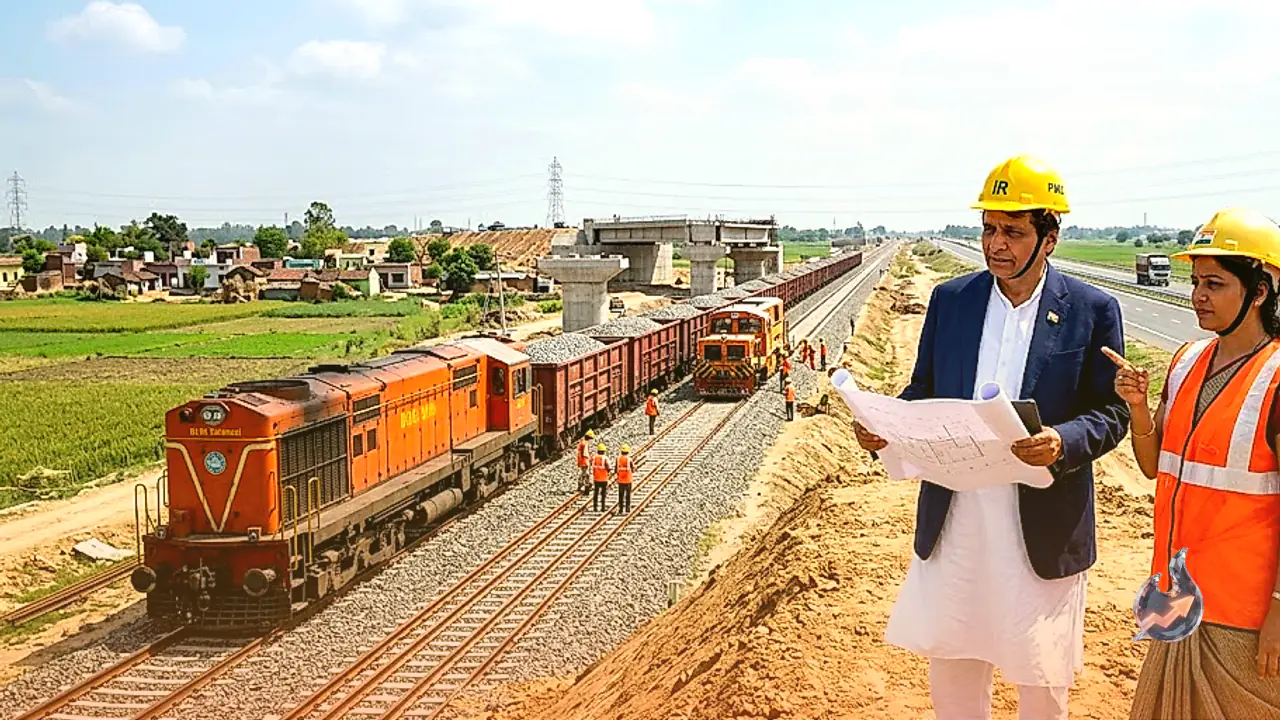

In a significant step to drive private investment into the country's transport network, the construction of six new freight-hauling tracks will adopt the operational framework of the highway sector. In early August, the Public Private Partnership Appraisal Committee under the Ministry of Finance approved the development proposal for these six new rail lines. Spanning a total length of approximately 647 kilometers, these routes will be developed under the Hybrid Annuity Model. This marks the first time railways will utilize this specific financial structure for a project, a model widely applied in the highway construction sector.
These six proposed rail projects are designated for development across three key states, with four situated in Odisha, one in Telangana, and one in Jharkhand. The tracks located in Odisha include the approximately 49.58-kilometer Balaram-Putgadia-Tentuloi inner corridor, the 112.56-kilometer Budhapank-Tentuloi-Luburi outer corridor, the 101.26-kilometer Jajpur-Keonjhar Road-Aradi-Dhamra port line, and the 48.96-kilometer Titikari station-Waltair bauxite mines line. Additionally, the 207.80-kilometer Manuguru-Ramagundam line in Telangana and the 126.52-kilometer Pakur/Nagranabi-Godda line in Jharkhand will be developed.
The total initial bid cost for these six projects is estimated at 15,976 crore rupees, while total capital expenditure during the entire concession period could reach approximately 40,866 crore rupees. The concession period for these routes is proposed between 17 and 19 years, and coal will be the primary commodity transported along these paths. Alongside coal, the movement of iron ore, bauxite, coking coal, fertilizers, cement, and food grains will also take place. Initially, the Public Private Partnership Appraisal Committee had granted in-principle approval under the Design, Build, Finance, Operate, and Transfer model, but following market feedback, the railway ministry reviewed the structure and decided to implement them under the hybrid model. These proposals will now be submitted to the union cabinet for final approval, following which tenders will be officially invited.
Under this arrangement, construction-period financial risks will be shared between the government and the private sector. During the construction phase, Indian Railways will provide 40 percent of the bid project cost as a grant, while the private company will finance the remaining 60 percent. Once the lines are operational, the railways will repay this 60-percent portion in installments along with interest, alongside regular payments to the private entity for maintaining tracks and other assets. A key feature of this model is that all revenue generated from train operations and freight transport will remain with Indian Railways. Furthermore, the railways will bear all traffic and tariff-related risks, meaning that if freight traffic or revenue on any route falls below estimates, the private company will not face financial penalties.
According to railway projections, construction on the six projects is proposed to begin in April 2028, and a senior railway official indicates that the bidding process is likely to commence during the financial year 2027-28. In addition to these six lines, railways have 49 other projects in the pipeline under the public-private partnership model, totaling an estimated cost of around 1.80 lakh crore rupees. Previously, railways successfully completed 18 projects under this model costing 16,686 crore rupees, while seven projects worth 16,362 crore rupees remain under construction, including initiatives linked to coal and port connectivity.