






















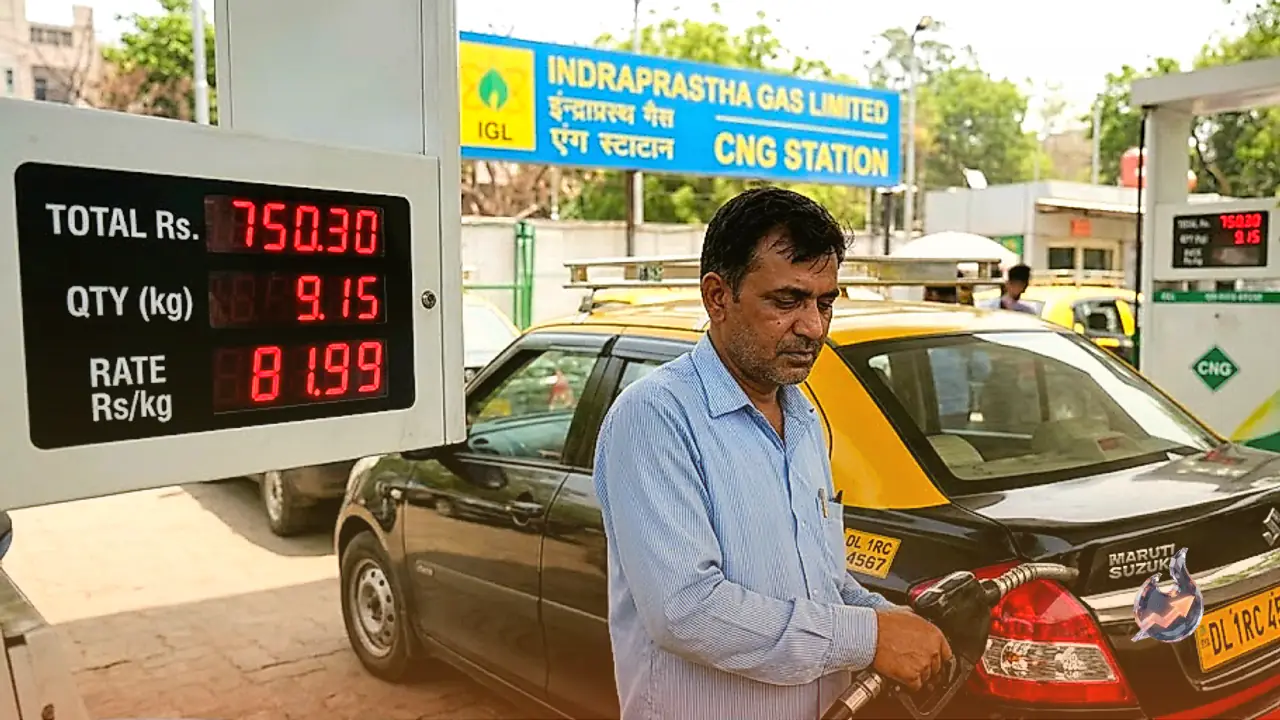

Commuters and commercial transport operators in the National Capital Territory of Delhi face increased fuel expenses starting Saturday, August 29, as Indraprastha Gas Limited (IGL) has executed a price hike on compressed natural gas (CNG). Under the revised tariff structure, the retail price of CNG in Delhi has been increased by Rs 3.89 per kg, pushing the consumer rate from Rs 83.09 per kg up to Rs 86.98 per kg. This upward revision comes as a direct consequence of escalating procurement costs for imported liquefied natural gas (LNG), which the city gas distribution network relies upon to satisfy expanding domestic energy requirements.
The tariff adjustment is expected to impact a wide range of daily road users throughout the capital region. Beyond personal CNG vehicle owners adjusting their monthly travel budgets, commercial operators including autorickshaw drivers, traditional taxi operators, app-based cab aggregators, and logistics fleets will experience an immediate squeeze on operational margins. Because compressed natural gas serves as the primary fuel source for public passenger transport in Delhi, the revised rates create fresh pressure on transport operator earnings across the metropolis.
Comprehensive City-Wise Breakdown of Revised CNG Tariffs
Indraprastha Gas Limited supplies compressed natural gas across multiple geographical zones in North India, resulting in varied retail tariffs based on regional taxation and logistical costs. In the neighboring Uttar Pradesh urban centers of Noida, Greater Noida, and Gautam Buddh Nagar, consumers will now pay Rs 95.59 per kg. The revised price in Ghaziabad has also been fixed at Rs 95.59 per kg, while motorists in nearby Hapur will see rates adjusted to Rs 96.59 per kg. Elsewhere in western Uttar Pradesh, the price stands at Rs 95.47 per kg across Muzaffarnagar, Meerut, and Shamli.
Further south in Uttar Pradesh, the revised rates push fuel costs even higher. In Kanpur, Hamirpur, and Fatehpur, the retail price of CNG has been set at Rs 98.31 per kg, marking one of the highest figures within IGL's operational territory. Meanwhile, in the Bundelkhand region covering Mahoba, Banda, and Chitrakoot, the updated rate is Rs 93.31 per kg.
In the state of Haryana, tariff structures remain relatively lower compared to adjacent Uttar Pradesh districts. The revised CNG rate in Gurugram now stands at Rs 92.01 per kg. Motorists refueling in Rewari will pay Rs 91.59 per kg, while the rate in Karnal has been set at Rs 91.32 per kg. In Kaithal, the price has been adjusted to Rs 92.32 per kg.
IGL's operational footprint in Rajasthan has also seen matching price modifications. In the cities of Ajmer, Pali, and Rajsamand, the retail cost of compressed natural gas has risen to Rs 96.33 per kg following the nationwide tariff recalibration.
Surging Global Benchmarks Drive Local Price Adjustments
The underlying driver for the retail price hike stems from severe cost inflation in international energy markets. According to data highlighted by IGL, domestic supply allocations have increasingly relied on spot cargoes of imported liquefied natural gas (LNG) to bridge the gap between fixed domestic natural gas quotas and rising market demand. As global LNG spot purchases became considerably more expensive over recent months, gas distribution companies were forced to pass a portion of these procurement costs down to end consumers.
Key international gas pricing benchmarks demonstrate the magnitude of this market shift. The Asia JKM (Japan Korea Marker) LNG benchmark recorded a sharp ascent, climbing from approximately $10.99 per MMBTU to $23.41 per MMBTU. This movement represents a massive price increase of nearly 113%. Simultaneously, European gas markets experienced a parallel surge, with the TTF (Title Transfer Facility) benchmark advancing from around $11.36 per MMBTU to $23.35 per MMBTU, translating to an increase of roughly 105%.
Geopolitical Bottlenecks and Future Pricing Dynamics
The dramatic rise in global gas pricing has been compounded by several international geopolitical and seasonal factors. Ongoing conflicts and geopolitical friction in West Asia have heightened anxieties regarding security across vital maritime trade corridors. Specifically, potential threats of trade movement disruptions through the Strait of Hormuz, a critical chokepoint for international LNG tanker shipments, have injected substantial risk premiums into spot cargo pricing.
In addition to trade transit concerns, European nations have aggressively expanded their gas procurement initiatives to rebuild underground storage inventories prior to the onset of the winter season. This concentrated seasonal demand from European buyers has intensified competition for available global LNG supply, driving spot rates to elevated levels globally.
Going forward, the trajectory of domestic CNG rates in Delhi-NCR and surrounding markets will remain tightly coupled with international market dynamics. Key determinants for future price movements include fluctuations in global spot LNG rates, overall supply availability, geopolitical developments affecting transit routes, and the exact proportion of imported gas needed to fulfill domestic consumption demand.