




















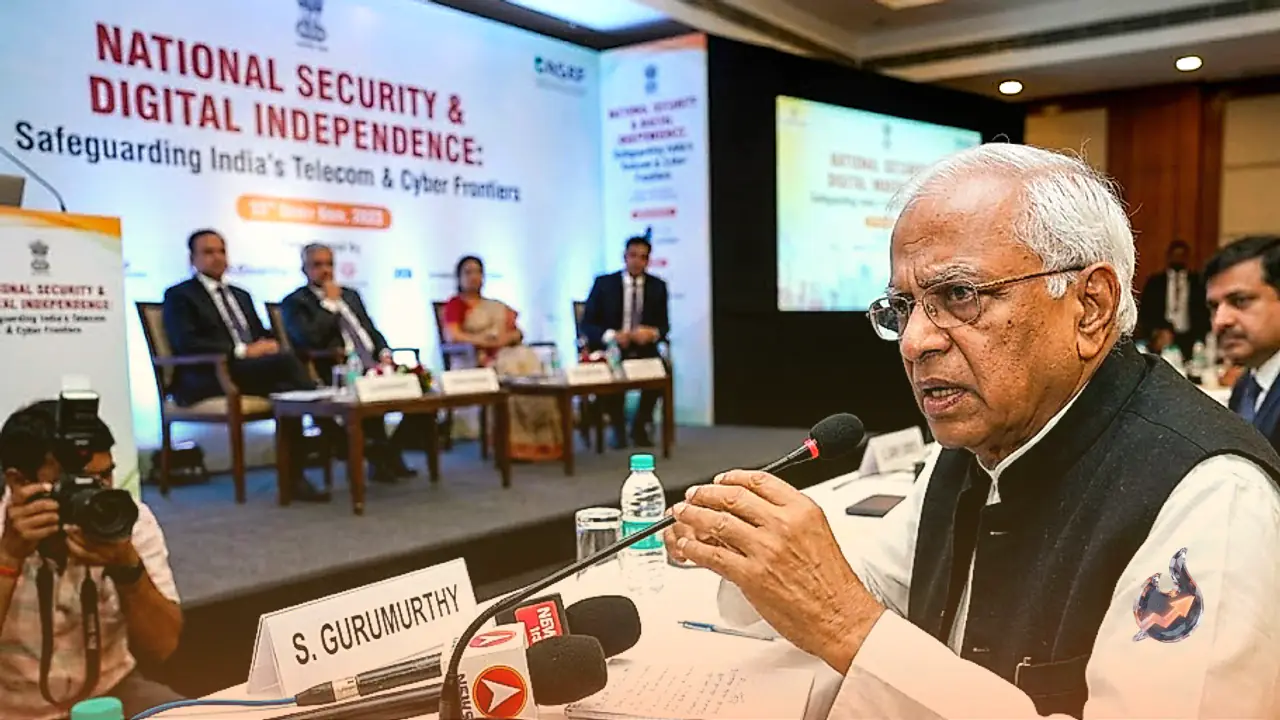

A sharp controversy has emerged around the planned launch of Elon Musk's satellite broadband project Starlink in India following remarks made by the tech entrepreneur. Indian journalist and commentator S Gurumurthy raised serious doubts about Musk's broader intentions, asserting that the foreign billionaire is attempting to play domestic politics inside India. Sharing his perspective on Saturday, Gurumurthy questioned why a foreign operator with such a record should be trusted with access to the country's critical telecommunications backbone.
Concerns Over National Security and Strategic Communications
Weighing in on social media, Gurumurthy focused on the sensitive nature of digital networks and infrastructure. He stressed that telecom connectivity serves as an indispensable pillar of modern sovereign security rather than an ordinary consumer utility. Given that reality, permitting a foreign magnate who openly involves himself in national political disputes to handle strategic communication assets creates valid national security concerns.
Gurumurthy argued that Musk, as a foreign citizen, ought to steer clear of internal political maneuverings within India. He noted that once a global business executive begins using public platforms to influence political outcomes, it becomes impossible to disentangle their corporate goals from their broader political ambitions.
Accusations of Acting Like a Politician Rather Than a Businessman
Elaborating on Musk's public record, Gurumurthy suggested that the billionaire behaves far more like an active political figure than a conventional commercial entrepreneur. He cited Musk's extensive involvement in the 2024 presidential campaign in the United States, alongside his frequent interventions across European Union and British public debates.
In Gurumurthy's assessment, this persistent habit of intervening in the governance and elections of various jurisdictions makes it difficult for Indian authorities to treat Musk purely as a neutral commercial actor, raising legitimate hesitations about his commercial ventures within India's strategic boundaries.
Sridhar Vembu Highlights Market Competition Realities
Gurumurthy's remarks came in response to a post by Sridhar Vembu, scientist and former CEO of Zoho Corporation. Vembu had previously called out what he viewed as a glaring contradiction in Musk's complaints about market barriers. Vembu emphasized that India currently provides consumers with some of the most affordable internet connectivity anywhere on the globe, whereas in the United States, Tesla enjoys regulatory and tariff protections against competition from Chinese electric vehicles.
Vembu noted that Prime Minister Narendra Modi has worked hard to foster an open and competitive economic structure where benefits directly reach ordinary citizens. He emphasized that the administration does not tolerate monopolies and instead nurtures startup enterprises as the truest sign of a vibrant, competitive economic ecosystem. Against that backdrop, claims that Indian market conditions are unfairly controlled by oligarchs run counter to visible market outcomes.
Financial Clout and Political Role in the United States
Examining Musk's political track record, Gurumurthy pointed out that the billionaire's influence extends far beyond commentary into massive campaign funding. During the 2024 United States presidential race, Musk emerged as the single most prominent financial backer supporting Donald Trump. Public filings from the Federal Election Commission revealed that Musk directed approximately 259 million dollars to political action groups backing Trump's campaign.
This massive financial deployment cemented Musk's status as one of the cycle's largest individual political donors. His contributions established him as a key political ally to Trump and secured him substantial leverage across Republican political circles, blurring the conventional line between private enterprise and partisan political power.
Interventions in British Politics and Policy Debates
Beyond the American political sphere, Musk has repeatedly waded into contentious British political controversies. He publicly referred to Britain as a tyrannical police state and took aim at former prime minister Keir Starmer, dubbing him "Two-Tier Keir". Musk further asserted that the British legal system operates with bias against right-wing groups.
Musk also launched sharp attacks against proposed adjustments to British agricultural inheritance tax rules, characterizing the government's overall direction as completely reminiscent of Stalin. Gurumurthy emphasized that such aggressive foreign broadsides against sovereign policy choices demonstrate that Musk does not restrict himself to technological or commercial affairs.
The Underlying Starlink Entry Dispute in India
Operated by Elon Musk's aerospace company SpaceX, Starlink uses a constellation of low-Earth orbit satellites to beam high-speed broadband to terrestrial dishes, specifically targeting remote, rural, and underserved regions lacking ground fiber cables. Musk had announced intentions to roll out the service across India in recent weeks.
However, the regulatory path became contentious after Musk alleged that certain "oligarchs" were actively maneuvering to block his venture's commercial rollout in India. The Indian government firmly rejected these claims as unfounded. With Gurumurthy and Vembu now speaking out, the debate has shifted from standard spectrum approvals into a broader argument over market fairness, sovereignty, and foreign political leverage.