























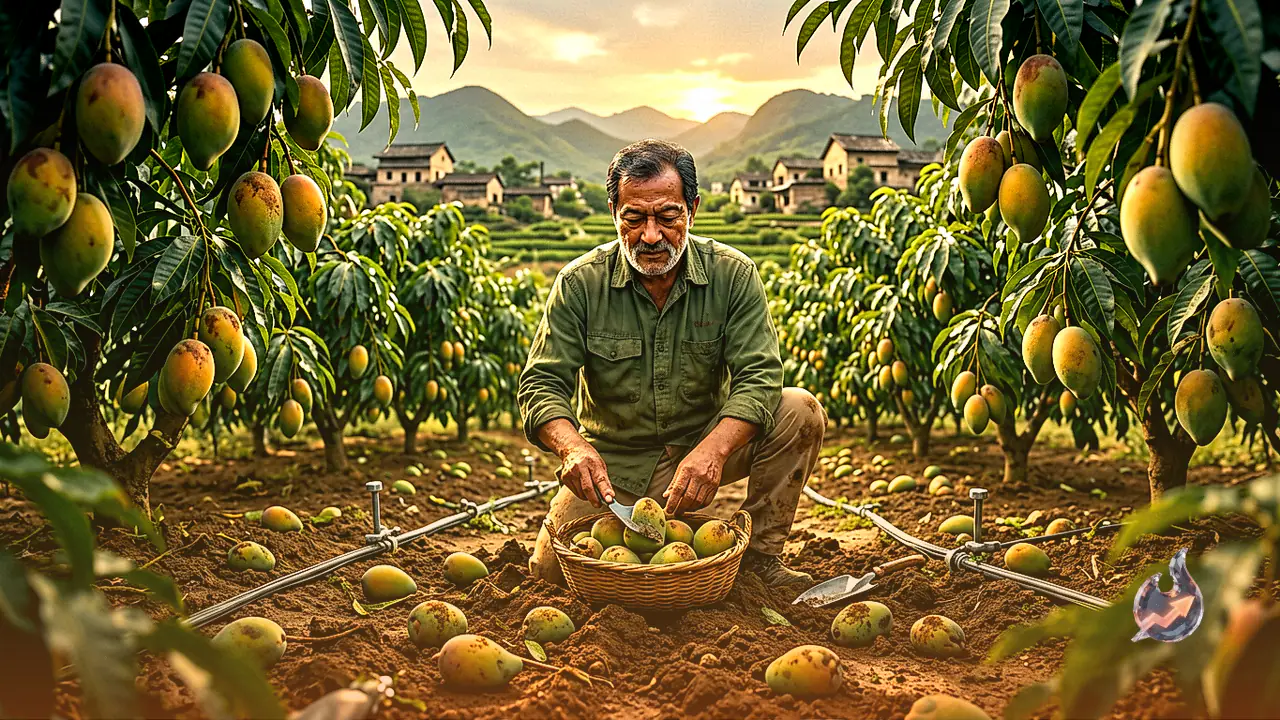

Commercial mango horticulture has emerged as a highly lucrative venture for farmers operating in tropical and subtropical regions. In states like Rajasthan, where rainfall can be unpredictable and water availability is restricted, adopting scientific orchard management techniques can significantly boost crop productivity and profitability. Agriculture expert Bajrang Singh highlights that the rainy season, spanning from June to September, serves as the most opportune window for planting new mango saplings. However, clear and sunny weather remains essential during the subsequent flowering and fruit-setting stages. For optimal vegetative growth and healthy canopy establishment, ambient temperatures between 24 and 28 degrees Celsius are considered ideal.
Soil Selection and Pit Preparation Guidelines
Before establishing a new orchard, thorough testing of soil quality and land drainage capabilities is indispensable. Well-drained sandy loam soil is best suited for mango cultivation. This light-textured soil facilitates unrestricted root expansion and accelerates sapling growth rates. The ideal soil pH ranges between 6.5 and 7.5, ensuring maximum availability of essential soil nutrients. Preventing waterlogging is crucial, as stagnant water around the root zone leads to root rot and sapling mortality. Consequently, orchards should always be sited on naturally sloped land or fields equipped with efficient drainage channels.
Pits measuring 1×1×1 meter should be dug roughly one month prior to planting and left exposed to sunlight for solarization to eradicate soil-borne pathogens. In standard orchards, a spacing of 10×10 meters must be maintained between adjacent plants. Conversely, for high-density varieties like Amrapali, farmers should adopt a closer grid spacing of 5×5 meters. Each pit must be refilled with topsoil thoroughly blended with 25 kilograms of well-decomposed farmyard manure and 1 kilogram of single superphosphate, elevating the soil level slightly above the surrounding ground.
Top Commercial Mango Varieties by Season
Farmers can select suitable cultivars based on local agro-climatic conditions and market demand. Commercial varieties are categorized into three distinct harvesting windows. Early-season varieties include Bombay Green, Totapuri, and Kesar. Mid-season selections feature Langra, Dasheri, Mallika, and Amrapali, all of which command high market value. Late-season varieties such as Chausa and Fazli extend the harvesting period and fetch premium prices toward the end of the season.
Beyond traditional cultivars, several high-yielding hybrids developed by the Indian Agricultural Research Institute have proven exceptionally well-adapted to the climatic conditions of Rajasthan. Prominent cultivars include Pusa Arunima, Pusa Surya, Pusa Lalima, Pusa Shreshta, Pusa Pratibha, and Pusa Pitambara. Additionally, modern hybrid varieties like Dasheri-51, Ambika, and Arunika offer outstanding yield potential and commercial viability.
Annual Fertilizer and Micronutrient Schedule
Nutrient applications must be scaled progressively as the tree matures over its initial years. During the first year, saplings should receive 15 kilograms of organic manure per plant, increasing gradually each year to reach 75 kilograms by the fifth year. Similarly, single superphosphate dosage starts at 250 grams per plant in year one and scales up to 1 kilogram per plant by the fifth year.
Nitrogen requirements are fulfilled through urea application, which begins at 250 grams in the first year and increases to 1.25 kilograms per plant by year five. The annual urea allotment should be split into two equal doses: the first half applied in March following fruit set, and the remaining half incorporated into the soil during June at the onset of monsoon rains. If foliage exhibits zinc deficiency symptoms, a foliar spray of 0.3 percent zinc sulfate solution should be applied promptly.
Drip Irrigation, Pest Control, and Expected Yield
To conserve water while supplying uniform moisture directly to the root zone, drip irrigation is highly recommended. Outside of the monsoon season, drip systems should operate once a week during hot summer months and at 15-day intervals throughout the winter season. Direct root-zone delivery minimizes evaporation losses and maintains optimal soil moisture. Under rigorous scientific management, farmers can achieve an impressive yield ranging from 15 to 20 tonnes per hectare.
Continuous monitoring is vital to protect orchards from damaging pests and diseases. Mango hoppers and mealy bugs are major insect pests that can severely impair crop yields. To control fungal infections such as powdery mildew, immediate spraying of wettable soluble sulfur is recommended. For infestations of bark-eating caterpillars, systemic insecticides should be injected directly into the active wood tunnels, followed by sealing the entrance holes.