





















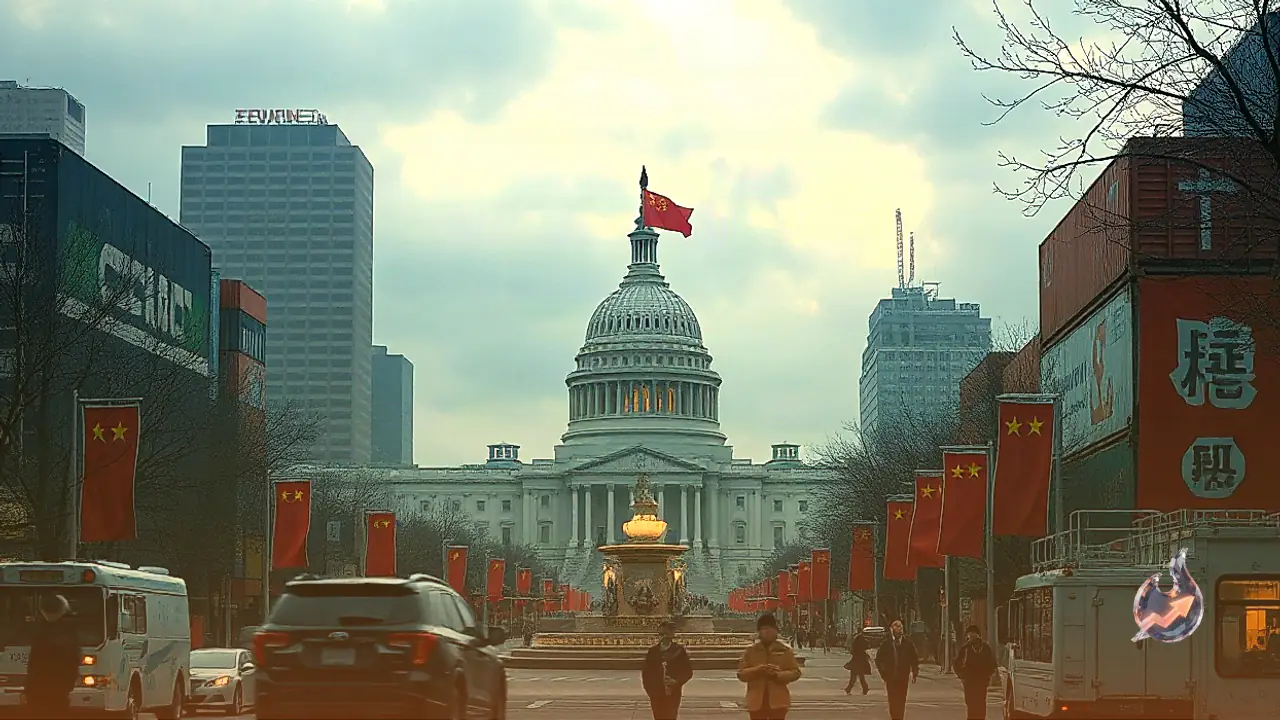

Chinese President Xi Jinping has arrived in Washington for high-level discussions with US President Donald Trump under an unusual diplomatic setup marked by the complete absence of a visible corporate delegation. The summit agenda spans unresolved trade disputes, artificial intelligence governance and strategic tensions surrounding Iran. However, the deliberate choice to leave China's leading executives behind has emerged as a focal point for global markets assessing the trajectory of bilateral economic ties. Rather than framing the visit around bilateral business contracts and commercial pageantry, Beijing has directed the engagement strictly along formal government channels.
Extended Trade Truce Offers Interim Relief to January
The bilateral meeting follows a mutual agreement between Washington and Beijing to prolong their ongoing trade truce by an additional two months. US Treasury Secretary Scott Bessent confirmed that the arrangement has been stretched beyond its previous November 10 cut-off to January 10, granting both administrations extra room to negotiate without the immediate revival of punitive tariffs or retaliatory restrictions. For international financial markets, the calendar extension mitigates the threat of an abrupt trade shock between the planet's two largest economic engines. Escalations between the pair have repeatedly destabilized global equity exchanges, distorted currency valuations, whipsawed raw material prices and clouded earnings visibility across industrial manufacturing, technology, global logistics and consumer goods.
The brief extension nevertheless leaves deeper structural conflicts unresolved. Washington and Beijing remain locked in disputes regarding massive state industrial subsidies, technological export barriers, market access limitations and intellectual property protections. In a macroeconomic climate complicated by geopolitical volatility, the pause until January 10 provides corporations and fund managers a measurable planning window rather than a permanent settlement.
Strategic Motivations Behind Leaving Chinese CEOs at Home
Beijing's decision to bypass an accompanying delegation of business leaders represents a calculated departure from typical summit protocols. It stands in stark contrast to Trump's prior official journey to Beijing, during which an extensive group of American corporate executives traveled alongside the delegation. Had prominent figures from China's technology and manufacturing sectors made the trip, they could have faced contentious inquiries regarding state financial backing, cross-border data handling rules, outbound export controls and industrial overproduction. By keeping corporate heads in China, both leaderships have stripped away private sector theatre to concentrate on direct state-to-state negotiations.
This divide will be particularly noticeable if senior American technology executives take seats at the state dinner hosted for Xi. United States software, semiconductor and cloud corporations retain massive commercial stakes in bilateral decisions governing microchip exports, computing infrastructure access and international collaborative research. Beijing's stance indicates an unwillingness to let its enterprise leaders serve as diplomatic bargaining chips or public targets during tense exchanges. Chinese authorities historically insulate corporate figures during sensitive diplomatic negotiations, especially as Chinese international business operations face rigorous scrutiny abroad under national security policies.
Artificial Intelligence as an Economic and Security Frontier
Artificial intelligence represents one of the most critical topics slated for the Trump-Xi discussions. AI has migrated from standard technology policy to the absolute center of national security planning, sovereign economic competition and market valuations. Both powers are aggressively contending for global supremacy across advanced hardware, frontier models, specialized chips and industrial deployment. The central diplomatic friction lies in balancing shared systemic safety standards against an escalating race to secure domestic computing supremacy and restrict rival access to essential software tools and silicon.
Financial markets are paying close attention to any formal language establishing mutual guardrails around AI technology. Even limited progress in clarifying baseline safety parameters or stabilizing export rules could boost investor sentiment toward the broader semiconductor and computing ecosystem. Conversely, any hardening of official rhetoric threatens to trigger renewed sell-offs across international chipmakers, cloud service providers and supply chain vendors distributed throughout Asia.
Regional Markets and the Geopolitical Backdrop of Iran
Asian stock markets delivered a fragmented performance leading into the summit. Benchmark indices across Hong Kong, Shanghai and Taipei drifted lower into negative territory. In contrast, Japan's Nikkei index jumped 1.6 percent as trading resumed following a three-day holiday weekend. South Korea's technology-focused Kospi remained closed for a public holiday, preventing a comprehensive regional assessment from semiconductor equities.
Geopolitical tensions involving Iran provide an additional layer of complexity to the Washington talks. Trump previously identified the conflict as an explicit item for discussion, despite having previously leveled allegations that Beijing provided intelligence assistance to Tehran. A substantive discussion on Middle Eastern stability introduces direct implications for global commodity pricing. Because China functions as a primary global crude oil importer while the United States anchors maritime security architecture in the Persian Gulf, diplomatic dialogue that tempers regional hostilities could help soften energy price spikes and ease global inflation anxieties.
Diplomatic Signals in New Delhi and Broader Market Implications
The geopolitical momentum surrounding the bilateral dialogue was accompanied by an intriguing diplomatic gesture in New Delhi. US Ambassador Sergio Gor attended a formal reception hosted by the Chinese Embassy at the Taj Palace hotel to celebrate the 77th anniversary of the founding of the People's Republic of China. Observers noted that public appearances by senior American envoys at such Chinese state events in India have been exceptionally rare in recent years. While the event carries no direct authority over formal negotiations in Washington, its occurrence immediately ahead of the summit underscores how closely diplomatic channels are tracking engagement between the two nations.
For investors focused on Indian equity and debt markets, the outcome of the Washington summit carries tangible consequences. Easing trade friction between the two dominant economies typically stabilizes foreign institutional capital flows toward emerging markets such as India. It also anchors stability across electronic hardware supply chains, input commodity costs and regional semiconductor sentiment. The Trump-Xi encounter is unlikely to dismantle long-term structural rivalry, but the prolonged trade pause through January 10 offers markets an essential reprieve from sudden escalation.