


















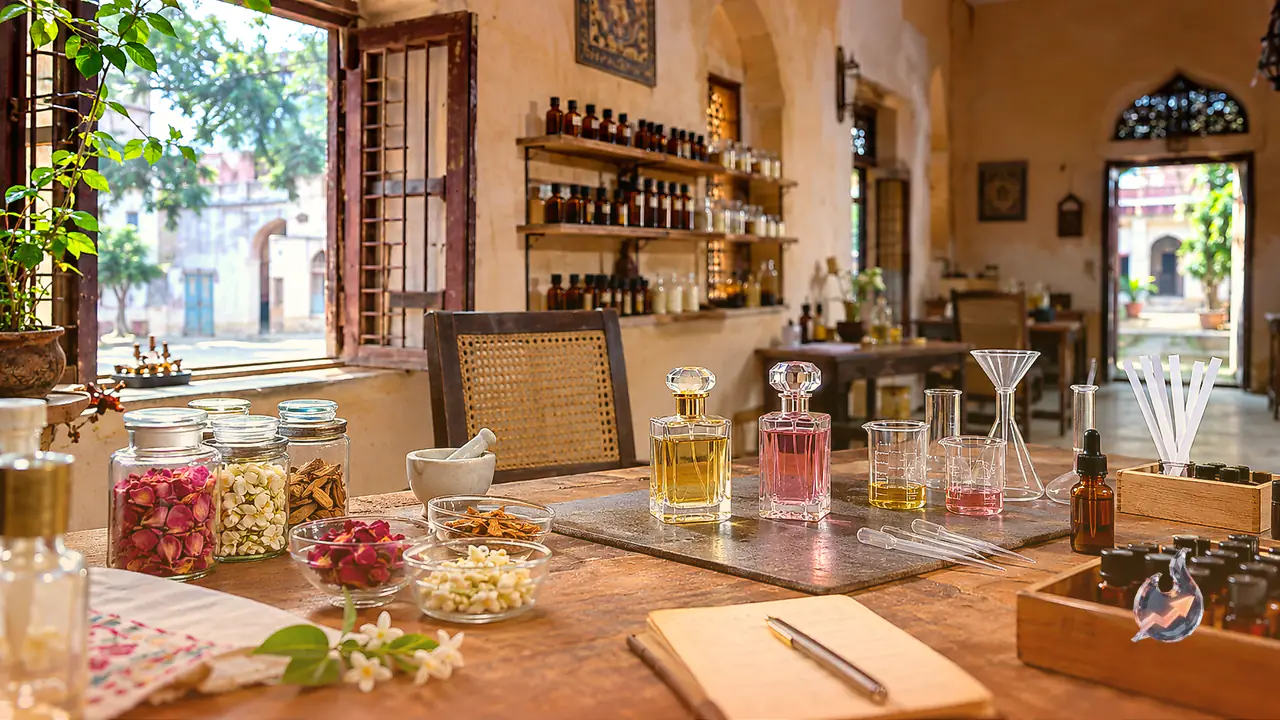

The district of Ghazipur has historically been recognized for its rose cultivation and rich aromatic heritage. Now, an effort is underway to connect this traditional identity with contemporary preferences. Local residents Mohammad Tauhid Khan and Arshad Raini have embarked on an innovative experiment by combining distinct fragrances to formulate special perfume combos, which also incorporate oud, a defining element of Arabian perfumery.
Creating Two Distinct Fragrance Blends
Under this initiative, two specific types of combos are being crafted. The first blend combines Jannatul Firdaus and white oud, while the second mixture utilizes musk tahara along with purple oud. Both fragrances are taken in equal quantities and subjected to a mild warming process, allowing them to fuse seamlessly and form an entirely new scent profile.
The Characteristics of Oud
The oud used in this process is a prominent hallmark of Arabian fragrance culture. It is derived from the resin found in agarwood, a fragrant timber. The aroma is typically deep, woody, and resinous, with certain varieties carrying a subtle smoky undertone. In Arab countries, it is widely used in traditional attars and bakhoor.
Pricing and Market Response
Explaining the measurements, Mohammad Tauhid Khan notes that one tola equals 12 ML. Two separate fragrances are mixed in equal portions of 6 ML each to form the combo. The price for a 12 ML pack is fixed at 500 rupees, while the 6 ML variant costs 250 rupees. According to him, the blend of musk tahara and purple oud aims to deliver a heavy aroma balanced with sweetness and a fruity touch. He adds that this combination appeals to people across various age groups, drawing steady interest from buyers.
Inspiration From Digital Media
An interesting background lies behind this aromatic experiment. Arshad, a businessman associated with Forever Fragrance, shares that he watched a discussion about the perfume industry on a YouTuber and podcaster's show. The segment provided insights into blending techniques and fragrance formulation, sparking the idea to create novel combinations independently. Following this, he tested the concept locally, leading to the creation of these specialized scent combos in Ghazipur.
Reviving Local Heritage
Mohammad Tauhid Khan views this endeavor as more than just manufacturing a new scent. He emphasizes the need to revive Ghazipur's traditional association with rose cultivation through modern approaches. By introducing such fragrance experiments, he hopes to give a fresh identity to the local scent trade. For optimal results when wearing these perfumes, he suggests applying a small amount on pulse points near the wrists and neck.