




















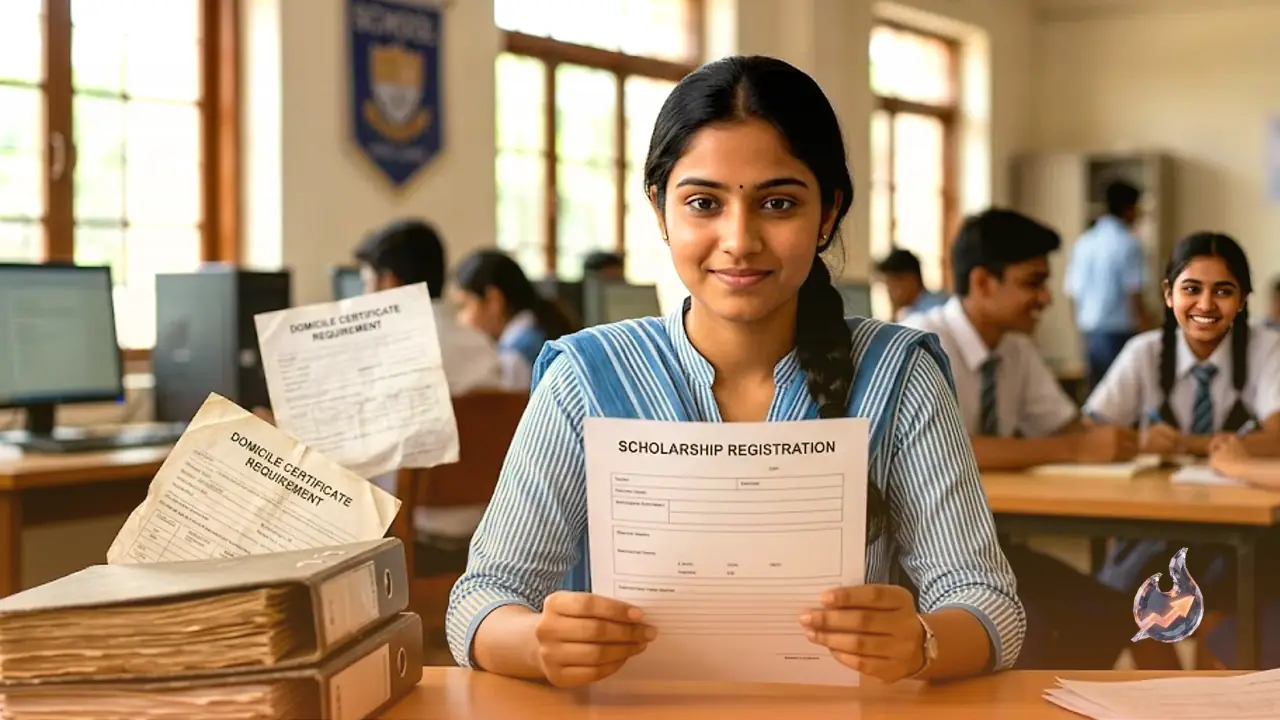

Millions of students who study far from home have just received a major relief. The Ministry of Social Justice and Empowerment (MoSJE) has overhauled the pre-matric and post-matric scholarship schemes meant for Scheduled Caste (SC) and Other Backward Class (OBC) students. Until now, applicants had to submit a domicile certificate, the proof of permanent residence, to fill out the scholarship form. That condition has now been scrapped entirely, and the move will directly benefit roughly 1.2 crore students across the country.
A domicile certificate is an official document issued by a state government to confirm where a person is a permanent resident. Submitting it was mandatory while applying for these scholarships. The rule hit hardest those students who live and study outside their home state. Many had to travel back home midway through their studies or run between offices and middlemen just to get the paper made, wasting both time and money. By cutting through this administrative tangle, the government has taken a step in the students' favour.
Why the change was needed
Figures from the Ministry of Education (MoE) make the reasoning clear. Of the 4.13 crore students enrolled in the country's higher education institutions, about 58 lakh are SC and 1.47 crore are OBC. According to migration data from the National Sample Survey (NSS) and the census, roughly 30 to 35 percent of students pursuing higher education move outside their home district or state to study. Senior ministry officials say the real purpose of removing this mandatory condition is to reduce the paperwork burden, cut the costs borne by students, and deliver the scholarship money directly to eligible students without any obstacles.
Which students these schemes cover
Both schemes help children from economically weaker families stay in school and college. The eligibility is set as follows.
- SC students (pre-matric): covers students in classes 9 and 10 whose parents have an annual income of up to Rs 2.5 lakh.
- SC students (post-matric): available for higher education from after class 10 all the way up to the doctoral (PhD) level.
- OBC schemes: pre-matric and post-matric schemes run for them too, with family income limits set at Rs 2.5 lakh and Rs 1 lakh per year respectively.
The SETU app puts every service in one place
Alongside the paperwork relief, the government has made a big push on the digital front. The Department of Social Justice and Empowerment has launched a new digital portal named SETU (Scholarship for Educational Transformation and Upliftment) on the UMANG platform. It is a single-window solution, meaning students no longer have to hop between different websites. Everything from filling the scholarship form to tracking its status can now be done on this one platform in minutes.
An equal chance and the strength of Digital India
The ministry says the aim behind simplifying the rules and bringing in modern digital tools like SETU is to promote inclusion across the country. The government believes that paperwork and official rules should not stand in the way of a student's education. These changes will make welfare delivery more transparent and faster, while also giving fresh confidence to poor and backward-class youth who come out of remote villages to study in cities.