





















When independent India was taking its first steps as a sovereign nation in 1947, its most formidable challenge lay in educating millions of illiterate citizens and building scientific and technological capabilities from scratch. To helm this massive responsibility, Prime Minister Jawaharlal Nehru chose a leader who had never set foot inside a formal school or university. Despite his lack of classroom schooling, Maulana Abul Kalam Azad served as India's first Education Minister from August 1947 until February 1958, laying the foundational architecture of the country's modern educational ecosystem. From founding IIT Kharagpur to establishing the University Grants Commission (UGC), his vision permanently reshaped higher education in India.
Born in Mecca and Educated Entirely at Home
Maulana Abul Kalam Azad was born in 1888 in Mecca, located in present-day Saudi Arabia. His father, Maulana Khairuddin, was a prominent Islamic scholar who harbored deep reservations about Western-style formal schooling. Fearing that modern institutional education might undermine traditional cultural and religious values, he chose not to enroll his son in any school or seminary. Instead, his father turned their home into a primary learning space. Maulana Khairuddin initially taught his son himself and later brought eminent scholars of various disciplines to tutor him at home. In his acclaimed autobiography, 'India Wins Freedom', Azad recounted how his entire foundational education was completed under his father's direct supervision within the domestic sphere.
Completing Studies by Age 12 and Editing a Journal at 15
Despite the absence of formal schooling, Azad possessed an extraordinary intellect and rapid learning capacity. According to research by historian Irfan Habib, Azad had completed his primary and classical education by the age of just 12. His academic prowess was evident when, at merely 10 years old, he began compiling a comprehensive Persian dictionary. In his early teenage years, he started writing sophisticated poetry. By the time he turned 15, he took on the responsibility of editing 'Lisan-us-Sidq', a respected literary and intellectual journal. Scholars of that era were often astonished that a boy so young could write with such profound intellectual depth and analytical maturity.
Self-Taught in English, Science, and Modern Philosophy
While receiving rigorous traditional and religious instruction at home, Azad realized that comprehending the contemporary world required a thorough understanding of modern subjects. He recognized that without learning science, history, Western philosophy, and English, he could not fully engage with global intellectual discourse. Driven by curiosity, he began learning English in secret without the help of a teacher. He started with the English alphabet, gradually moving on to reading English newspapers with the aid of a dictionary. Through dedicated self-study, he immersed himself in works of modern history, science, philosophy, and literature. This independent pursuit transformed his worldview, instilling a rational approach where every concept was tested against logic and empirical reasoning.
Journalism as a Weapon Against British Rule
Recognizing the power of the press early in his life, Azad turned to journalism to awaken the public consciousness against colonial rule. In 1912, he launched the famous Urdu newspaper Al-Hilal. Through its columns, he launched blistering critiques of British imperial policy and strongly urged Indian Muslims to shed any illusions about colonial benevolence. He appealed to them to join the broader national movement for independence. Al-Hilal gained immense popularity, alarming the British administration, which repeatedly imposed heavy financial penalties on the publication before forcibly shutting it down. Undeterred, Azad launched another newspaper named Al-Balagh, but the colonial authorities banned it as well and interned Azad near Ranchi.
Youngest Congress President at 35 and Opposition to Partition
Following his intense journalistic crusade, Azad plunged directly into the freedom movement. Working alongside Mahatma Gandhi, he led multiple national campaigns and endured repeated imprisonment. In 1923, at the age of just 35, he became the youngest person ever elected President of the Indian National Congress. At a time when internal political divisions threatened party unity, Azad successfully brought diverse factions together. Azad was also among the most steadfast opponents of the Partition of India. He firmly believed that Hindus and Muslims shared a single cultural heritage and did not constitute two separate nations. He fought until the final moment to preserve a united India, and when Partition occurred in 1947, he was deeply anguished. Shortly after independence, he delivered a memorable address from the steps of the Jama Masjid in Delhi, urging Muslims not to flee in fear and to maintain unwavering faith in their homeland.
Establishing IIT Kharagpur and Transforming Technical Learning
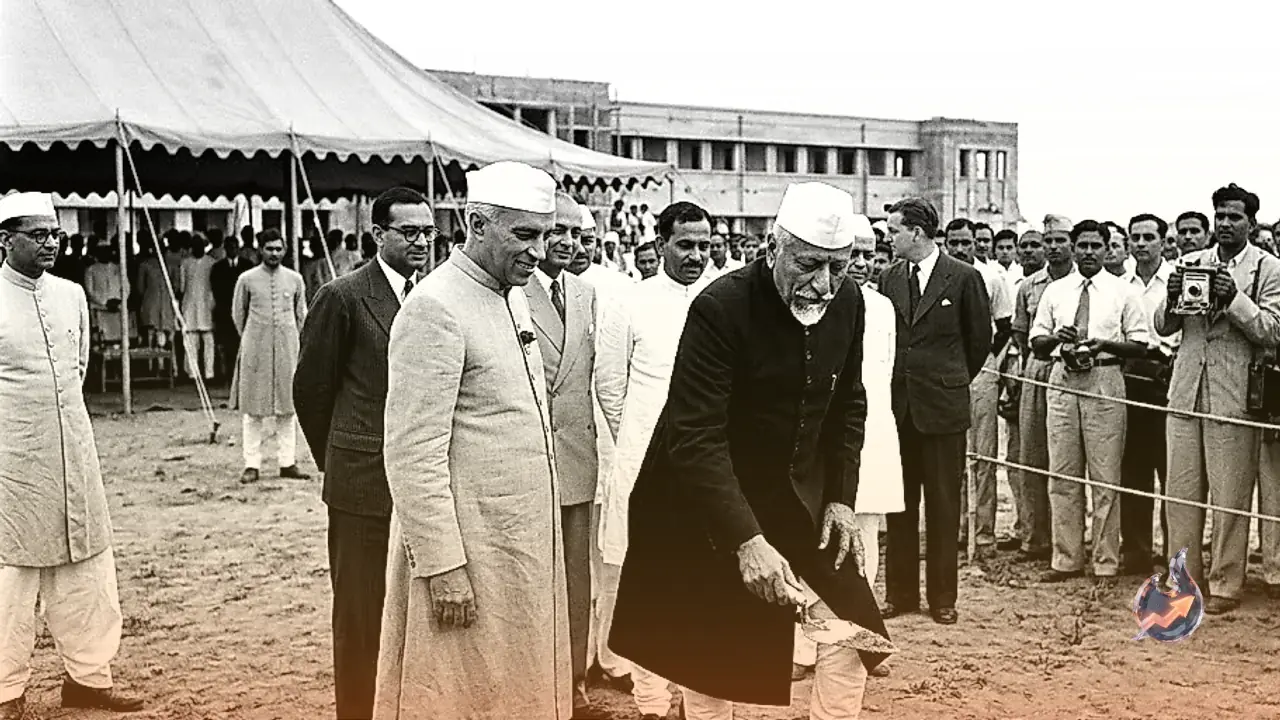
On August 15, 1947, India gained independence, and Prime Minister Jawaharlal Nehru appointed Maulana Azad as the nation's first Education Minister. He held this cabinet portfolio continuously for nearly 11 years until his death in February 1958. At the dawn of independence, India faced a severe shortage of qualified engineers and scientists. Azad believed that without high-caliber technical education, national industrialization and self-reliance would remain out of reach. Through his decisive leadership, India's first Indian Institute of Technology, IIT Kharagpur, was established in 1951. During its inauguration, he envisioned an institution so advanced that students from around the globe would come to study in India. Today, the IITs are globally recognized as benchmark institutions in engineering and technology.
Creating the UGC and Expanding the National Education Budget
Azad's educational vision extended beyond technical institutes to the comprehensive reform of Indian universities. He constituted the University Education Commission under the chairmanship of eminent philosopher Dr. Sarvepalli Radhakrishnan. Based on the commission's recommendations, the University Grants Commission (UGC) was established in 1953 and granted full statutory authority by an Act of Parliament in 1956. To this day, the UGC serves as the apex regulatory body governing higher education in India. Azad strongly maintained that education was a fundamental right for every child. He championed free and compulsory primary education, adult literacy programs, female education, teacher training, and merit-based scholarships. Under his stewardship, the central education ministry's annual budget expanded dramatically from approximately 2 crore rupees to over 30 crore rupees, underscoring his lasting commitment to national enlightenment.