























Adopting sustainable agricultural practices offers growers a reliable way to manage crop health while cutting down on costly synthetic inputs. Dr. Sandeep Sharma explained how farmers can prepare Dashparni Ark directly on their farms using ten specific types of leaves. He pointed out that selecting naturally bitter foliage forms the foundation of this homemade plant protection blend, providing a potent defence against common field pests.
Required Ingredients and Setup
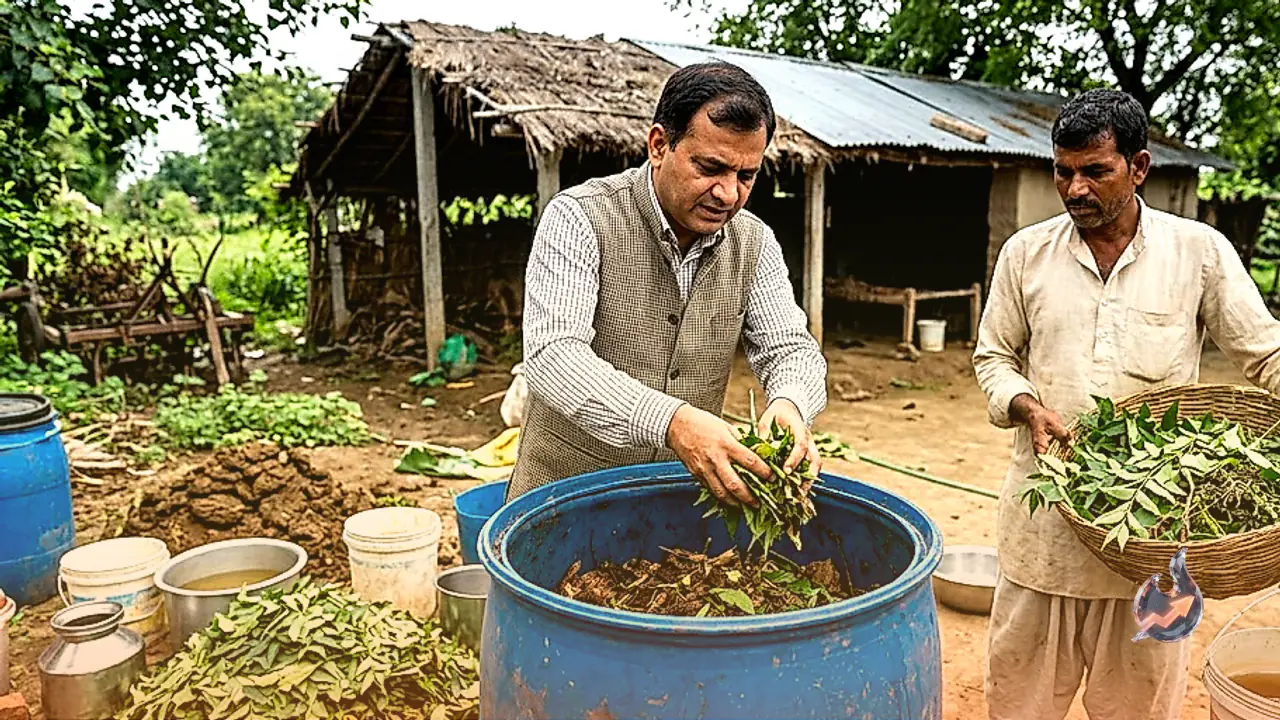
The formulation relies on selecting plant foliage that carries inherent bitterness. Leaves gathered from plants such as karanj, bael, beshram, turmeric, and papaya are incorporated among the total of approximately 10 varieties chosen for the recipe. These plant parts work together with other biological inputs to create a balanced biological pest deterrent.
The setup begins with a 200-litre plastic drum filled with 200 litres of water. To this reservoir, approximately 10 litres of cow urine and 1 to 2 kilograms of cow dung manure are introduced. In addition to these farm materials, selected botanicals and spices, specifically turmeric powder, chilli, asafoetida, and tobacco leaves, are combined along with the 10 varieties of selected leaves inside the water container.
Fermentation Period and Filtration Process
Once every component is placed inside the container, maintaining a consistent stirring routine becomes essential. Dr. Sharma noted that the entire mixture must be stirred regularly in a clockwise direction. This continuous movement helps integrate the solids and aids the natural decomposition of the raw materials inside the drum.
The mixture takes roughly 40 days to fully ferment and reach maturity. After this 40-day waiting period concludes, the liquid must be separated from the sediment using a clean cloth or a fine sieve. The resulting filtered liquid is the finished Dashparni Ark, ready for dilution and field application.
Dosage Instructions and Targeted Crops
Applying the solution requires precise measurement to achieve effective pest control across the field. Generally, 5 to 6 litres of the extracted Dashparni Ark are thoroughly diluted in 250 litres of water. This calibrated batch is formulated to cover exactly one hectare of farmland during spraying operations.
The primary purpose of applying Dashparni Ark is to suppress populations of sap-sucking insects and various types of caterpillars that target standing crops. Growers can apply this herbal concoction across a variety of plantings, including major pulse crops like arhar, urad, and moong.