


















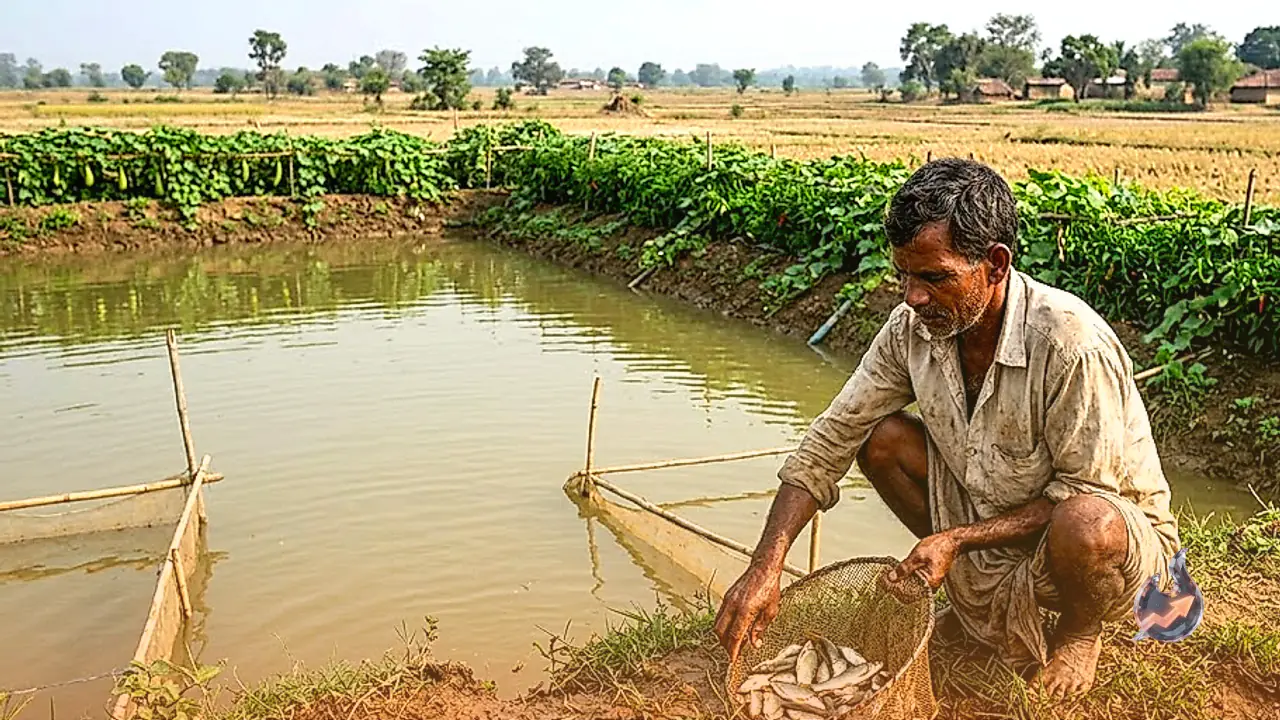

Struggling with thin profit margins in traditional paddy cultivation, farmer Shiv Balak from Surguja district in Chhattisgarh decided to diversify his agricultural operations. By leveraging a dedicated farm pond, known locally as a dabri, he integrated aquaculture with vegetable farming to establish a dependable livelihood stream. The transition yielded promising economic results during the initial phase itself, offering a sustainable alternative to single-crop dependency.
Water harvesting pond constructed under rural employment scheme
Shiv Balak explained that the farm pond on his agricultural plot was constructed under the rural employment scheme. Once the excavation and water storage framework were in place, he capitalized on the resource by introducing fish fingerlings into the water body. Relying solely on monsoon paddy had previously failed to generate the desired revenue, but the functional pond provided the stability needed to ensure regular and improved earnings across seasons.
Initial harvest delivers 2 quintals of fish and steady returns
During his very first production cycle, Shiv Balak harvested and sold approximately 2 quintals of fish, generating revenue between 20,000 and 25,000 rupees. Encouraged by this baseline return, he has intensified his pond management efforts this season by supplying higher-quality feed. With enhanced nutritional care and consistent monitoring, he expects higher biomass yields and substantially increased financial gains in upcoming marketing cycles.
Multi-species composite fish farming optimizes pond resources
Rather than stocking a single variety, the farm pond is utilized for composite fish farming featuring a combination of Katla, Rohu, Mrigal, and Grass Carp. Cultivating multiple compatible species allows effective utilization of different water zones and feed niches within the small pond. This ecological balance maximizes the carrying capacity of the available water, accelerating growth rates without creating competition for territory or nutrients.
Irrigation for summer vegetables creates dual income streams
The utility of the water storage structure extends well beyond fishery management. Following the completion of the paddy cycle, Shiv Balak uses the stored pond water to irrigate vegetables during the harsh summer months. This integrated water management technique prevents resource wastage and provides his family with a steady flow of supplemental cash throughout the agricultural off-season, turning the pond into an enduring economic asset.