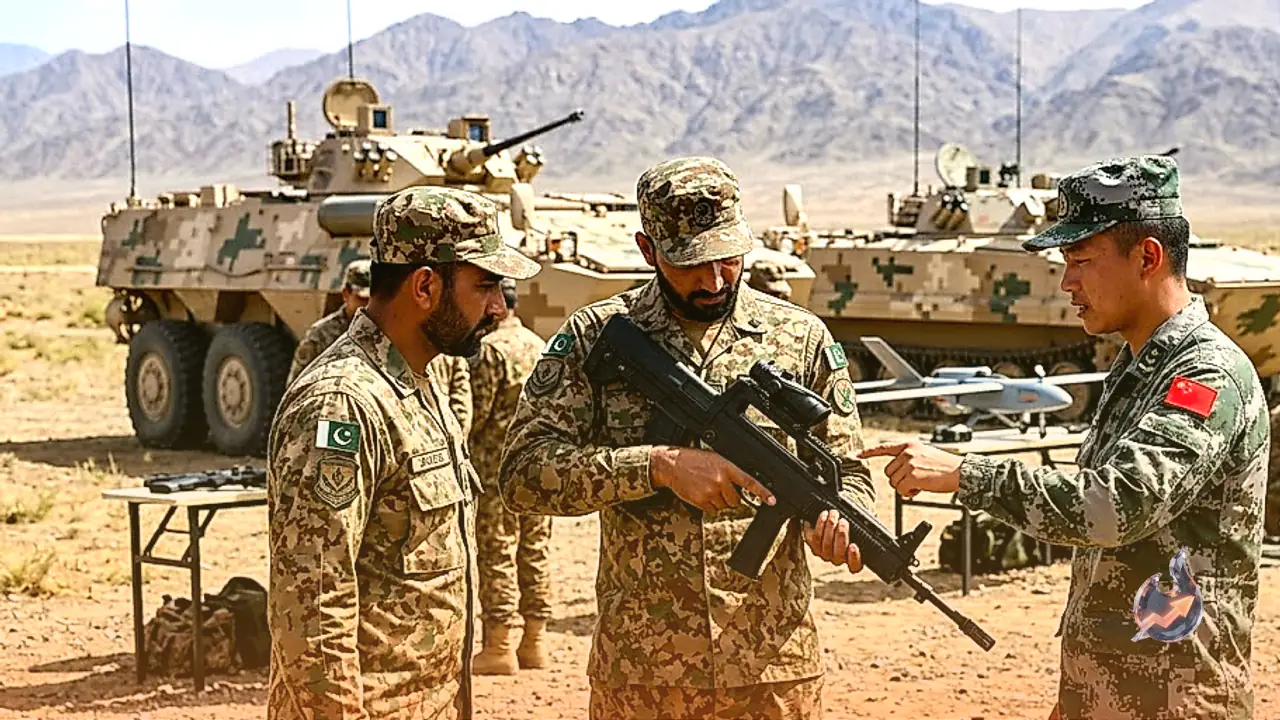

Joint military drills designated as Karakoram 2026, conducted at the Korla military base in China's Xinjiang region, have drawn significant attention from global strategic observers. Ground forces arriving from Pakistan participated in the exercises utilizing infantry rifles, machine guns, and armored fighting vehicles supplied entirely by their host nation. Marking the first large-scale joint exercise of this kind between the land armies of both nations, Chinese military authorities under Xi Jinping deployed an extensive operational range of frontline hardware directly into the hands of Pakistani infantry units.
Frontline Weaponry Featured in the Bilateral Drills
A broad array of modern combat equipment took center stage during the field exercises. Participating troops were equipped with the Type 191 assault rifle, an advanced standard-issue platform engineered for high accuracy and reliable operation across extreme operational climates. Accompanying this infantry platform was the Type 201 squad machine gun, designed as a lightweight automatic support weapon capable of delivering high-volume suppressive fire.
Mechanized mobility in rugged mountain terrain was supported through wheeled Type 11 armored assault vehicles alongside Type 08 infantry fighting vehicles (IFVs). Airspace operations integrated suicide attack drones, coordinated surveillance unmanned aerial systems, and high-tech anti-drone countermeasure platforms. Defense specialists observe that selecting wheeled armored combat vehicles over heavy tracked main battle tanks reflects operational calculation. Wheeled platforms traverse unpaved tracks and broken mountain terrain with superior road speeds, permitting swift tactical repositioning during rapidly developing engagements.
Strategic Objectives Behind Exclusive Chinese Arms Utilization
Defense specialist Wang Yunfei highlighted that the complete reliance of Pakistani units on Chinese equipment during this drill is a calculated strategic maneuver rather than a matter of convenience. Primarily, the arrangement serves as a live operational demonstration intended to pave the way for future arms acquisitions. Directly operating advanced hardware across demanding mountain terrain creates momentum for multi-billion-dollar defense procurement contracts, allowing Beijing to solidify dominance over Islamabad's military equipment market.
Furthermore, standardizing equipment directly targets operational interoperability. When two allied militaries utilize identical firearms, standardized communication protocols, and uniform vehicular platforms, their tactical cohesion is streamlined. In the event of a wider regional conflict or operational emergency, soldiers from both forces could operate each other's equipment without mechanical disparity, facilitating unified action under integrated command directions.
Integration of Unmanned Aerial Systems and Modern Combat Tactics
According to Senior Colonel Chen Xi of the Chinese Ministry of National Defense, the week-long October exercise extends far beyond foundational rifle qualification to encompass sophisticated dimensions of modern warfare. Formations are undergoing extensive drills in combined-arms drone operations, simultaneously handling strike drones and tactical reconnaissance platforms. Training modules also feature rapid target acquisition against moving hostiles in mountain environments as well as long-range sniper engagements executed across extensive distances.
Military analysts point out that Pakistani forces hold sustained ground experience derived from counter-insurgency operations against domestic separatists, whereas the Chinese military commands sophisticated technological ecosystems and expansive drone capabilities. Merging these operational backgrounds forms a tightly aligned combined combat doctrine.
Implications Along the Indian Strategic Perimeter
The geographic location of the Korla military training area in Xinjiang sits in proximity to India's border zone in Ladakh. Given the sensitive security posture along the Line of Actual Control (LAC) spanning from Ladakh to Arunachal Pradesh, alongside the Line of Control (LoC) facing Pakistan, this bilateral defense synergy remains under active scrutiny. The coordinated deployment of standardized lethal weaponry and coordinated field doctrine represents a major strategic focal point for Indian defense planners and national security agencies.