























Decentralized derivatives and layer-1 network Hyperliquid has recorded its initial $14.58 million USDC revenue distribution through its Aligned Quote Asset v2 (AQAv2) architecture. This newly established capital channel unlocks an ongoing source of protocol income that operates completely decoupled from trading volume fluctuations and execution fees. The underlying capital is dedicated to reinforcing the Assistance Fund, which conducts systematic buybacks of the native HYPE token to strengthen the network's liquidity and tokenomics over the long run.
Mechanics of AQAv2 and the Assistance Fund
Activated in late August, the AQAv2 framework harvests yield generated across USDC reserve holdings located throughout the Hyperliquid environment. This initial $14.58 million distribution accounts for an operating window of roughly 30 days. Under protocol guidelines, approximately 90% of the cost-adjusted reserve yield flows directly into the Assistance Fund. The primary mandate of this fund is to deploy captured revenue toward purchasing HYPE directly from the market.
Should the protocol maintain this yield generation trajectory across consecutive monthly intervals, the initial $14.58 million payout translates to an annualized run rate of approximately $193 million. Protocol administrators have noted that collecting the $14.58 million does not mean those funds were instantly deployed to acquire or burn HYPE tokens from active circulation. Instead, the liquidity expands the financial firepower of the Assistance Fund, leaving secondary market purchases to execute via distinct protocol mechanisms.
Institutional Infrastructure: Circle and Coinbase Integration
The operational framework relies heavily on bridging mechanics linked to HyperEVM. Token holders route USDC into HyperEVM, where Circle supplies the foundational architecture for stablecoin issuance. Coinbase simultaneously serves as the designated treasury deployer managing the assets. This institutional setup allows the underlying pool of reserves to earn steady yield, with the net proceeds cycling directly back to Hyperliquid, establishing a sustainable non-fee revenue model.
HYPE Technical Landscape and Critical Levels
From a chart perspective, HYPE retains an encouraging near-term structure on the daily timeframe as spot quotes hover comfortably above the 20-day, 50-day, and 100-day Exponential Moving Averages (EMAs), located at $89.5, $83.1, and $74.8, respectively. The technical positioning of faster EMAs remaining elevated above slower baselines points to an intact upward trend. Furthermore, the 14-day Relative Strength Index (RSI) registers at 58, holding within a constructive territory that signals persistent demand without crossing into overheated boundaries.
Looking higher, the immediate obstacle sits at the horizontal resistance shelf near the all-time high of $97.7. A confirmed breakout above this ceiling would position HYPE to print fresh record valuations before challenging secondary resistance around $109.1. On corrective declines, downside support surfaces first near the 20-day EMA around $89.5, backed by an interim horizontal cushion at $85.6. Further down, the 50-day EMA at $83.1 along with structural cushions at $75.4 and $74.8 stand ready to buffer more extensive retracements.
Regulatory Developments and Altcoin Price Actions
Beyond Hyperliquid, regulatory discussions picked up after Commodity Futures Trading Commission Chairman Michael Selig stated that the agency intends to push forward with standalone crypto market supervision following Congress's inability to enact a unified digital asset bill. This administrative posture has kept speculative enthusiasm somewhat measured across major platforms.
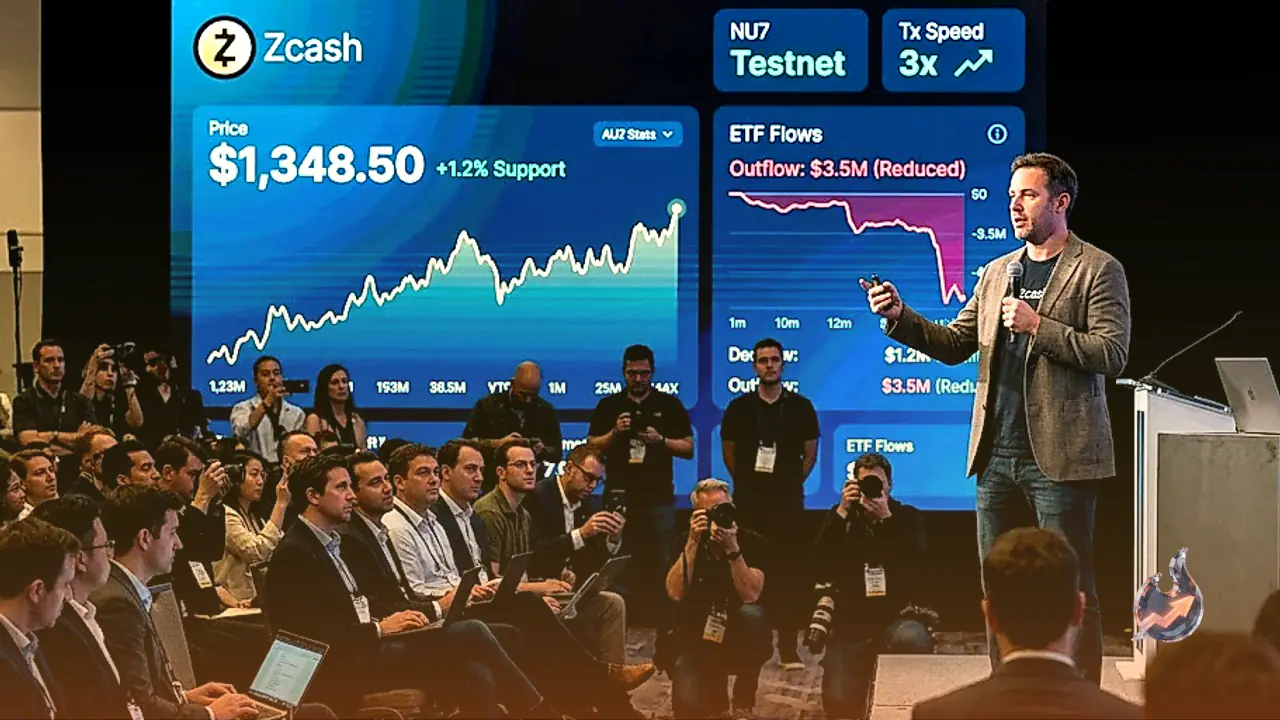
Among legacy altcoins, Ripple and Stellar encountered downward pressure, slipping below $1.499 and $0.220, respectively, following an opening-week retreat. Softening derivatives indicators alongside waning upside traction highlight risks of continued consolidation across XRP and XLM pairs. In contrast, privacy asset Zcash held steady near $1,348, defending its Sunday price advances. Zcash successfully rolled out its NU7 network upgrade on Monday, which enhanced overall transaction throughput and reallocated 60% of transaction fees toward future protocol rewards. In tandem, institutional capital outflows from Zcash slowed dramatically to approximately $3.50 million on Monday compared to $93.56 million during the prior week, reflecting sharply diminished redemption pressure.