






















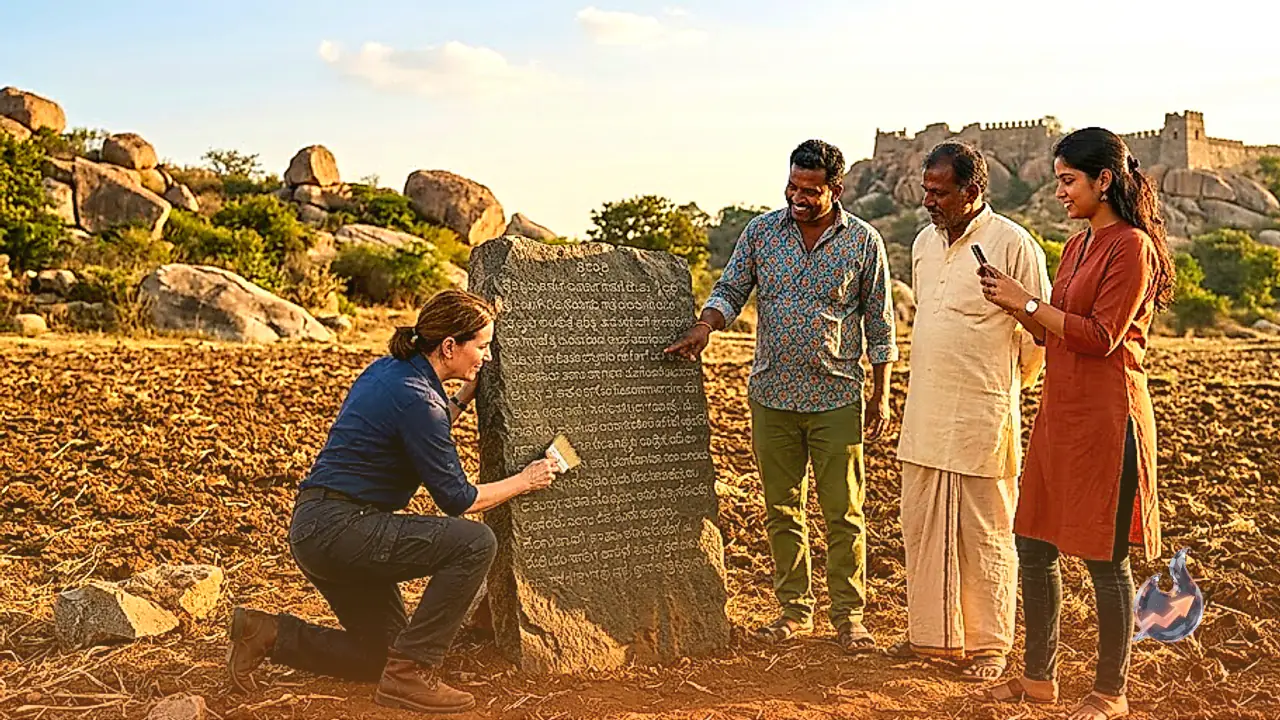

An extraordinary 16th century historical artifact has emerged from an agricultural field in the Chitradurga district of Karnataka. Farmers engaged in routine ploughing unexpectedly uncovered a heavy black stone slab buried beneath the soil. While initially appearing to be an ordinary rock, clearing away the dirt revealed 17 distinct lines of ancient script. Dating back roughly 450 years, the inscription offers fascinating insights into medieval governance, water management practices, and social conventions of the era. Beyond recording a royal land grant, the stone features a dramatic curse designed to deter anyone from usurping the property.
Discovery at Survey Number 85 in Javagondanahalli Village
The discovery took place in Javagondanahalli village, located within the Hiriyur taluk of Chitradurga district. Local farmers were tilling land registered under survey number 85 when their machinery struck the buried slab. Preliminary archaeological analysis links the artifact to the reign of Immadi Chikkanna Nayaka, a prominent ruler of the Kamageti dynasty who governed the region between 1575 AD and 1586 AD. The inscription serves as official documentation of state rewards granted for public utility achievements during that period.
According to the translated text, an official named Doddagowda, who served under King Immadi Chikkanna Nayaka, constructed a large lake or pond in Javagondanahalli to provide water for the community. Doddagowda was the son of Lakkajia and held an administrative position under the monarch. Pleased by this public service, the king bestowed upon him a tax-free land grant known as 'Umbali'. In medieval South Indian administration, Umbali referred to revenue-free land gifted to individuals as compensation or reward for exceptional service to the state.
Seventeen Lines of Old Kannada Script and the Imprecatory Curse
Engraved upon the black stone slab are 17 lines written in Old Kannada script. The text explicitly authorizes Doddagowda and his descendants to enjoy the benefits of the tax-free land 'for as long as the sun and the moon endure'. Such poetic formulations referencing celestial bodies were standard legal phrasing in medieval Indian copper plates and stone epigraphs to signify the permanent, perpetual nature of the grant.
Following the terms of the grant, the text transitions into a stern imprecatory warning aimed at future generations. It proclaims that anyone who attempts to encroach upon, destroy, or forcibly seize the gifted land from the family will incur a sin equivalent to slaughtering a sacred cow in the holy city of Kashi. During the medieval period, enforcing property rights relied heavily on social and religious deterrents alongside administrative authority. Invoking the grave spiritual consequence of committing cow slaughter in Kashi created a powerful moral boundary against land grabs.
Archaeological Investigation and Preservation Efforts
Upon receiving news of the find, officials from the Chitradurga Archaeology, Museum and Heritage Department visited the site to inspect the artifact. Prahlad G, Assistant Director of the department in Chitradurga, stated that initial evaluations place the inscription around 1581 AD, though meticulous analysis remains ongoing to establish the precise year. He confirmed that the text carries a explicit warning of spiritual damnation for anyone attempting to dispossess the family of their land.
Department officials are currently conducting field investigations to determine whether survey number 85, where the stone was unearthed, represents the exact plot granted to Doddagowda's family in the 16th century. Promptly reported by the villagers, the 450-year-old stone slab has been securely transferred to the Chitradurga Government Museum for long-term conservation and scientific study by epigraphists.
Date Discrepancies and Linguistic Characteristics
While the inscription explicitly mentions the lunar date 'Karthika Shuddha Dashami' coinciding with a Thursday, the exact Gregorian year cannot yet be finalized. Time and environmental exposure have worn down the specific portion of the stone that recorded the Shaka Samvat era and Samvatsara calendar details. Certain characters have gradually eroded over the centuries.
Epigraphists examining the text also identified several spelling variations and grammatical informalities within the 17 lines. In medieval stone carving, local scribes or engravers occasionally reflected regional dialects or informal phonetic spellings rather than strict formal syntax. Historians are comparing this text with other contemporary inscriptions from the Nayaka era to cross-reference historical events and pin down the exact date.
Significance for the Kamageti Dynasty and Medieval Water Management
The discovery holds substantial value for understanding the Kamageti lineage, considered the founding dynasty of the Chitradurga Nayakas. Local chieftains and rulers belonging to this family played a crucial role in administering large swathes of central Karnataka from the 16th century until the late 18th century.
Rather than being merely a religious document, the inscription acts as a historical record of medieval water governance and administrative incentives in Karnataka. Rewarding officials with tax-free land for building public water reservoirs demonstrates the high priority state authorities placed on water security and civic infrastructure nearly four and a half centuries ago.