




















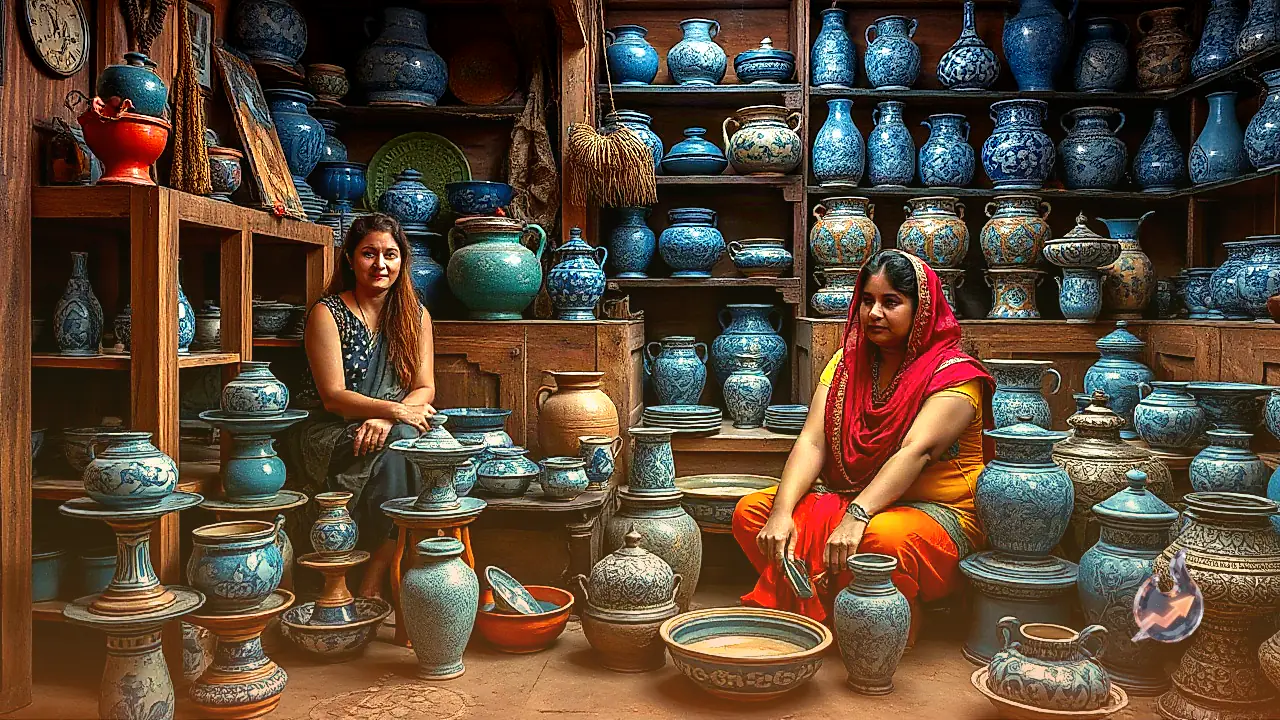

The historic city of Jaipur has long been renowned across the globe for its magnificent cultural heritage, craftsmanship, and artisanal traditions that have been carefully nurtured across successive generations. Among its celebrated handicrafts, Jaipur blue pottery occupies an exceptional position, widely admired by connoisseurs and collectors worldwide. Even amidst modern alternatives made from various metals and ceramics, the aesthetic appeal and market demand for these striking blue vessels and decorative artifacts remain remarkably strong. Originating in Persia, the specialized craft of making vibrant blue pottery traveled to India during the Mughal era between the 16th and 17th centuries. In the decades that followed, Jaipur emerged as the heart of this artistic journey, with the legendary artist Kripal Singh Shekhawat widely celebrated as the founding father of modern Jaipur blue pottery. Today, his family continues to preserve and expand this extraordinary craft tradition.
The Revival at Sawai Ram Singh Shilp Kala Mandir
The modern resurgence of the craft is deeply rooted in institutional patronage and dedicated artistic revival. In 1868, Maharaja Sawai Ram Singh of Jaipur established a specialized craft institution in the city to provide structured training to local artisans. However, over the decades that followed, the once flourishing art form experienced a severe decline and eventually faded almost completely into obscurity. A pivotal resurgence occurred in 1963 when Kripal Singh Shekhawat, who had received rigorous training at Visva-Bharati University in Santiniketan, Kolkata, as well as the University of Tokyo in Japan, was appointed as the director of Jaipur's Sawai Ram Singh Shilp Kala Mandir. Faced with an art form that had nearly vanished, he undertook an ambitious reinvention, introducing innovative kiln methods, original motifs, and entirely new color formulations to rebuild the craft from the ground up.
The Genesis of Kripal Kumbh and Color Innovation
The transformation of blue pottery into a versatile artistic medium gained major momentum during the late 1960s with the establishment of Kripal Kumbh. Founded by Kripal Singh Shekhawat, this initiative served as an experimental studio where creative boundaries were continuously expanded. Historically, artisans engaged in this discipline were restricted strictly to varying tones of blue. Shekhawat broke this centuries-old convention by engineering distinctive shades of green, yellow, brown, and black, thereby introducing a vibrant multicolored palette to blue pottery. Alongside this chromatic breakthrough, he moved beyond conventional shapes, designing novel contours and intricate geometric and floral patterns that captured international acclaim.
Hailing originally from a modest village in Shrimadhopur within Rajasthan's Jhunjhunu district, Kripal Singh Shekhawat rose through artistic discipline to establish himself as one of India's most celebrated master craftspersons. In recognition of his foundational contribution to the nation's artisanal heritage, the Government of India conferred upon him the prestigious Padma Shri in 1974. Later, in 2002, he was honored by the Government of India with the title of Shilp Guru, cementing his status as an iconic figure in Indian handicrafts.
The Unique Technique: Quartz, Glass, and Metallic Oxides
Unlike conventional pottery that relies on standard clay, authentic Jaipur blue pottery is created using a distinct composite base and specialized mineral chemistry. The signature cobalt blue pigmentation traces its origins back to Persia, where cobalt is historically referred to as Zafar in Persian. Sand infused with cobalt is known as Gil-e-Lajward, linked to the semi-precious stone lapis lazuli or lajward. The core structural ingredients of this craft are quartz powder and finely ground glass. These materials are combined with a precise measure of Multani mitti (Fuller's earth) and water to form a pliable dough rather than using clay from a potter's wheel.
Once the vessels are shaped and dried, artisans smooth every surface thoroughly using abrasive sandpaper to achieve a uniform finish. A protective slip-cover coating is then layered onto the objects, creating a canvas upon which intricate patterns are meticulously drawn and painted. The pigments utilized are natural metallic oxides; deep shades of blue are derived directly from cobalt, whereas soft, light blue tones are produced using copper compounds. Following painting, the pieces are treated with a clear glaze and fired at high temperatures inside specialized kilns, yielding the glossy, durable finish characteristic of authentic blue pottery.
Sustaining the Legacy Across Generations
The artistic mantle created by Kripal Singh Shekhawat is now being actively carried forward by his daughters, Meenakshi Rathore and Mukund Rathore. Working in close collaboration, the two sisters manage their family workshop, preserving the authenticity of their father's methods while successfully distributing these exquisite artifacts to an international clientele. Their dedication to maintaining rigorous craftsmanship while catering to global design aesthetics has earned them widespread recognition, including prestigious National Awards for their contribution to Indian handicrafts. Through their enduring efforts, the legacy of Kripal Kumbh continues to thrive, keeping Jaipur's blue pottery firmly placed on the world's cultural map.