














In the rich tapestry of Indian classical music, certain artists leave an impression that transcends their stage performances, turning their entire lives into a dedicated sanctuary of art. Vasundhara Komkali, affectionately known across musical circles as Vasundhara Tai, was one such luminary of Hindustani classical vocal music. Guided by her naturally sweet tone, intricate pitch control, and unwavering devotion, she carved out an independent and celebrated presence on the national stage. While she is often remembered as the steadfast life companion of the legendary musical innovator Kumar Gandharva, her personal artistic stature was equally formidable, making her a vital pillar of India's cultural heritage.
A Childhood Encounter That Sparked a Lifelong Passion
Born on May 23, 1931, in Jamshedpur, located in present-day Jharkhand, Vasundhara Komkali exhibited a deep affinity for music from an early age. A pivotal moment altered the trajectory of her life when she was just 12 years old. Attending a major classical music conference in Kolkata, she heard the young maestro Kumar Gandharva perform live for the first time. The depth, original phrasing, and emotive power of his vocal recital deeply moved the young girl, instilling in her an immediate clarity of purpose.
Following that unforgettable performance, she resolved to dedicate her life to mastering Hindustani classical music and expressed a strong desire to learn under Kumar Gandharva's tutelage. However, practical constraints and family circumstances prevented her from moving to Mumbai right away. Undeterred by these initial obstacles, she remained in Kolkata and pursued her vocal studies with relentless discipline. Her naturally melodic voice and rhythmic precision soon earned her an opportunity to perform for All India Radio at a young age, gradually introducing her talent to music enthusiasts.
Move to Mumbai and Master-Student Journey
Vasundhara Tai's determination to deepen her musical knowledge eventually brought her to Mumbai in 1946. Upon arriving in the city, she began formal instruction under the eminent musicologist and veteran pedagogue Professor B.R. Deodhar. Under Professor Deodhar's guidance, she built a robust foundation in classical theory and vocal technique. Simultaneously, she fulfilled her childhood dream of receiving direct guidance from Kumar Gandharva, absorbing the subtle nuances and innovative approaches that defined his singing style.
Over years of rigorous joint practice, artistic exploration, and shared stage work, a profound bond blossomed between master and student. After spending extensive time studying and nurturing their shared musical vision, Vasundhara Tai and Kumar Gandharva were united in marriage in 1962. Their union represented not merely a marital partnership, but a harmonious alignment of two artistic souls dedicated to the preservation and evolution of Indian classical music.
From Tanpura Accompanist to Independent Legend
Following their marriage, Vasundhara Tai continued to flourish as a musician. For decades, she shared the stage with Kumar Gandharva, captivating audiences across the nation and abroad. In the initial phase of her concert career, she primarily took her seat beside him on stage to play the Tanpura and provide vocal harmony, supporting his intricate improvisations. However, as her artistic maturity deepened, her distinct creative voice gained widespread acclaim.
Refusing to remain solely in the background, Vasundhara Tai established her individual brilliance across multiple classical and semi-classical genres. She brought rare depth to Khayal renditions while simultaneously specializing in Nirguni Bhajans, folk melodies, and traditional compositions. Her singing stood out for its seamless synthesis of classical orthodoxy and expressive innovation. Over time, she earned widespread recognition as a front-rank solo vocalist in her own right, admired for the emotional purity of her renditions.
National Recognition, Passing in Dewas, and Living Heritage
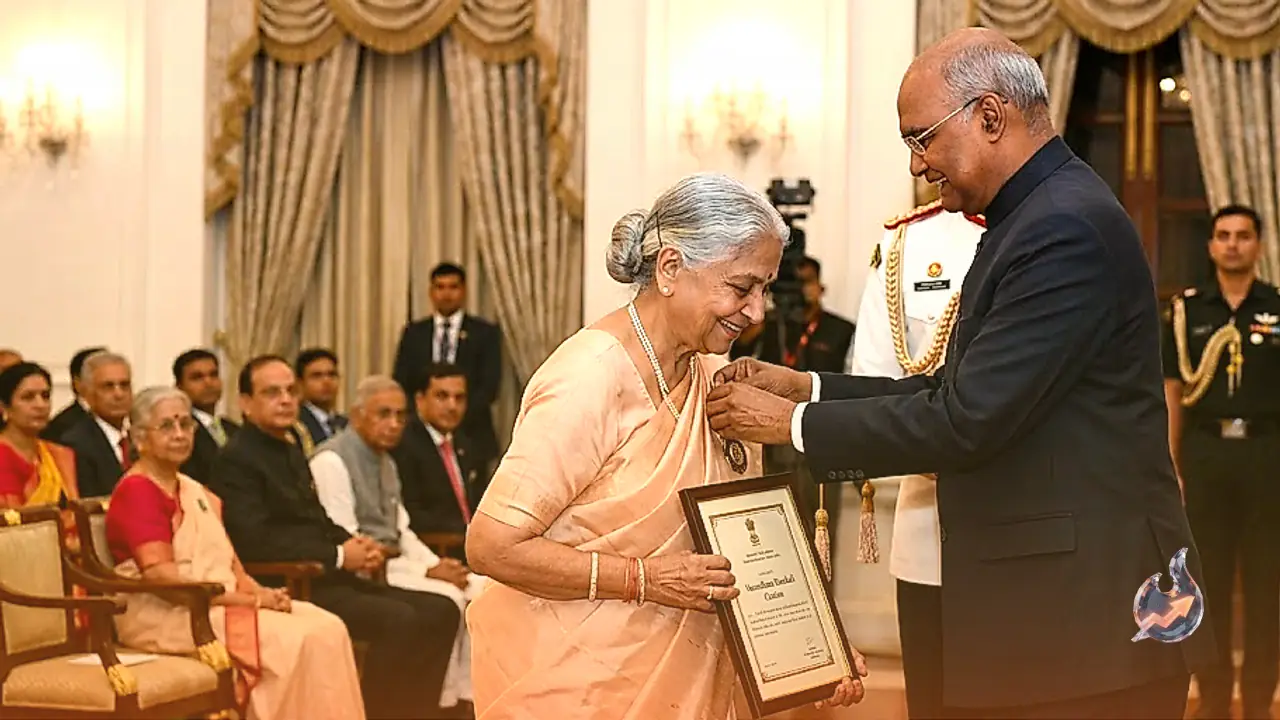
In recognition of her extraordinary contributions to Indian classical music and cultural preservation, the Government of India conferred upon Vasundhara Komkali the prestigious Padma Shri award in 2006. She was also honored with the prestigious Sangeet Natak Akademi Award, cementing her place among the most respected icons of Indian performing arts.
Vasundhara Tai spent her final years at her family residence in the historic town of Dewas, Madhya Pradesh. On July 29, 2015, she passed away following a cardiac arrest at her home in Dewas. Though she is no longer physically present, her rich musical legacy continues to resonate. Her daughter, Kalapini Komkali, herself a renowned Hindustani classical vocalist, actively carries forward the family's artistic tradition, ensuring that the musical philosophy perfected by her mother and father lives on for future generations.