




















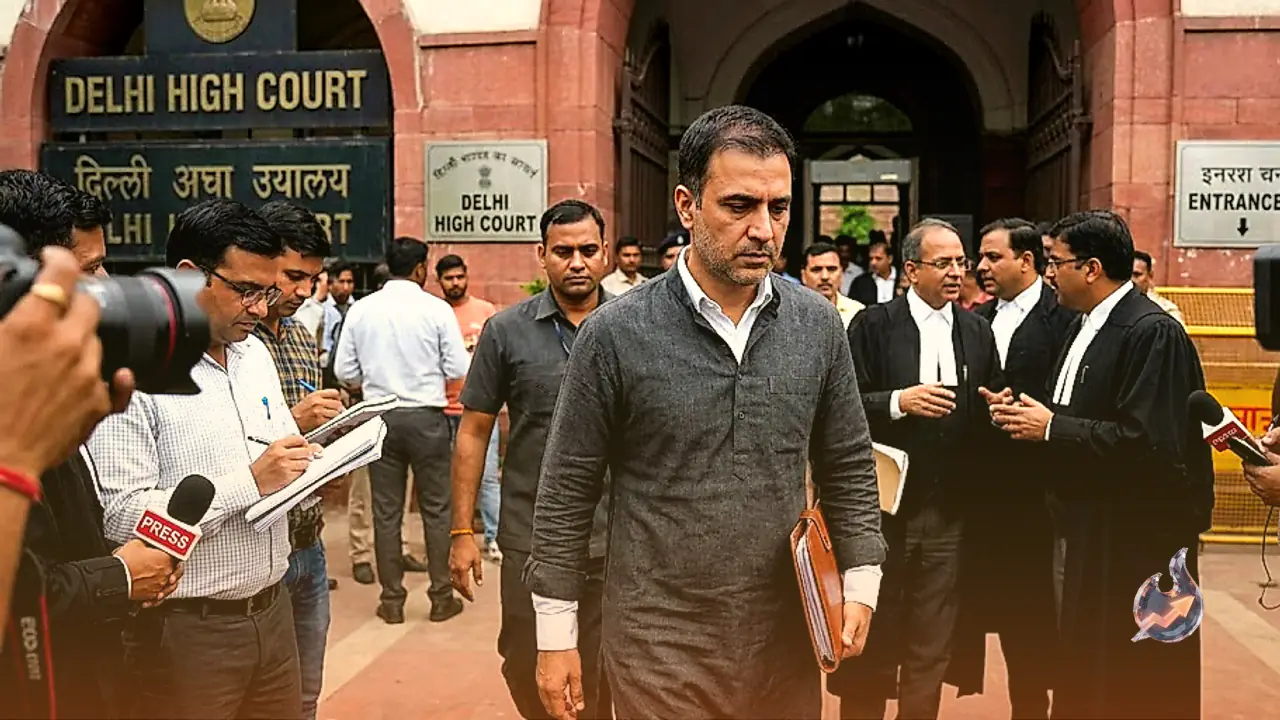

The Delhi High Court has agreed to entertain an appeal filed by former Aam Aadmi Party (AAP) councillor Tahir Hussain challenging his conviction and life sentence in connection with the brutal murder of Intelligence Bureau (IB) employee Ankit Sharma during the February 2020 North East Delhi riots. A bench comprising Justice Pratibha M. Singh and Justice Vikas Mahajan has sought a formal response from the Delhi Police on the matter, which represents one of the most high-profile trials arising from the communal violence that swept the capital.
Court Orders and Timeline for Proceedings
Admitting Tahir Hussain's appeal for regular hearing, the bench directed that the case be listed for further proceedings on 02 December alongside other interconnected appeals arising from the riot cases. The High Court further instructed prison administrators to file a comprehensive status update regarding the convict's conduct and details on record. Simultaneously, the court summoned the complete trial court records to facilitate an in-depth judicial review. In his petition, Hussain has contested the trial court's findings, claiming that the investigative agencies framed him under public pressure and outrage following the widespread unrest.
Background of the Murder and Recovery of Body
According to the prosecution's case registered at the Dayalpur police station, complainant Ravinder Kumar reported on 26 February 2020 that his son Ankit Sharma, an IB employee, had gone missing on 25 February 2020. Local residents subsequently alerted the family that a victim had been murdered and his body thrown into the Khajuri Khas drain near the Chand Bagh pulia mosque. Police forces later retrieved Ankit Sharma's body from the drain. Medical examinations and autopsy reports revealed a total of 51 distinct injury marks across his body, establishing extreme physical assault prior to death.
Trial Court Ruling and Co-Convicts
On 31 July, the trial court delivered its judgment convicting Tahir Hussain alongside four co-accused individuals identified as Nazim, Kasim, Javed, and Anas for the murder of Ankit Sharma. All five convicts were handed life imprisonment sentences. In its sentencing decision, the trial court noted that while the offense was exceptionally grave and violent, it did not satisfy the threshold of the "rarest of rare" category required under Indian jurisprudence to warrant the death penalty.
Context of the 2020 North East Delhi Riots
Communal violence originally broke out in North East Delhi on 24 February 2020 following fierce clashes between groups supporting and opposing the Citizenship Amendment Act (CAA). The conflict rapidly escalated over several days, spreading through neighborhoods such as Chand Bagh and Khajuri Khas. By the time order was restored, at least 53 people had lost their lives, hundreds suffered severe injuries, and extensive destruction of private and commercial property had taken place throughout the affected areas.