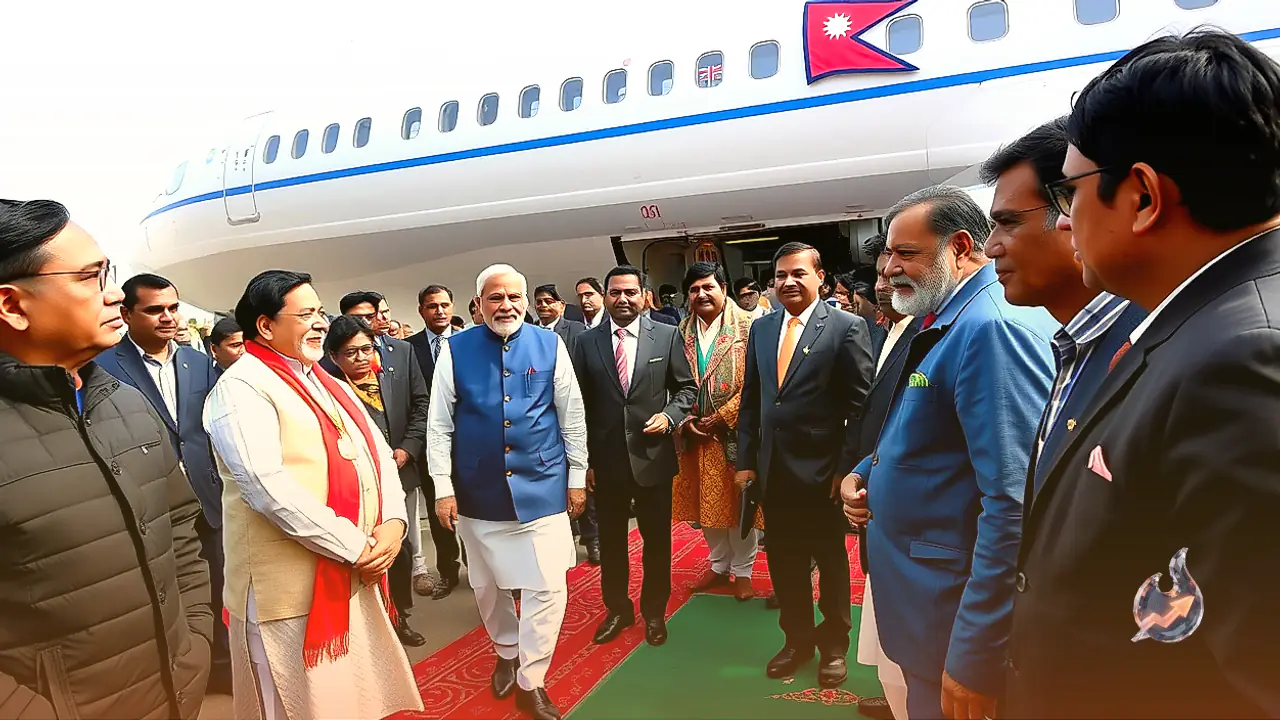

Nepal's Prime Minister Balen Shah (Balendra Shah) is preparing to travel to India in November, marking his first official bilateral foreign visit roughly eight months after assuming office. Diplomatic sources and planning frameworks indicate that the three-day trip is tentatively scheduled for the third or fourth week of November. During the proposed tour, Shah is expected to engage in extensive bilateral discussions with Prime Minister Narendra Modi in New Delhi. The agenda is set to encompass a broad array of critical matters, including cross-border infrastructure, bilateral energy cooperation, reconstruction assistance following severe floods, and unresolved boundary questions.
Officials from both countries have already exchanged comprehensive lists of bilateral development projects that could either be inaugurated or formally initiated during Shah's presence. Although official dates have not yet been formally notified by the respective foreign ministries, administrative preparations in Kathmandu and New Delhi are moving forward steadily. In diplomatic circles, the upcoming engagement is viewed as an important milestone in setting the tone for neighborhood relations under Shah's leadership.
A Return to Traditional Diplomatic Norms
Historically, India has served as the traditional first foreign port of call for newly appointed prime ministers of Nepal. However, several previous leaders chose to depart from this established convention. In 2008, Pushpa Kamal Dahal Prachanda selected China for his maiden foreign trip after taking office. Similarly, following his return to power in December 2024, KP Sharma Oli opted to travel to China for his first overseas tour. Against this backdrop, Balen Shah's decision to travel to India for his first dedicated bilateral engagement carries significant geopolitical weight across South Asia.
Shah took office as Prime Minister in March. While he travelled to the United States in September to participate in the annual United Nations General Assembly session, that multilateral appearance differed from a dedicated bilateral head-of-government visit, making New Delhi his first official bilateral foreign destination. During the earliest months of his administration, Shah maintained a cautious posture regarding personal meetings with foreign diplomats. Over time, he established structured communication channels, holding separate meetings with the ambassadors of both India and China. In August, Shah conducted his first personal diplomatic meeting with Indian Ambassador Naveen Srivastava, laying the groundwork for high-level ministerial and prime ministerial engagements.
Infrastructure Inaugurations and Energy Agreements on the Horizon
The upcoming summit is anticipated to serve as the launchpad for numerous development initiatives supported by Indian technical and financial partnerships. Potential projects lined up for formal dedication include the Nepal Police Academy situated in Panauti, the Bhairahawa Integrated Check Post located near the border with Uttar Pradesh, and newly constructed bridges in the Darchula district of western Nepal. Cross-border bridge projects along the Mahakali River are also positioned prominently on the bilateral docket.
Beyond completed structures, both prime ministers may formally inaugurate the commencement of work on the Dodhara Chandani Integrated Check Post, the Lower Arun hydroelectric project, and the cross-border Siliguri-Jhapa petroleum pipeline. The bilateral energy portfolio is slated for deep exploration, specifically regarding hydroelectric assets overseen by Indian public sector undertaking NHPC. These include the 750 MW West Seti venture, the 480 MW Phukot Karnali project, and the 450 MW Seti River-6 facility. The two sides are also expected to explore cooperation regarding river training on the Koshi River, the proposed Ayodhya-Janakpur rail link, and Indian technical support for Nepal's emerging artificial intelligence (AI) roadmap.
Boundary Deliberations, Air Routes, and Trade Imbalances
Alongside expansive development cooperation, the bilateral dialogue will inevitably address longstanding friction points that remain unresolved between Kathmandu and New Delhi. These topics include territorial disputes concerning the Kalapani-Lipulekh sector, Nepal's persistent request for additional air entry routes from Indian airspace, widening bilateral trade deficits, and transit treaty arrangements.
Senior diplomatic officials in Kathmandu have emphasized the necessity of candid discussions on boundary demarcation, new air corridors, and trade imbalances to build long-term economic resilience. Preliminary consultations to finalize the agenda were organized immediately following the Dashain festival period. In addition, the two leaders are expected to touch upon the protracted Pancheshwar Multipurpose Project, an ambitious joint endeavor that has faced bureaucratic and regulatory delays for decades. Progress on sensitive boundary questions and transit mechanisms will be closely watched as a measure of the summit's tangible achievements.
Post-Flood Reconstruction and Financial Assistance
Humanitarian collaboration has remained an essential pillar of bilateral cooperation, particularly in response to severe weather disasters. Following devastating flash floods in the Bhotekoshi basin on August 26, the Indian government extended rapid search, rescue, and relief operations. Prime Minister Narendra Modi contacted Balen Shah directly to assure all possible humanitarian support. India subsequently dispatched over 130 metric tons of emergency relief supplies and mobilized 54 specialized personnel to assist with rescue logistics and forensic field tasks.
Addressing the federal parliament on September 2, Shah expressed gratitude to India and other international partners for their prompt assistance during the emergency. In the wake of that initial relief phase, Nepal is now seeking Indian financial grants and concessional loan facilities to reconstruct damaged transport corridors, destroyed bridges, and interrupted hydropower plants. Nepal's Finance Minister Swarnim Wagle recently visited New Delhi to confer with counterparts regarding the technical structuring of this post-disaster financial package.
Charting the Future Trajectory of Bilateral Ties
Balen Shah's proposed mission to India occurs at a strategic moment when both nations are endeavoring to advance physical and energy connectivity while simultaneously seeking productive pathways to resolve complex legacy issues. Nepal's Foreign Minister Shishir Khanal noted on September 30 that both administrations are working to make Shah's visit result-oriented and mutually beneficial.
During his maiden address at the United Nations General Assembly in September, Shah proposed the establishment of a trilateral climate cooperation mechanism bringing together India, Nepal, and China, drawing particular attention to the vulnerability of Himalayan communities facing recurring ecological hazards. The forthcoming discussions in New Delhi will demonstrate how Shah balances these broader environmental and regional visions with practical bilateral diplomacy, potentially opening a renewed chapter of collaboration between the two neighbors.