




















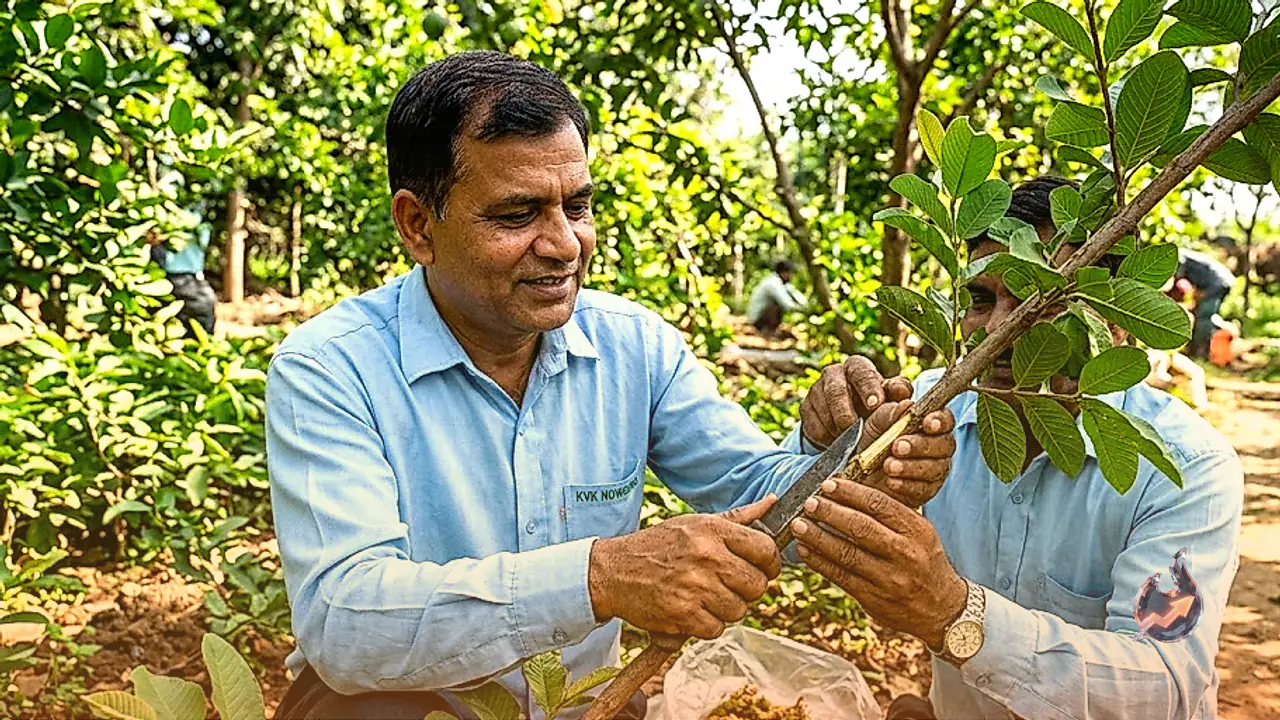

For home gardeners and fruit growers looking to expand their orchards with guava, pomegranate, lemon, and lychee trees without relying on seeds, vegetative propagation offers a reliable and efficient alternative. Growing fruit plants from seeds often requires years of waiting and comes with the uncertainty of cross-pollinated genetic variation. To bypass seed germination and produce genetically identical healthy saplings, experts advocate the air layering technique, locally known as the Guti method. Dr. Kamlesh Ahirwar, a horticulture scientist posted at the Krishi Vigyan Kendra in Nowgong, Chhatarpur, has provided a comprehensive overview of this scientific propagation process and its key steps.
Understanding the Science of Air Layering
According to horticultural principles, air layering is a vegetative propagation method in which new roots are induced to form directly on an attached, living branch of a mature tree. Rather than severing a cutting immediately, a moist growing medium is wrapped around a ringed section of the branch while it remains nourished by the parent tree. Once a dense root system develops inside the wrapping, the branch is severed below the root zone and transplanted as an independent plant. A key advantage of this method is genetic stability. If air layering is performed on a traditional indigenous variety, the resulting plant remains purely indigenous, whereas layering a hybrid tree yields a sapling with identical hybrid traits.
Selecting the Ideal Branch for Propagation
The overall success of air layering heavily depends on choosing the correct branch. Horticulture Scientist Dr. Kamlesh Ahirwar emphasizes that gardeners must select a healthy, strong, and disease-free branch from the parent tree. The ideal branch should match the approximate thickness of a standard pen or pencil. Choosing a branch that is excessively thick or overly thin can hinder root initiation and lead to failure during the propagation process.
Step-by-Step Procedure to Perform Air Layering
Developing a new fruit plant using the Guti method involves six systematic steps
- Step 1: Carefully identify and select a healthy, disease-free branch that matches pencil-like thickness.
- Step 2: Using a clean tool, carefully strip away a ring of bark about 1 inch wide from around the selected section of the branch.
- Step 3: Apply a thick layer of moist soil or well-decomposed cow dung manure directly over the exposed, peeled section.
- Step 4: Wrap the soil-covered area thoroughly with clear polythene film and tie both ends tightly with string to lock in essential moisture.
- Step 5: Over a period of approximately 1 to 2 months, or a few weeks, fine white thread-like roots will begin to emerge through the medium.
- Step 6: Once the roots are firmly established, sever the branch just below the rooted portion and plant it directly into a prepared pot or soil bed.
Ideal Season and Essential Precautions
The rainy or monsoon season is considered the most favorable time to execute air layering. Dr. Kamlesh Ahirwar notes that atmospheric humidity during the monsoons helps maintain consistent moisture levels inside the wrapped soil, creating optimum conditions for rapid root development. This technique is particularly successful for fruit crops such as guava, pomegranate, lychee, and lemon.
To ensure high success rates, several vital precautions must be observed throughout the process. The soil mixture used for wrapping must be completely disease-free to prevent fungal or bacterial infections at the cut site. Additionally, the surrounding ground soil of the parent tree must retain adequate moisture levels. All cutting and peeling instruments used for air layering should be razor-sharp and rust-free to avoid tearing plant tissues or causing structural injury.