























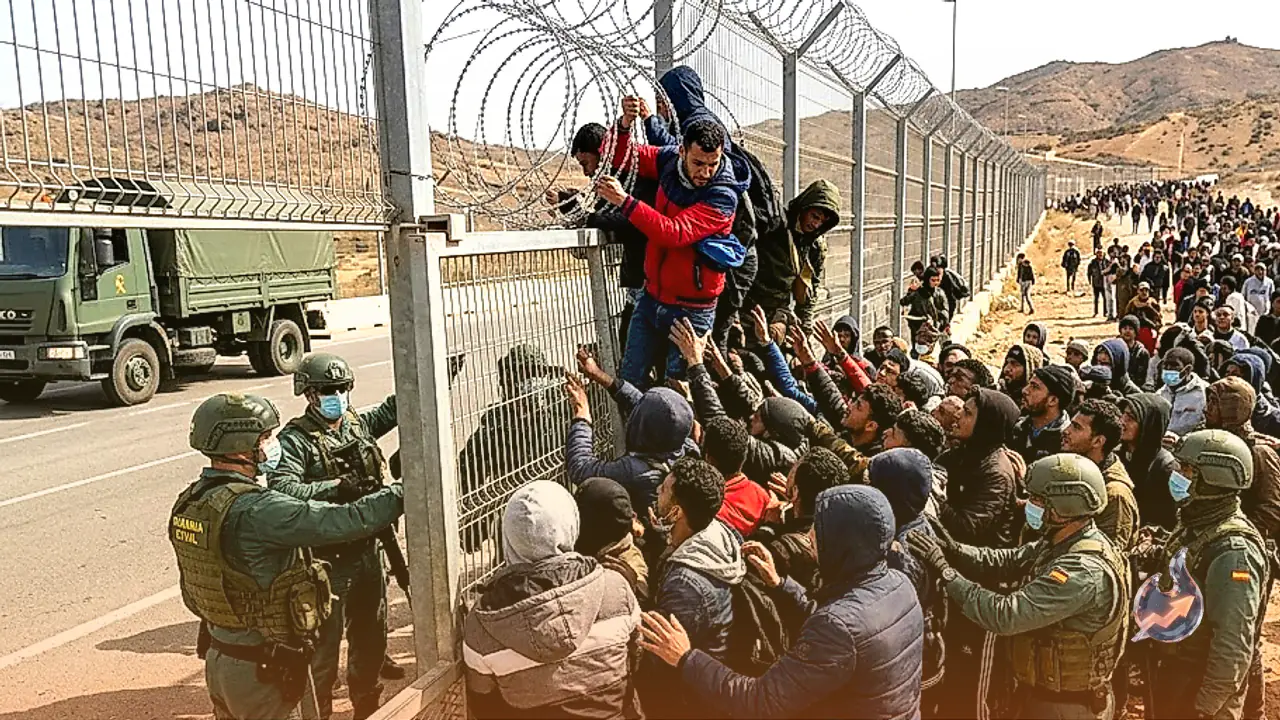

An unprecedented migration crisis has unfolded along the border of Spain's North African territory of Ceuta, where an estimated 49,000 migrants successfully crossed from Morocco over a single 24-hour period. The sudden surge, occurring across both land and sea entry points, has pushed local border infrastructure into total collapse and prompted the Spanish government to deploy military forces to restore order. With border controls temporarily breaking down, thousands of individuals navigated rocky jetties and swam through coastal waters to reach European soil. The rapid influx has triggered immediate security measures in Ceuta and the nearby exclave of Melilla, while sparking a sharp diplomatic dispute between Spanish and Italian leadership over European border control and solidarity.
Massive Influx and Scale of Arrival in Ceuta
Official estimates released by Spanish authorities underscore the extraordinary scale of the border event. The arrival of approximately 49,000 individuals in roughly a single day represents more than half of Ceuta's entire population, which stands at around 83,600 according to the most recent local census data. Images and video footage captured thousands of people swimming around coastal barriers toward the city on Thursday, with local media confirming that crossings persisted unabated throughout the night.
The perilous journey has also proved tragic for several attempting the passage. Officials confirmed that at least 18 people have died in recent days while attempting to reach the territory. The crowds gathering along the border were predominantly composed of young men, though significant numbers of women, children, and infants were also present. Authorities estimate that at least 7,000 of those who entered illegally during the 24-hour window are unaccompanied minors.
In standard circumstances, individuals attempting to enter Ceuta swim several kilometers from points further along the Moroccan coastline. During this surge, however, groups were able to approach the physical border fencing with relative ease. Initial arrivals walked along the protective rock jetties before wading around the perimeter, though the majority ultimately swam through open waters to reach the beaches on the Spanish side.
Border Control Breakdown and Emergency Military Response
The sudden breakdown of border integrity raised immediate questions regarding monitoring along the Moroccan side of the frontier. It remains unclear where Moroccan border guards were positioned during the initial push or why the approaching crowds were not dispersed. One Spanish official described the state of the border at the height of the crossing as a total collapse.
The massive entry on Thursday followed several days of steadily increasing arrivals by sea, as news of successful crossings quickly circulated among waiting groups. Overnight into Friday, continuous attempts to cross resulted in ongoing friction and confrontations between migrants and border police along the perimeter line.
In response to the emergency, Madrid ordered the deployment of armed forces to reinforce security personnel in Ceuta and its sister exclave of Melilla, which recorded between 300 and 400 overnight crossing attempts of its own. Spain's Interior Ministry announced it was coordinating with Moroccan counterparts to facilitate the rapid return of those who crossed illegally. Spanish Prime Minister Pedro Sánchez announced plans to visit Ceuta later on Friday to inspect security operations firsthand.
Legal Backdrop and Supreme Court Ruling
The timing of the border surge coincides with significant legal developments within Spain. Earlier this month, Spain's Supreme Court issued a landmark ruling stating that migrants intercepted at sea while attempting to reach Ceuta or Melilla cannot be subjected to summary returns to Morocco. The judicial decision established that individuals intercepted maritime must be brought to port and granted access to standard legal procedures rather than immediate pushbacks.
Geographically, Ceuta is situated on the northern coast of Morocco, separated from the Iberian Peninsula by the Strait of Gibraltar. Together with Melilla, these semi-autonomous Spanish territories represent the European Union's only direct land borders with the African continent. Local officials in Ceuta had previously requested federal assistance from Madrid following an earlier rise in crossing attempts, prior to the complete breakdown of border checkpoints on Thursday.
Geopolitical Friction and Historical Context
The territories of Ceuta and Melilla have long been points of diplomatic tension between Madrid and Rabat. Morocco claims sovereignty over both enclaves, whereas Spain maintains that both cities are integral semi-autonomous regions of the Spanish state, holding status equivalent to regions on the mainland.
The current influx draws parallels to a major border incident in 2021, when Moroccan authorities permitted approximately 8,000 people to cross into Ceuta following a dispute with Madrid over the sovereignty of Western Sahara. Regional political friction flared again recently after Prime Minister Pedro Sánchez traveled to Algeria, a nation that actively supports independence movements in the Western Sahara region.
European Fallout and Diplomatic Dispute with Italy
The events in Ceuta quickly resonated across European capitals, sparking immediate political friction. Italy's Prime Minister publicly characterized the footage from Ceuta as shocking, writing on social media that uncontrolled immigration constitutes a direct security threat to Europe. She further suggested that Italy might evaluate suspending the Schengen free-movement agreement with Spain. Analysts noted that any formal suspension would carry little practical impact, as Spain and Italy do not share land borders and migrants arriving in Ceuta remain confined to the enclave without immediate access to mainland flights.
The remarks were echoed by Italian Foreign Minister Antonio Tajani, drawing a sharp response from Spanish Foreign Minister José Manuel Albares. Albares accused Italian leadership of politicizing immigration for domestic ends and engaging in partisan demagoguery. He emphasized that such statements were inappropriate coming from a European partner from which solidarity should be expected. To formally express Madrid's dissatisfaction, Albares summoned the Italian ambassador to Spain on Friday.