


















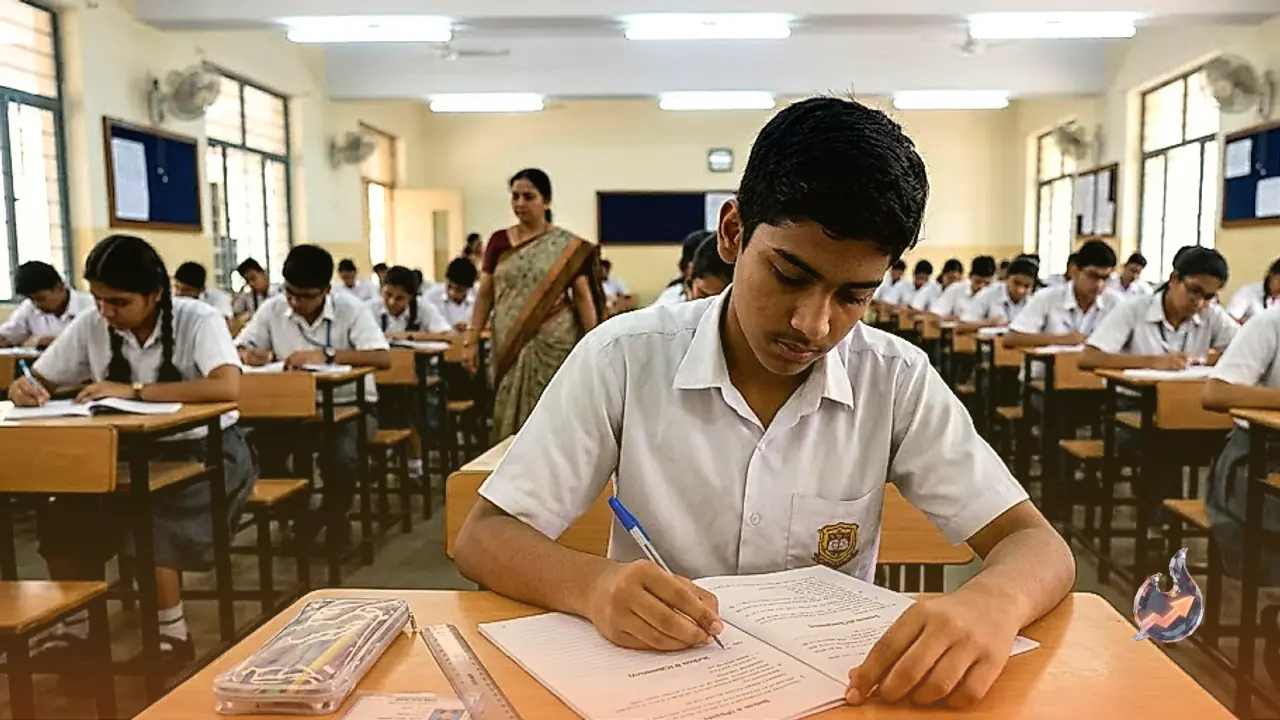

A critical revision in the evaluation architecture has been put into effect by the Central Board of Secondary Education for candidates appearing in the Class 10 board examinations scheduled for the year 2027. Under this updated framework, writing a completely accurate answer could still lead to zero marks if an examinee fails to adhere to the designated sectional divisions. Students and their guardians must understand these strict procedural rules well in advance, as minor carelessness during the test can undo months of preparation.
During high-stakes board examinations, candidates frequently make the mistake of scribbling responses in any remaining blank space or placing one topic's answer inside another section due to time pressure. In the 2027 board exam, such missteps will carry severe consequences because of the complete overhaul in paper assessment. Ignoring the board's new instructions can directly harm overall scores and elevate the risk of academic setbacks.
Discipline-Specific Evaluation Replaces Single-Examiner Grading
Historically, a single examiner was assigned to assess an entire Class 10 Science answer sheet from start to finish. Central Board of Secondary Education has dismantled this convention by introducing a discipline-specific evaluation system. Under this arrangement, different portions of the exact same answer booklet will travel to subject matter experts for assessment. Biology educators will evaluate only the biology portion, chemistry teachers will grade chemistry answers, and physics specialists will review the physics section.
Science Question Paper Organised into Three Distinct Sections
To support this compartmentalised evaluation process, the Class 10 Science paper has been arranged into three dedicated sections
- Section A: Dedicated exclusively to questions from Biology.
- Section B: Allocated entirely for Chemistry concepts and assessments.
- Section C: Reserved specifically for Physics numerical problems and theoretical questions.
Zero Marks and Unattempted Status for Sectional Misplacement
Under the board's strict guidelines, if an examinee solves a physics numerical or theoretical question from Section C inside the Section B chemistry area, the chemistry evaluator will strike through the answer. No partial credit will be awarded regardless of factual correctness, and the answer will be marked as zero while being catalogued as an unattempted question. Students must mentally map their answer booklets as soon as they receive the paper in the examination hall. Avoiding overwriting and confining each solution strictly to its designated section is now non-negotiable.
Question Pattern and Assessment Weightage for Science Paper
Beyond the evaluation workflow, Central Board of Secondary Education is also steering the examination blueprint toward concept retention and analytical thinking rather than rote learning
- 50 Percent Foundational Questions: Half the total paper assesses clarity of basic concepts and core scientific knowledge.
- 30 Percent Application-Based Questions: This segment examines how scientific laws and theories are applied in practical daily life scenarios.
- 20 Percent Competency-Focused Questions: This component requires examinees to demonstrate analytical breakdown, evaluation skills, and creative problem solving.
Official Date Sheet and Sample Papers to Be Released Online
The Central Board of Secondary Education is preparing to issue the formal exam schedule for the main board exams on its official website, cbse.gov.in. To align study plans with the updated format, candidates can access and download the new science syllabus alongside practice papers from cbseacademic.nic.in. Reviewing the 2027 sample papers will provide learners with clear insight into the complex and analytical question styling planned by the board.