




















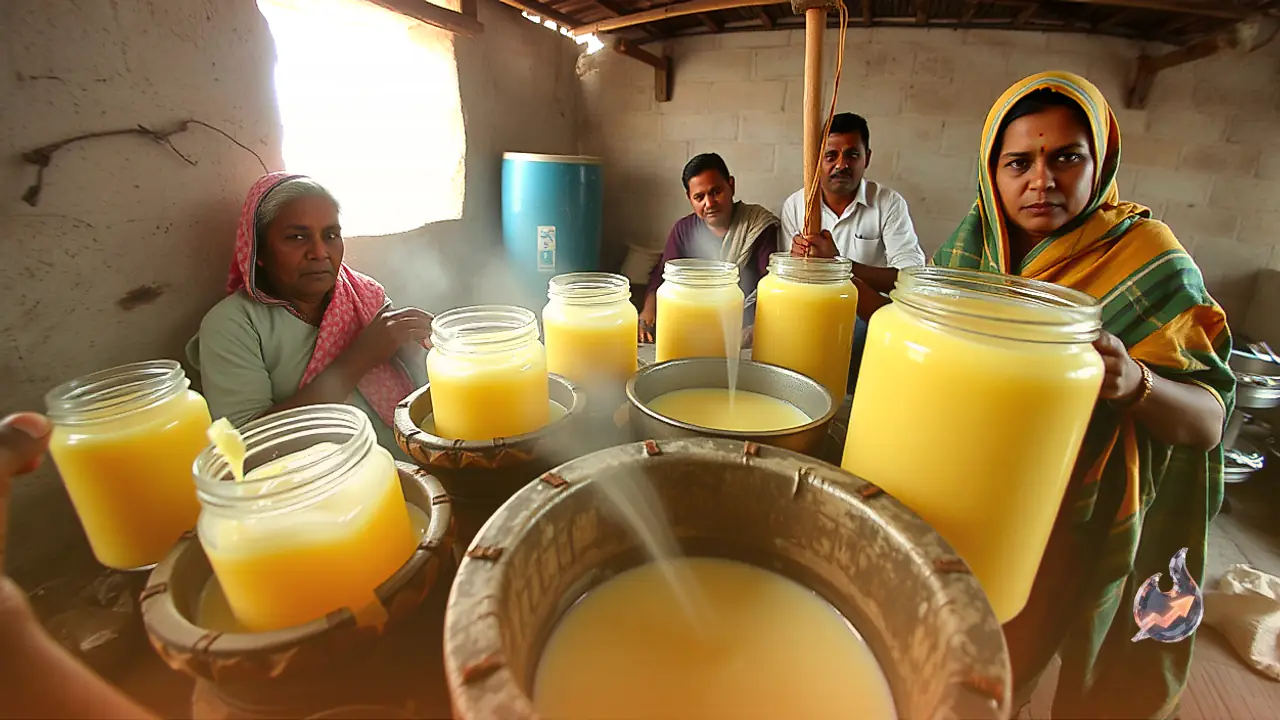

With rising health awareness and a preference for unadulterated food, traditional clarified butter made right at home continues to enjoy strong demand over commercial packaged alternatives. In the rural areas of Lakhimpur Kheri district in Uttar Pradesh, households continue to preserve age-old dairy traditions by making desi ghee from fresh milk cream and butter. Butterfat processed in this customary domestic manner provides rich culinary flavour and remains naturally shelf-stable for long periods without spoiling.
Collecting Milk Cream and Setting the Starter Culture
The entire process of making pure desi ghee begins with fresh milk. After boiling the milk thoroughly, it is allowed to cool down, causing a thick layer of rich cream to form on top. This cream is skimmed off and collected in a clean vessel day after day. To maintain freshness and prevent spoilage over several days of accumulation, the collected cream is safely stored in a refrigerator. Once a sufficient quantity gathers, a small spoon of curd is introduced as a starter culture to let the cream ferment properly, preparing it for smooth churning.
Traditional Churning to Separate Butter and Buttermilk
Rural households continue to rely on traditional wooden churners to extract fresh butter. When the fermented cream is vigorously churned with the wooden tool, fresh white butter readily separates from the liquid, leaving refreshing buttermilk behind. As churning progresses, butter gathers into distinct round lumps. These fresh butter balls are skimmed out of the vessel and thoroughly rinsed in clean cold water, ensuring any lingering traces of sour liquid or milk residue are washed clean before cooking.
Simmering on Low Heat for Perfect Clarification
Once rinsed, the clarified butter making moves to the stove. The cleaned butter is placed into a heavy-bottomed pan to prevent scorching and cooked over a steady, low flame. As the temperature rises, moisture within the melting butter continuously evaporates as steam. The thick foam that develops initially begins to subside, revealing a clear golden liquid while milk solids settle gently to the bottom of the pan. As soon as all water content evaporates and the characteristic rich aroma fills the air, the pan is promptly removed from heat.
Ready in 20 to 30 Minutes Without Any Additives
According to Muskan, preparing ghee through this rural technique using a wooden churner remains uncomplicated and dependable. After safely collecting milk cream in the refrigerator and separating the buttermilk with the churner, the actual simmering process takes only about 20 to 30 minutes. In that short window, pure homemade desi ghee is ready without synthetic additives or artificial processing. This ensures complete confidence in purity that commercial alternatives rarely provide.
Identifying Purity Through Texture, Color, and Aroma
In rural communities, experienced makers assess the authenticity of homemade ghee not just by its appearance, but through its texture and aroma. Upon cooling, the clarified liquid sets into a granular solid texture. However, the final shade and consistency vary according to the animal's feed, milk quality, and cooking temperature. For instance, ghee prepared from cow milk retains a distinct yellow tone and does not set into a completely rigid solid.