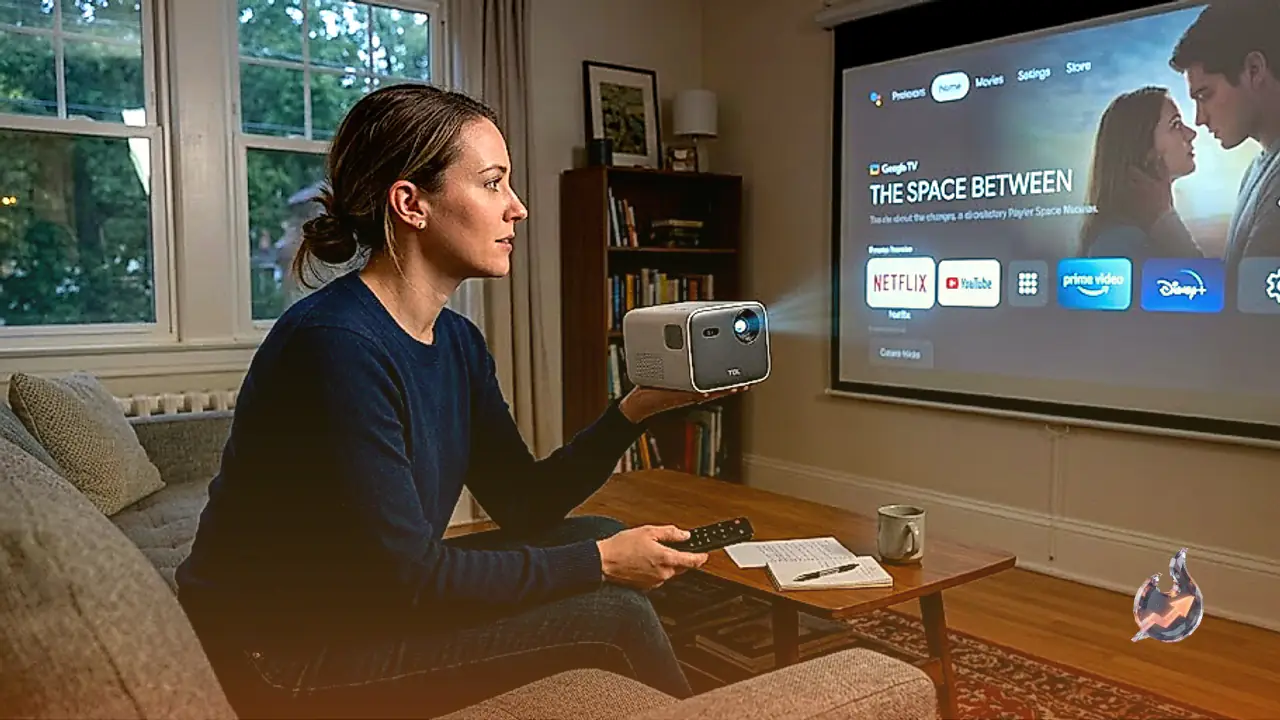



















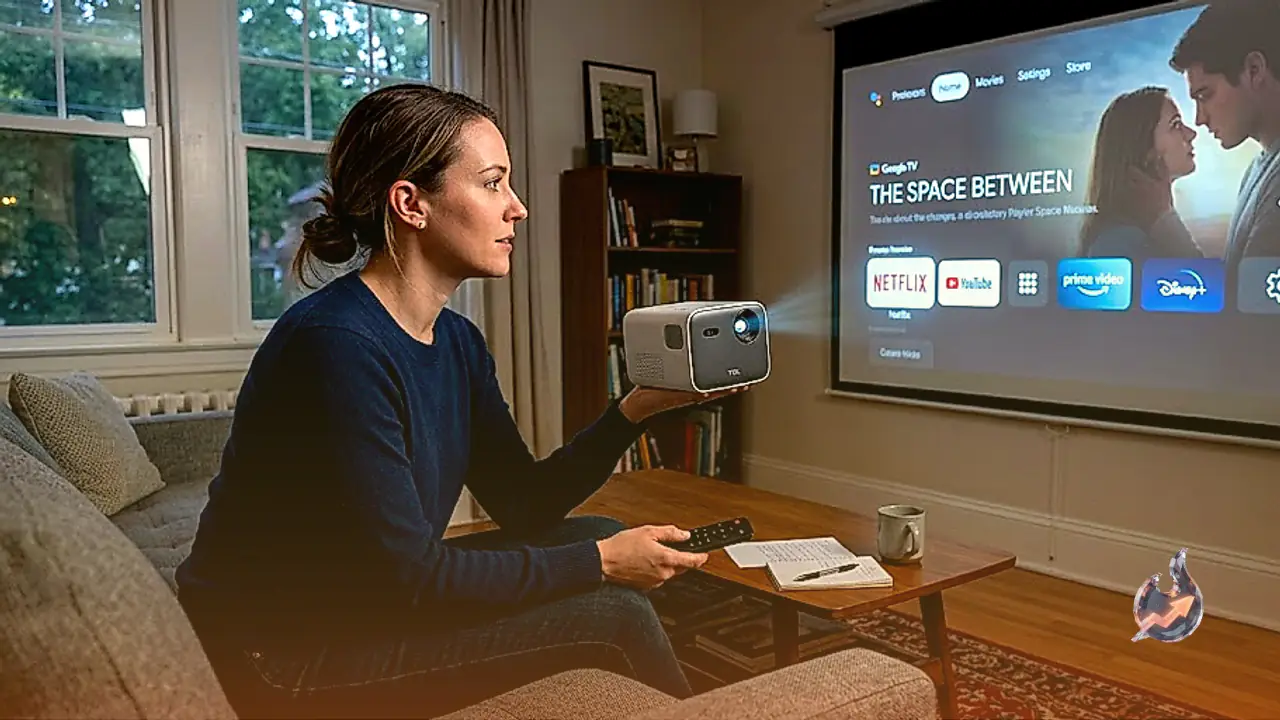

Finding an ideal compromise between easy handling and cinematic visual output is rarely simple in the portable display segment. The TCL A1s enters this space as an LCD projector running at a native 1080p resolution and driven by an LED light source. Portability stands front and center in its overall concept, highlighted by a compact, lightweight body and an integrated top handle designed for effortless carrying from space to space. Beyond transport duties, that same handle tilts up to 15 degrees to serve as an angle-adjusting desktop stand. While the form factor nails the basics of moving video around the house, testing reveals that several foundational display compromises remain evident underneath.
Smart Platform and Automatic Alignment Features
Convenience receives a solid boost through built-in Google TV software. Having the platform integrated natively means you do not have to carry or plug in an external streaming dongle to enjoy popular streaming channels and video libraries. The operating system navigates easily and supports automated screen setup algorithms. These adaptation tools include autofocus, automatic keystone correction, obstacle avoidance, and automatic screen fitting. The projector attempts to automatically size around obstructions on the wall, saving setup minutes when shifting rooms. However, heavy reliance on digital keystone correction instead of physical placement degrades image sharpness and reduces pixel fidelity.
Projection Geometry and Physical Limitations
On the hardware side, the optical assembly omits advanced mechanical aids such as optical zoom or lens shift. Because there is no optical zoom or lens shifting mechanism, achieving the best possible picture quality requires physically picking up the projector and repositioning it closer or farther away, as well as dead-center to the projection surface. With a throw ratio rated at 1.25:1, the device is capable of casting an image measuring between 45 and 150 inches diagonally. Tripod mounting provides an alternate way to assist with height and vertical aim. Port connectivity is sparse, offering only a single HDMI port for wired media devices. Audio duties are handled by a pair of integrated 8W full-range speakers, which produce enough volume for casual background listening.
Dark Room Visuals and Picture Accuracy
Evaluated as a dedicated home theater display, performance drops significantly below enthusiast standards. Across varied scenes, contrast is noticeably sub-par. Deep black tones lack depth and settle into an unconvincing dark gray, leaving shadowy night scenes washed out while daytime scenes lack dimensionality and appear flat. The processing also fails to eliminate judder, resulting in motion that looks noticeably choppy when tracking camera pans in films and broadcasts. Color performance suffers from a cramped color volume, leaving palettes looking dull and heavily muted. Right out of the box, chromatic accuracy is poor, leaning heavily toward an overly cool and bluish bias. While calibration tools can dial out the excess blue tint, the colors remain noticeably undersaturated across all content. Limited peak brightness prevents the image from delivering visual punch, even when running inside a fully darkened, pitch-black space. Adding to the drawbacks, internal cooling fans generate substantial noise, which becomes a clear distraction during quiet dialogue sequences, particularly when seated in front of the unit. On the positive side, the display engine does not produce any rainbow effect, which provides clean viewing for individuals sensitive to single-chip color-wheel artifacts.
Outdoor Reliability and Everyday Room Use
Taking this projector outside reveals strict operational limits. Because brightness output is low, ambient light easily washes out the canvas, meaning outdoor use requires total darkness and switching off surrounding patio lamps. Portability is enhanced by the light frame, built-in carry handle, and the included protective carrying case. Yet despite its travel-friendly build, there is no built-in battery, demanding continuous access to a mains power outlet and extension cords wherever you place it. For secondary rooms like a bedroom, the fast automatic keystone and autofocus tools shorten installation friction when projecting onto bare drywall. Even so, the loud fan noise remains noticeable when enjoying content at lower late-night listening levels.
Gaming Responsiveness and Motion Clarity
Interactive entertainment is another area where the hardware struggles. Benchmark testing shows high input latency that behaves erratically, shifting its lag figure with each console handshake. This produces an unresponsive, inconsistent controller feel in gameplay. Signal handling caps at 1080p @ 60Hz, leaving no pathway to utilize the 120Hz refresh rate supported by modern gaming hardware. The underlying LCD panel introduces visible motion blur during fast-paced movement, while the projector's muted colors and flat contrast wash out in-game lighting and texture detail.