



















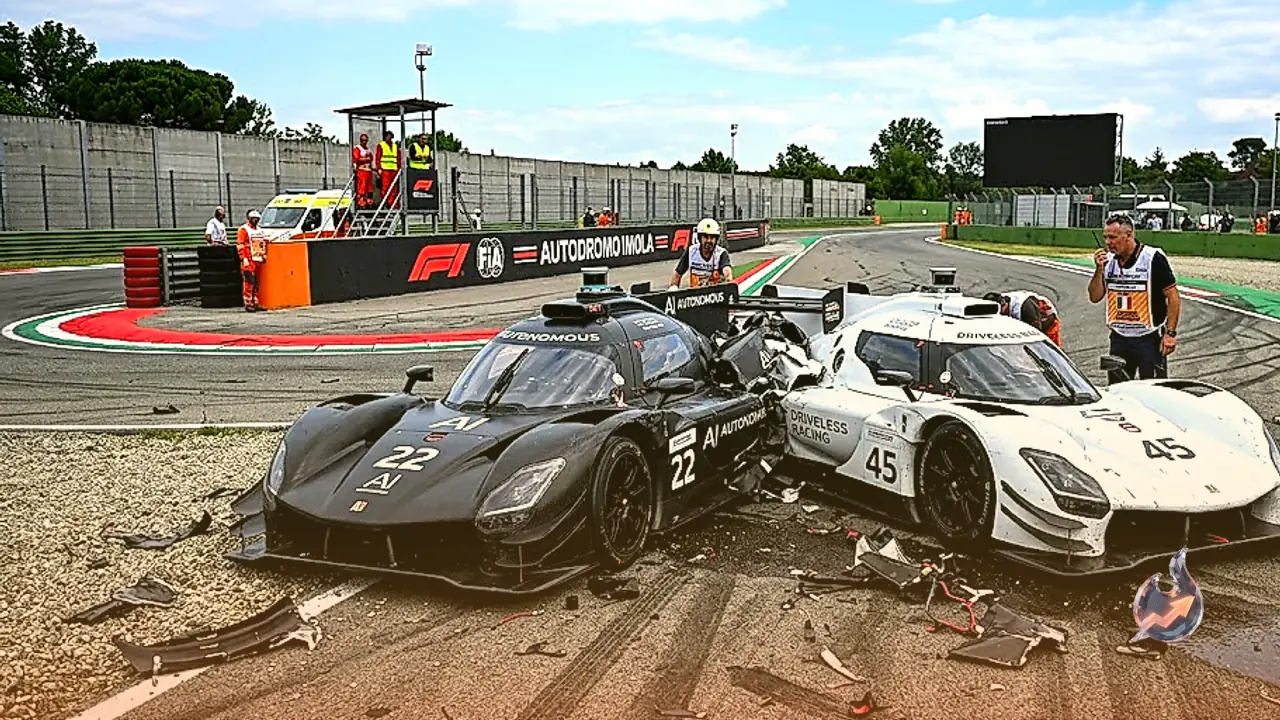

At the Autodromo Internazionale Enzo e Dino Ferrari in Imola, Italy, two autonomous race cars travelling at 155 mph collided in the notoriously treacherous Rivazza section. Rivazza marks the final sequence of the circuit, featuring a series of sharp, deceptive corners that have previously caught out world-class Formula 1 champions. This time, however, the heavy impact carried zero threat to human life because neither machine had a driver behind the wheel. The collision laid bare the acute contrast between the raw processing power of autonomous systems and their real-time ability to avert disaster when hardware or perception fails at extreme limits.
A2RL Ventures Beyond Abu Dhabi into Imola's Unforgiving Terrain
The Abu Dhabi Autonomous Racing League, known as A2RL, was established in 2024 to push driverless vehicle technology to its absolute operational boundaries within motorsport. While its initial development took place at the relatively familiar Yas Marina Circuit in Abu Dhabi, this event marked the championship's inaugural international outing at an unfamiliar venue. Rather than picking a gentle layout, organizers deliberately brought the machines to one of the most punishing road tracks in Europe.
Teams were granted merely nine days of on-track physical testing prior to the final showdown, contending with harsh and unpredictable weather that featured heavy rain and hail. Nicola Palarchi, the engineering director at Aspire, the organization that created A2RL, explained the rationale behind selecting such a punishing venue by noting that handling easy tracks proves little. The league sought to prove that autonomous systems can perform where environmental and track conditions are genuinely demanding. Palarchi emphasized that autonomous racing does not exist to replace or rival human racing drivers. Instead, it operates as a distinct motorsport category that serves as a high-speed proving ground, functioning like an open-air laboratory surrounded by safety barriers.
The Anatomy of a High-Speed Collision: Sensor Outage and Physics
Operating an autonomous race car involves three consecutive computational stages: perception, trajectory planning, and actuation control. The vehicle relies on an array of sensors to identify its spatial location and track boundaries, feeds that data into trajectory software to plot an optimal path, and finally commands the steering, throttle, and braking systems. At 155 mph, these calculations must happen instantaneously, leaving virtually no margin for incomplete data or system lag.
Ahead of the final, A2RL head of sporting Alexander Winkler pointed out that the steep elevation drop along the track creates a temporary blind zone for oncoming cars. He warned that if an entrant came to a halt immediately beyond that crest, any trailing machine would have less than a single second to register the obstruction and initiate an evasive line.
That theoretical hazard quickly turned into reality. Gianna, the car fielded by team Unimore, experienced a complete loss of data streams from both its lidar and radar arrays. Because standard GPS lacks the pinpoint accuracy required to navigate a narrow racing line at triple-digit speeds, Gianna's safety architecture triggered an immediate emergency stop. The vehicle braked with an intense deceleration force of roughly 1 g. Trailing only 1.5 seconds behind was Eva, the car entered by team PoliMove.
According to PoliMove, Eva's perception stack correctly detected Gianna halted on the track and immediately computed an evasive steering maneuver. However, the inevitable latency chain—encompassing object perception, hazard classification, trajectory replanning, mechanical actuator reaction, and physical vehicle dynamics—could not overcome basic momentum. With Gianna braking violently in the middle of a corner, avoiding a high-speed collision became physically impossible. The incident clearly demonstrated that even the most advanced computer chips cannot alter the laws of physics once closing distances shrink past critical thresholds.
Mechanical Setbacks and Only Two Cars Crossing the Finish Line
The demanding nature of the Imola circuit took a heavy toll on the five-car grid, leaving only two vehicles to see the checkered flag. The UAE-backed Kinetiz claimed first place with its car Sparkz, while Germany's Constructor Racing crossed the line as the runner-up. PoliMove earned third position despite its battered car being unfit for the official podium celebration, requiring a replacement vehicle for the trophy presentation. Meanwhile, two-time A2RL winner TUM suffered an early exit during the formation lap when the rear-left brake on its car, Hailey, locked up under low-to-medium hydraulic pressure. TUM's withdrawal served as a stark reminder that even flawless autonomous code remains entirely vulnerable to classical mechanical failures.
Addressing Gianna's sudden shutdown, Unimore noted that the car was forced to halt because it lacked an effective secondary fallback system. Team engineers indicated that upcoming iterations will integrate cameras alongside an inertial measurement unit, allowing the vehicle to limp safely forward at reduced speed until its primary sensor arrays recover signal lock.
Translating Track Crashes into Safer Street-Legal Autonomous Vehicles
Despite the damage, engineers across the paddock viewed the collision as an invaluable technical success. The event generated rare, high-stakes edge cases that simulated computer modeling cannot accurately replicate, including total sensor blackout, localized positioning loss, violent braking, restricted visibility over blind crests, and the intricate interaction between two distinct autonomous algorithms making split-second decisions.
Beyond predictive software, Palarchi highlighted that extreme racing conditions expose hardware to intense stress tests. Internal temperatures inside these race car cockpits can climb toward 170 degrees Fahrenheit. While commercial robotaxis operate in far milder interior environments, building lidar and radar sensors capable of enduring that level of heat will prove crucial as urban centers face increasingly extreme summer heatwaves. Chee Kiong Ong, deputy team principal at Kinetiz, also pointed out that racing algorithms designed to control cars sliding at the outer edge of adhesion will eventually transfer to production passenger vehicles, allowing them to execute emergency evasive maneuvers and stop safely to prevent fatal accidents.
Data Restrictions and the Return to Abu Dhabi
One notable constraint of the championship is that participating outfits are under no regulatory obligation to make their detailed vehicle telemetry publicly accessible. The proprietary data generated by the league's bespoke EAV 25 race cars, which are constructed on modified Dallara SF23 single-seater chassis, currently remains locked within the competition.
The A2RL circuit will stage its next event back at the Yas Marina Circuit, where teams will build on years of accumulated baseline code. Organizers are already drafting changes to raise the competitive bar even higher, considering proposals to trim testing days, expand the starting grid to eight cars, and deliberately throttle GPS connectivity. Those stricter parameters will test whether autonomous race cars can adapt dynamically on the fly, offering another glimpse into how track-tested safety protocols will eventually filter down to consumer roads.