























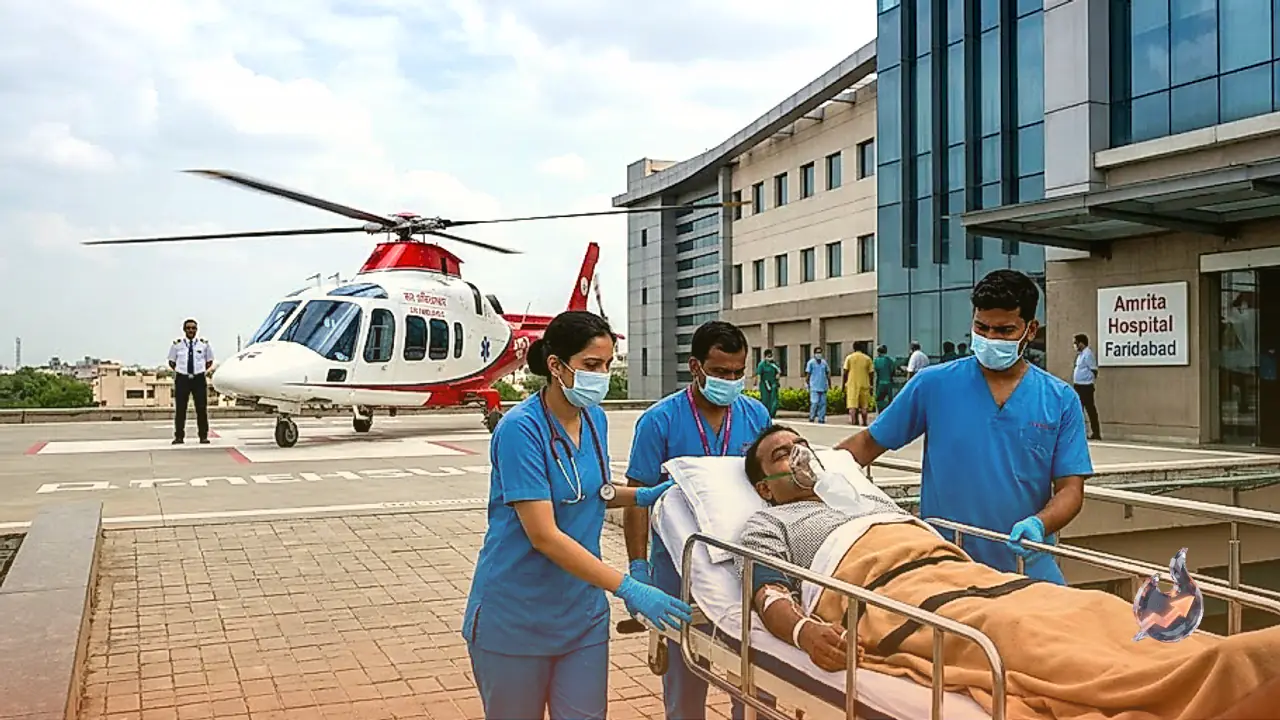

In the treatment of critically ill individuals, transporting them to a medical facility in a timely manner is just as crucial as the medical care itself. In densely populated metropolitan areas like Delhi and the National Capital Region, severe traffic congestion often forces conventional ambulances to navigate long and cumbersome routes. In such dire situations, helicopter-based medical services are emerging as a vital alternative to save critical lives. In a notable first for Faridabad, a patient was flown in directly from Kanpur via helicopter straight to a hospital's emergency unit.
Dedicated Helipad Facility at Amrita Hospital
According to Dr. Ashutosh Sharma, Medical Superintendent of Amrita Hospital in Faridabad, such advanced facilities are indispensable in today's era because even a delay of a few minutes or hours in critical medical conditions can severely impact a patient's health. Recognizing this pressing need, provisions for a rooftop helipad were integrated into the hospital building's design right from its inception. Formal approval for operating this critical service was granted by the Directorate General of Civil Aviation, or DGCA, in February 2026.
Estimated Costs and Technical Requirements of Air Ambulances
Dr. Ashutosh Sharma explains that the rental cost of a helicopter varies depending on its model and the operating aviation service provider. A single-engine helicopter can incur expenses of up to approximately 2.5 lakh rupees per hour, whereas larger twin-engine helicopters can cost between 4 lakh and 4.5 lakh rupees per hour. This mode of transport proves most beneficial and cost-effective for distances covering around 300 kilometers.
To construct a functional helipad, the building's structural framework requires reinforcement to bear the additional load, driving up construction costs by roughly 30 to 40 percent compared to standard architecture. The primary advantage for the patient is that upon landing, they do not need to be transferred to another road vehicle, thereby eliminating transit delays.
Internal Hospital Transit and Insurance Provisions
Dr. Ashutosh Sharma notes that dedicated elevators are installed inside the hospital premises to transport patients directly from the rooftop helipad down into the facility, moving them seamlessly to the emergency ward, critical care area, or operating theater based on clinical requirements. The patient arriving from Kanpur was similarly taken straight to the emergency department. However, bearing the private expense of an air ambulance is not financially viable for every ordinary household.
To ease this burden, some insurance companies include air ambulance coverage within their health policies. Individuals whose policies encompass this feature can utilize it in accordance with prescribed terms and conditions. Furthermore, final clearance for helicopter landings is authorized exclusively by the DGCA, prior to which mandatory clearances from the fire service, structural engineers, and local administrative bodies must be fulfilled. Landing permission is granted only after rigorous safety inspections are completed.
Scenarios Where Aerial Transit Proves Most Beneficial
Aerial pathways can prove instrumental during medical emergencies such as heart attacks, severe brain strokes, major road accidents, complex childbirth complications, and neonatal crises. Time plays an indispensable role in organ transplants as well. Transporting a liver or kidney available in another city swiftly enables the transplantation procedure to commence without delay.
If a patient lands at the Delhi airport and travels by road to a hospital, severe traffic can consume at least two to two-and-a-half hours purely in transit. Conversely, a helicopter lands directly on the rooftop helipad, allowing the patient to bypass all traffic hurdles and reach the emergency department instantly. This marks the inaugural instance at this hospital where a patient has arrived directly via an airborne medical transport.
A Potential Game Changer for Medical Emergencies
Given the escalating traffic congestion in major cities and the critical value of time for emergency patients, Dr. Ashutosh Sharma believes that helicopter-based ambulance services could emerge as a major game changer in the realm of medical emergencies in the future.