






















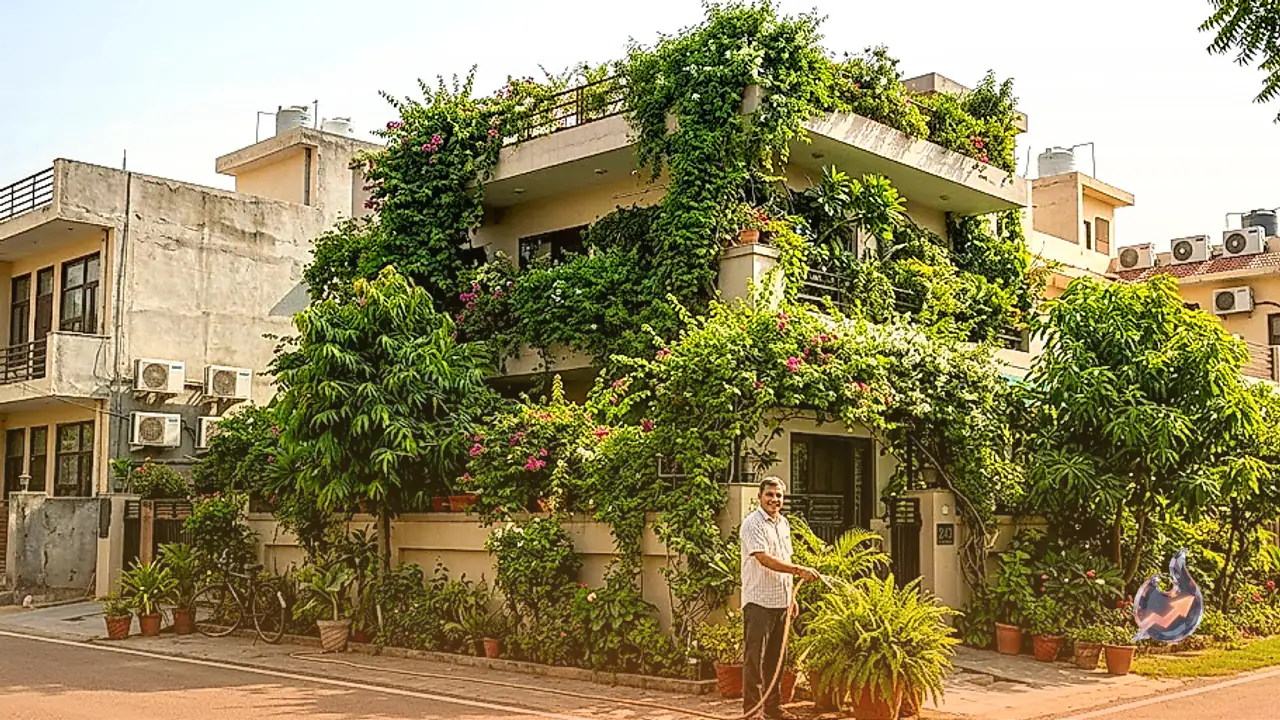

On days when the mercury in Faridabad climbs past 45 degrees Celsius, one house right next to the Delhi border stays noticeably cooler, with indoor temperatures running 7 to 10 degrees lower than outside. The secret isn't any machine, it's the greenery that covers most of the property from the courtyard to the rooftop.
Gardens cover more than half of the 1,000-yard house
The house sits on roughly 1,000 square yards of land, and more than half of that space has been turned into a garden. Hundreds of varieties of plants grow here, including medicinal herbs, leafy greens, vegetables and seasonal flowering plants. Owner Anurag Jain says that even when Faridabad's temperature crosses 45 degrees, the heat barely registers inside his home.
Air conditioning runs for just one hour a day
According to Jain, the air conditioner in his house needs to run for only about an hour out of the full 24-hour day. Within that hour, the room cools down enough that the AC gets switched off again. He credits the shade and greenery for keeping both the temperature and the pollution levels indoors well under control.
Growing pollution pushed him to build a green home
Jain says he moved into this house around three years ago. Watching air quality worsen steadily across cities, he decided to create an environment inside his home where the family could live healthily. Every winter, pollution levels spike dangerously across Faridabad and the wider Delhi NCR region, largely due to smoke from stubble burning that fouls the air. In the three years he has lived there, Jain says he has never felt the effect of pollution inside his home, even as reports keep coming in from Delhi about breathing trouble and hazardous air.
Herbal plants were already there when he bought the house
Jain says the house sits right on the edge of Delhi, and more than half of its area has been developed into gardens. When he first bought the property, it already had many plants growing on it, including several herbal varieties he knew little about at the time. Some of those plants died off over the years, and he has now begun reintroducing them. He believes the soil itself is particularly suited to herbal plants, and says that while he doesn't know the specific use of every single plant, almost none of them are without some purpose.
Punarnava and other medicinal plants said to help kidney and liver health
Among the plants growing at the house is punarnava, which is commonly said to be useful for issues related to the kidney and liver. Jain notes that every plant carries its own distinct properties. Solar panels have also been installed on the upper floor, which helps keep the roof somewhat cooler as well. With greenery spread across every side of the property, the entire atmosphere of the house feels distinctly different from a typical urban home.
A Kashmiri chinar tree thriving in Faridabad's soil
One of the more unusual details is that plants typically associated with cold, hilly regions are also flourishing at the house. The chinar tree, usually found in Kashmir, grows easily here, and its flowers are cooked and eaten as a vegetable. Jain says only organic fertiliser is used across all the plants, with cow dung manure ordered once a year and added to the soil. The garden also includes dragon fruit, ridge gourd, sunflowers, hibiscus and several other flowering plants.
Kitchen waste turned into compost, and a papaya tree grew on its own
Jain says organic waste from the kitchen was routinely mixed into the soil, and several plants sprouted on their own as a result, including a papaya tree that grew without being deliberately planted. He recently picked eight papayas from that very tree in a single go. His experiment shows how a bit of planning and consistent effort can recreate a cooler, healthier, hill-like environment even in the middle of a city.