
























India's ancient practice of yoga is earning recognition well beyond cultural celebrations. Across clinical trials, research laboratories, and peer-reviewed medical journals, it is steadily being established as a legitimate, evidence-based health intervention. This shift is particularly meaningful in the field of cardiovascular medicine, where every proposed treatment must survive rigorous scientific scrutiny before it is accepted. The growing body of evidence is making it difficult to dismiss yoga as merely a lifestyle choice.
Ninety Percent of Yoga Research Has Emerged in Just Two Decades
Professor Dr. Ambuj Roy of the Cardiology Department at AIIMS Delhi points out that the volume of scientific study on yoga has grown at a striking pace. Approximately 90 percent of all published scientific research papers on yoga have appeared in the last 20 years alone, and the rate of publication has accelerated further over the past 10 years. In PubMed, the leading biomedical research database, the number of yoga-related clinical trials listed in the most recent decade has more than doubled compared to the decade before it. This trajectory signals that yoga has moved firmly into the mainstream of medical research.
The YOGA-CARE Trial: The Largest Study on Yoga and Heart Recovery
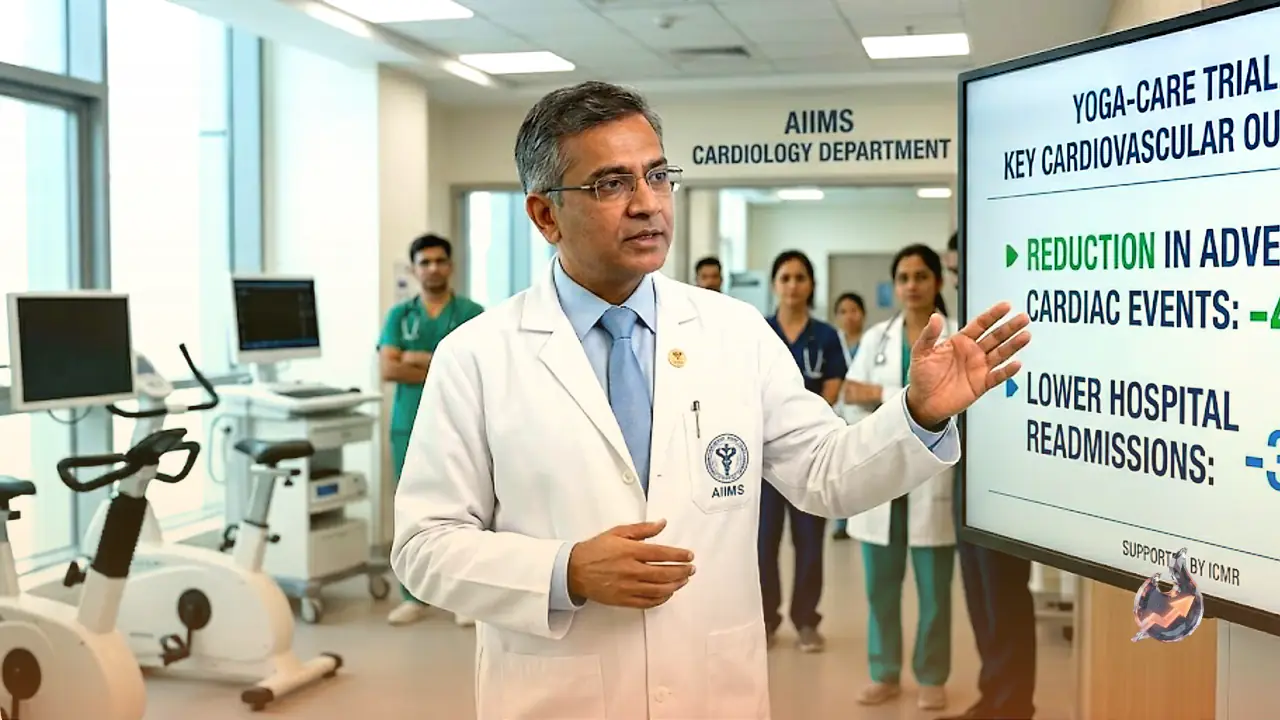
The strongest scientific case for yoga in heart care comes from the YOGA-CARE trial, funded by ICMR and published in 2020 in the Journal of the American College of Cardiology. Conducted across 24 centres in India, the trial enrolled approximately 4,000 patients who were recovering from heart attacks, making it the largest randomized clinical trial ever carried out on yoga-based cardiac rehabilitation. The findings were striking: patients who attended 75 percent or more of the prescribed yoga sessions saw adverse cardiac events fall by up to 40 percent. These patients also returned to normal life faster and reported better overall health outcomes after their heart attacks.
Beyond the clinical numbers, the trial carries a deeper significance. It demonstrated that yoga can be evaluated using the same rigorous scientific standards applied to pharmaceutical drugs and medical devices, a credibility benchmark that gives its findings genuine weight in the medical community.
CAREMATCH Analysis Points to Fewer Hospital Readmissions
The CAREMATCH analysis offered further support for yoga's cardiovascular benefits. It indicated that yoga-based rehabilitation is comparable in effectiveness to conventional cardiac rehabilitation programmes. Patients undergoing yoga-based recovery showed measurable improvements in quality of life, and their likelihood of being readmitted to hospital fell by approximately 30 percent. For a country like India, where conventional cardiac rehabilitation services are expensive and largely out of reach for patients in smaller towns and rural areas, this finding carries real practical weight. Yoga presents a comparatively affordable, accessible, and culturally familiar alternative for heart patients across the country.
Blood Pressure Findings Across 49 Studies
A pooled analysis drawing on 49 separate studies found that regular yoga practice is associated with an average reduction of 5 mmHg in systolic blood pressure and 3 mmHg in diastolic blood pressure. While these figures may appear modest in isolation, experts note that even a reduction of this size can substantially lower the risk of stroke and heart attack over time.
The Biological Pathways Behind Yoga's Heart Benefits
Research is also clarifying the mechanisms through which yoga supports cardiovascular health. Regular practice improves autonomic balance within the body, enhances heart rate variability, and reduces the secretion of hormones associated with chronic stress. It also strengthens mental health, which is closely intertwined with cardiac outcomes. Together, these effects indicate that yoga acts on multiple pathways simultaneously, addressing both the physiological and psychological dimensions of heart disease. This makes it a genuinely holistic tool for cardiac care, one that works from the inside out.