




















A major scientific advancement has emerged for stroke survivors struggling with speech loss. Researchers from the Indian Institute of Technology Delhi (IIT Delhi), the All India Institute of Medical Sciences (AIIMS), and the Institute of Human Behaviour and Allied Sciences (IHBAS) have collaboratively designed a Hindi-adapted version of Melodic Intonation Therapy. This music-based intervention provides a promising pathway for stroke patients suffering from aphasia, a condition that severely impairs their ability to communicate. While melodic intonation techniques have been utilized in Western healthcare for years, this marks the first time experts have tailored the therapy to align specifically with the linguistic cadence, phonetic structure, and speech patterns of the Hindi language.
Understanding Stroke and Speech Impairment (Aphasia)
A stroke occurs abruptly when blood circulation or oxygen supply to the brain is obstructed, causing immediate cell damage. While strokes can be fatal, survivors frequently endure long-term physical and neurological disabilities. Among these consequences, speech impairment remains one of the most debilitating. Patients often experience severe slurring, fragmented articulation, or long pauses when trying to utter simple words. Known medically as aphasia, this condition prevents individuals from expressing thoughts clearly despite their cognitive intent. The newly introduced Melodic Intonation Therapy offers a structured rehabilitation approach to help these patients regain articulate speech and restore their daily communication abilities.
Adapting Musical Rhythm to Hindi Speech Patterns
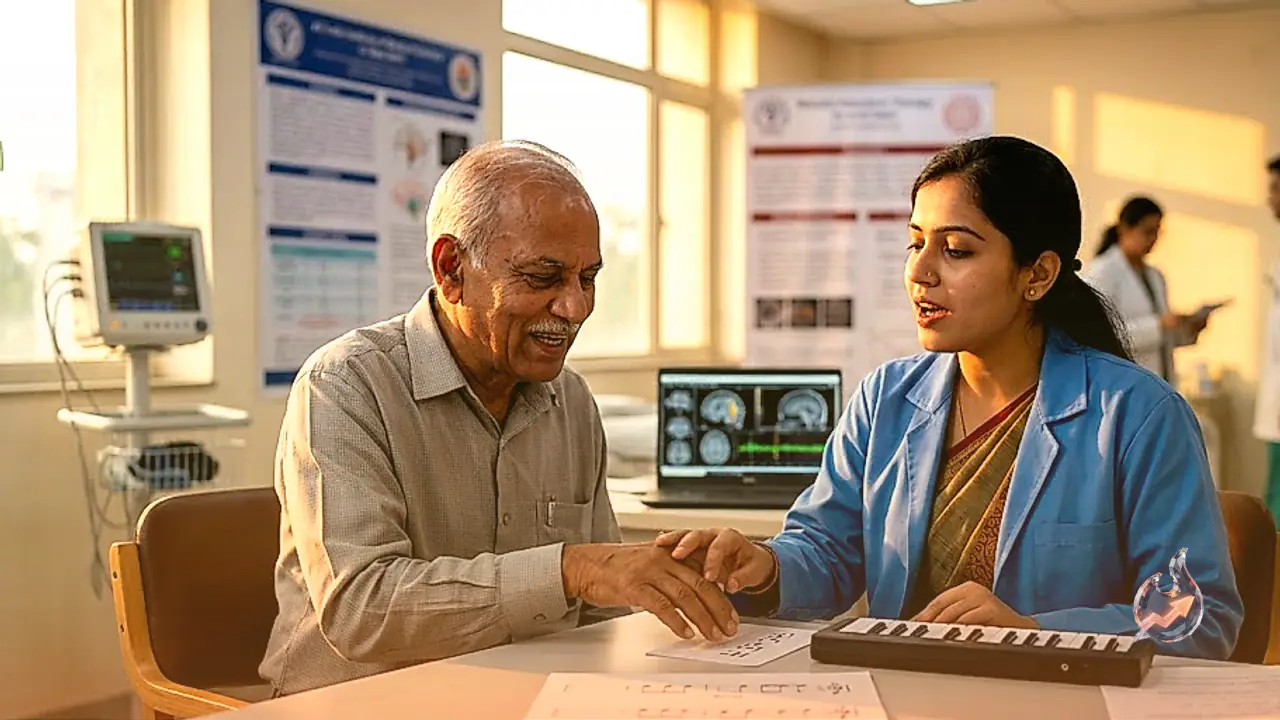
The research team leveraged a unique neurological observation: stroke patients who struggle to speak conversational sentences can often hum familiar old songs with relative ease. Capitalizing on this phenomenon, experts from IIT Delhi, AIIMS, and IHBAS linked speech retraining directly to musical pitch and rhythm. Rather than performing a literal translation of Western English protocols, the scientists conducted an in-depth analysis of how Hindi is naturally spoken, focusing on its stress patterns, vocal rhythms, and phonetic transitions. During session exercises, a therapist sits opposite the patient and sings phrases in a structured rhythmic melody. The mirror neurons within the patient's brain observe and listen, prompting the patient to imitate the therapist's vocal cues.
The Neuroscience of Neuroplasticity and Brain Remapping
The therapeutic mechanism relies fundamentally on the principle of neuroplasticity. In most individuals, language processing resides predominantly in the left hemisphere of the brain. When a stroke damages left-hemisphere neural networks, conversational speech is severely compromised. However, the right hemisphere typically remains intact and functional following a stroke. Because the right brain is responsible for processing music, pitch, rhythm, and melody, the therapy utilizes melodic singing to engage this uninjured hemisphere. Initial phases bind target words to musical tunes, causing the right brain to activate and send signals to the vocal cords. Over successive sessions, the musical melody is systematically faded out while retaining natural sentence rhythm. Eventually, language control shifts to newly formed neural connections in the right hemisphere, enabling patients to speak in normal conversational tones without singing.
Clinical Trial Results and Expansion via Mobile Technology
The efficacy of this Hindi-adapted therapy was evaluated in an initial clinical trial involving 6 Hindi-speaking stroke survivors. Participants underwent 40 structured sessions, with each session lasting between 45 and 60 minutes. Following the completion of the therapy regimen, all 6 patients demonstrated significant and positive improvements in their verbal communication. Patients progressed from fragmented speech to forming longer, coherent sentences and conversing comfortably in daily interactions. Crucially, the intervention produced zero adverse side effects. Published in the international peer-reviewed journal Aphasiology, these encouraging findings have prompted the research team to begin developing digital tools and mobile applications. These upcoming digital platforms aim to extend the benefits of melodic therapy to patients residing in remote areas, allowing them to undergo rehabilitation from the comfort of their homes.