





















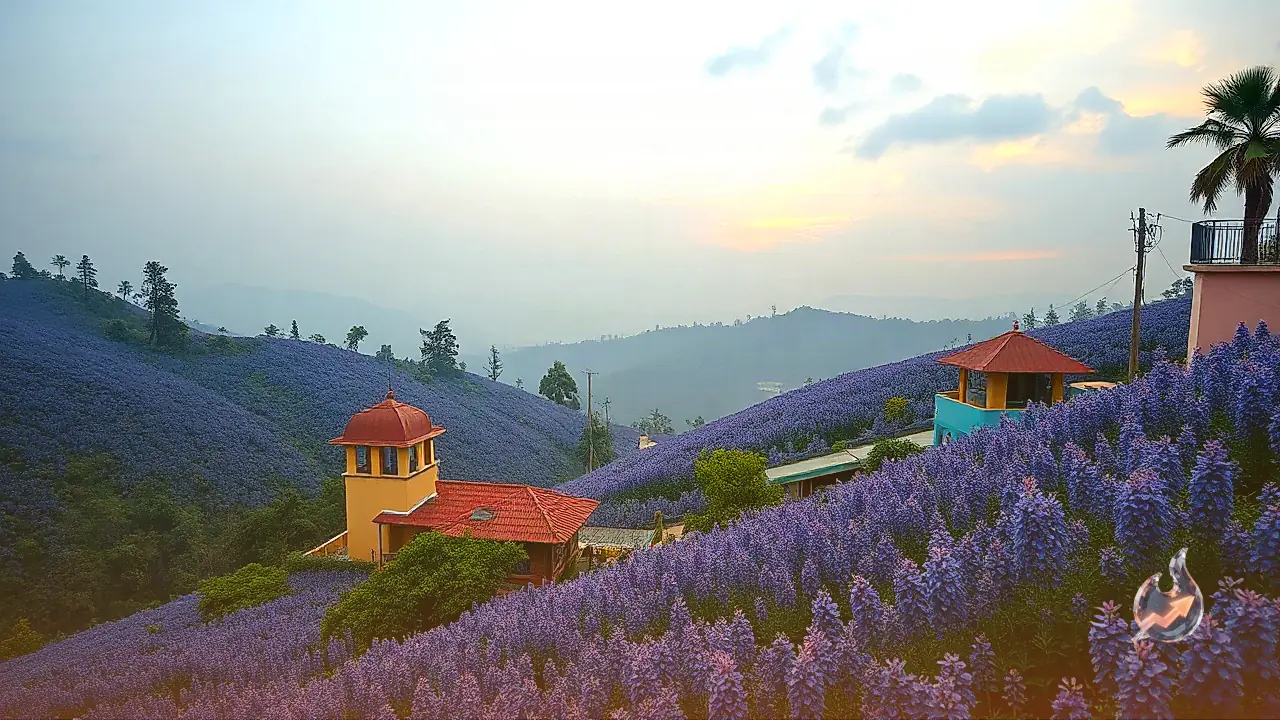

Travel enthusiasts and nature lovers who enjoy exploring mountain landscapes and valley views have a major reason to celebrate as a rare natural phenomenon unfolds. The hills of Munnar in Kerala are currently adorned with the stunning bloom of Neelakurinji flowers after a long wait of twelve years. The western mountain region is painted in vibrant shades of blue and purple. Because these blossoms appear only once in a dozen years, the sight is considered exceptionally rare, prompting heavy tourist footfall. Understanding why this happens requires looking closely at the unique life cycle of the plant.
What Does Neelakurinji Mean
The name of the flower itself describes its appearance accurately. Neela translates to blue, while Kurinji refers to a flower. This naming fits the blue-violet blossoms perfectly. When the bloom occurs, entire mountain slopes are drenched in blue hues. For years, the plant remains unnoticed without any distinct features, only to burst into vibrant flowers suddenly when the cycle matures.
Why Do They Bloom Every 12 Years
The twelve-year flowering cycle is driven by the natural life cycle of the plant, known as a pleiocyclic or mass-flowering pattern. During this process, the plants spend many years growing quietly before producing a massive quantity of flowers and seeds simultaneously in the twelfth year. Once the blooming phase ends, the plants wither and drop seeds that remain dormant in the soil until the next cycle begins. Glimpses of this phenomenon have been shared widely on platforms like social media by visitors.
Slopes Covered in Blue and Purple
When the Neelakurinji flowers bloom on a massive scale, the hillsides resemble a thick blue-violet carpet. The vista of these flowers spreading across distant mountain ranges is breathtaking. It is widely believed that the Nilgiri Hills derived their name from this very natural spectacle, as Nilgiri translates directly to blue mountains.
Where Do These Flowers Grow
Neelakurinji typically grows at altitudes ranging from 1,300 to 2,400 meters and is found in select parts of Kerala, Tamil Nadu, and Karnataka. Munnar, located in the Idukki district of Kerala, is among the most famous destinations to witness this blooming event. During the season, Eravikulam National Park, Mattupetty, and surrounding hills present a stunning blue-violet visual. These flowers generally bloom between the months of September and October.