




















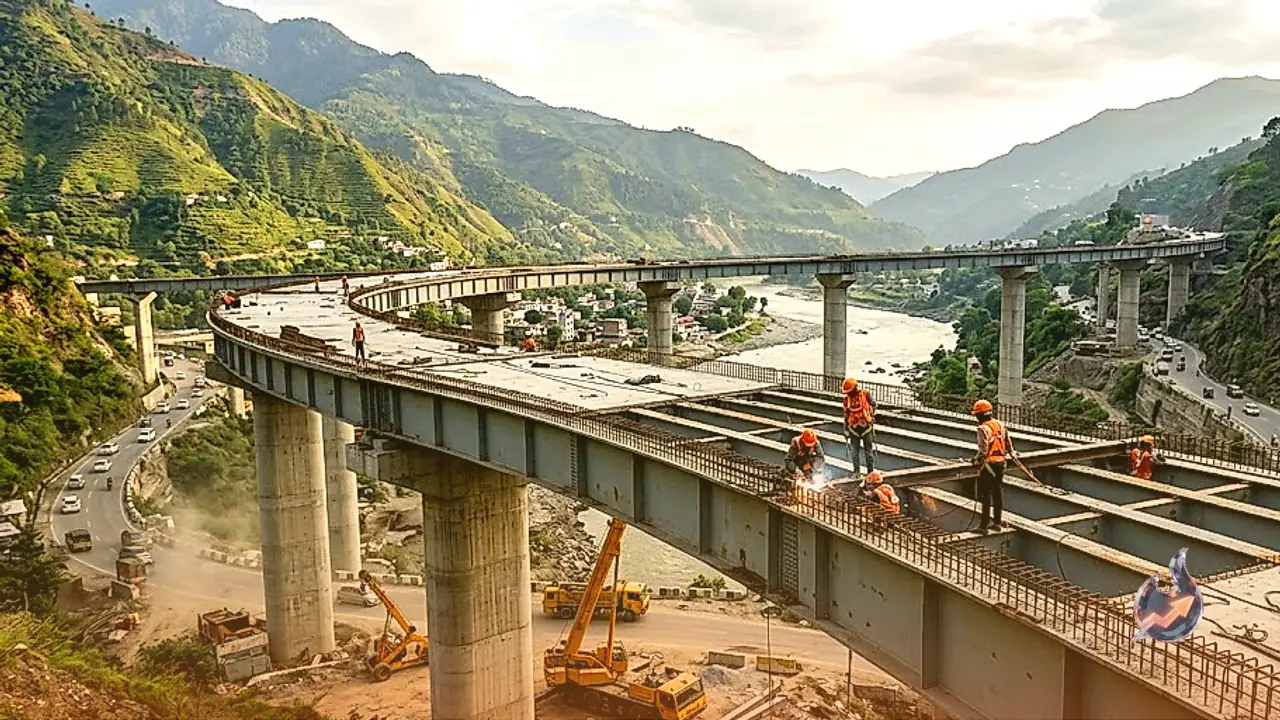

A landmark infrastructure upgrade is underway in the Mandi district of Himachal Pradesh to transform connectivity across mountain corridors. Located at Bindravani, North India's very first overhead elevated rotary is currently under construction to seamlessly link the Chandigarh-Manali National Highway with the Pathankot-Mandi National Highway. Designed specifically to overcome complex Himalayan terrain, this engineering structure will allow vehicles to navigate the busy junction continuously without experiencing traditional traffic delays.
Signal-Free Junction Designed for Continuous Movement
Standard roadway intersections connecting multiple major highways typically rely on traffic light systems, forcing vehicles to come to a stop and often creating severe congestion along narrow mountain passes. The overhead elevated rotary being developed in Mandi eliminates the need for signals altogether. By providing dedicated elevated lanes, the junction ensures that drivers traveling between Chandigarh, Manali, Pathankot, and Mandi can maintain uninterrupted movement, significantly improving highway safety and reducing overall travel times.
Five Ramp Connections to Handle Highway and City Traffic
Detailing the structural design of the project, National Highways Authority of India (NHAI) Project Director Varun Chari stated that the elevated rotary will feature five distinct access ramps. Two ramps are designated specifically for vehicles entering and exiting the Chandigarh-Manali route, while another two ramps will serve traffic along the Pathankot-Mandi corridor. Additionally, a fifth dedicated ramp is being constructed to allow smooth entry directly into Mandi city, preventing local arterial roads from getting choked by transit traffic.
Engineering Challenge Solved by Elevated Architecture
Explaining the technical reasons behind choosing an elevated design, Vikas Nagar, General Manager of construction firm Gawar Construction Limited, noted that connecting the two national highways presented significant engineering hurdles. The Pathankot-Mandi highway and the Chandigarh-Manali route sit at vastly different elevations, with one road positioned significantly higher than the other. Due to this steep altitude variation, a conventional flat intersection was impossible to construct. NHAI subsequently approved the overhead elevated rotary concept to bridge the vertical gap safely and effectively.
Construction Progress Passes 50 Percent Ahead of March 2027 Deadline
Work on the overhead elevated rotary officially commenced in April 2025 as part of the broader Pathankot-Mandi National Highway project. According to Vikas Nagar, construction teams have already completed over 50 percent of the total work, keeping the project firmly on track to meet its final completion target of March 2027. Although the ongoing heavy construction work currently creates temporary travel disruptions for local commuters and long-distance travelers, the completed facility will deliver permanent traffic relief and long-term economic benefits for the entire region.