

















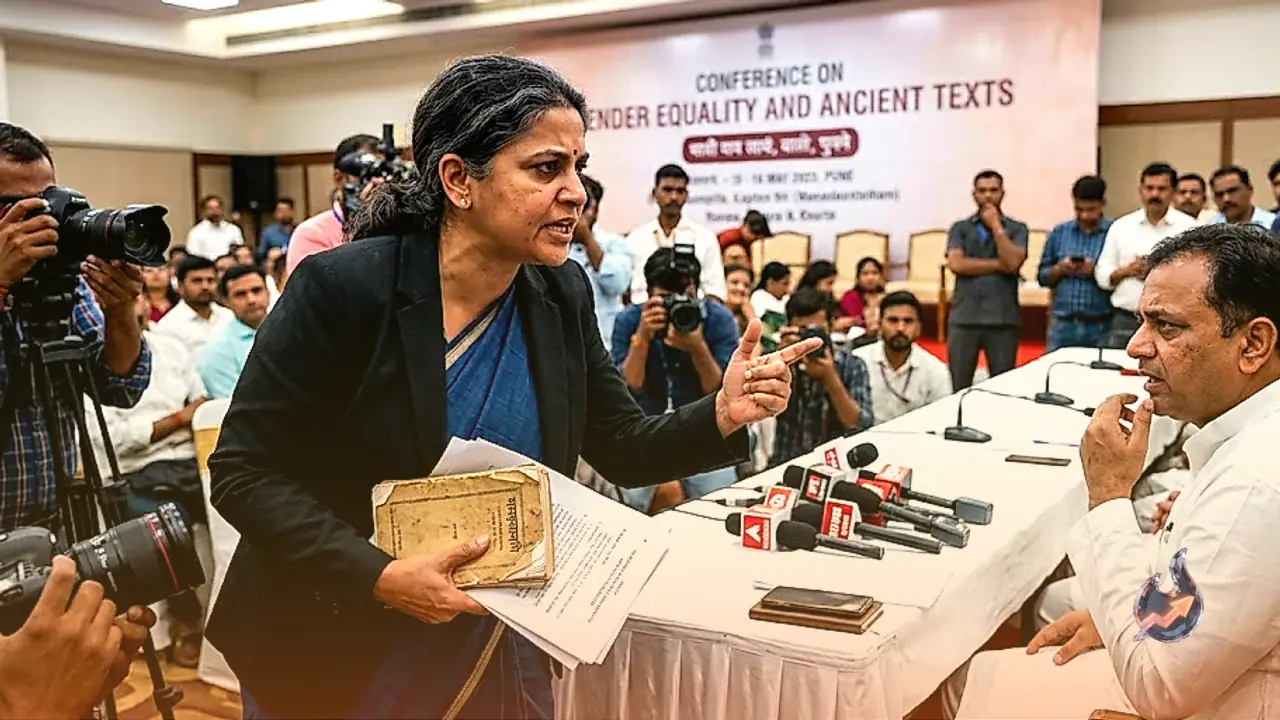

A fresh ideological and political confrontation broke out across the country following a public address by Rahul Gandhi in Pune on August 22. During the event, Rahul Gandhi cited a specific verse from the ancient text Manusmriti, which prescribes that a female must stay under the authority of her father during childhood, her husband in youth, and her sons after her husband's demise, and that she should never seek self-reliance or independence. Categorizing this injunction as deeply disgraceful, Rahul Gandhi stated that a woman's true identity is not derived from her male relatives but belongs entirely to herself. The statement immediately stirred up a major national debate, drawing sharp responses from opposing political camps.
Political Backlash and Accusations
Following the statement, leaders from the ruling party launched a severe counterattack. Assam Chief Minister Himanta Biswa Sarma criticized the remarks, stating, "Under the pretext of advocating women's rights, he is looking for an excuse to defame Hinduism." Simultaneously, Union Minister Kiren Rijiju raised questions regarding the consistency of the Congress party's stance on religious traditions. Kiren Rijiju asked, "Why does the Congress target Hindu traditions alone?" He further questioned why the opposition remains silent on the status, legal rights, and social conditions of women within minority communities. This exchange quickly shifted the focus from an ancient text to active national politics.
Origins of Manusmriti and the Role of British Colonial Rule
Manusmriti, also known as the Manu Samhita or Manava Dharmashastra, is recognized as one of the oldest texts within Hindu tradition. Historical research indicates that it emerged roughly 1,800 years ago during a period when Vedic Hinduism was transitioning into temple-focused Puranic Hinduism. Historian Narhar Kurundkar writes in his book Manusmriti: Contemporary Thoughts that the title itself combines two words, Manu referring to the author and Smriti indicating remembered religious tradition. Kurundkar notes that the initial drafting of the work began two to three centuries prior to the Christian era.
Additionally, historian and cultural scholar Patrick Olivelle observes in The Manu Code of Law: A Critical Edition and Translation of the Manava Dharmashastra that the symmetrical structure of Manusmriti suggests it was composed by an exceptional scholar or compiled by a central editor. The widespread legal authority attached to the text in modern times is largely attributed to British colonial administration. Professor Rajiv Lochan of Panjab University explains that when British rulers assumed administrative control in India, they presumed that just as Islamic law relied on Sharia, Hindu legal matters required a standardized textual reference like Manusmriti. Consequently, British courts began deciding Hindu civil and property disputes based on Manusmriti translations, cementing the public belief that it served as the definitive code of law for all Hindus.
Structural Composition and Controversial Injunctions
In terms of structure, Manusmriti consists of 12 distinct chapters containing between 2,684 and 2,964 verses depending on the manuscript tradition. The text covers code of conduct, governance, economics, and religious obligations. Scholars Wendy Doniger and Brian Smith note in The Laws of Manu that the core theme revolves around the ideal organization of society and daily conduct according to dharma. They emphasize that the authors positioned Brahmins at the pinnacle of human societal hierarchy, while assigning Shudras at the base the singular duty of serving higher castes, alongside embedding clear gender-based restrictions.
The primary point of ongoing controversy involves verses addressing gender roles and caste hierarchies. According to the translation by Patrick Olivelle and Suman Olivelle in Manu's Code of Law, key contentious passages include
- Chapter 1, Verse 31: Details the creation of the cosmos, stating that Brahmins emerged from Brahma's mouth, Kshatriyas from his arms, Vaishyas from his thighs, and Shudras from his feet.
- Chapter 5, Verse 148 & Chapter 9, Verse 3: Mandates that a woman must remain subordinate to her father in childhood, her husband in youth, and her sons upon her husband's death, prohibiting independent living.
- Chapter 5, Verse 151: Directs a woman to serve the husband chosen by her family throughout his lifetime and maintain lifelong celibacy following his death.
- Chapter 8, Verse 21: Asserts that if a Shudra interprets law for a ruler, the kingdom sinks helplessly like a cow trapped in mud.
- Chapter 8, Verse 129: Advises that even a capable Shudra should refrain from acquiring wealth, alleging that wealthy Shudras cause distress to Brahmins.
- Chapter 8, Verse 371: Prescribes public execution by dogs for any woman found guilty of disrespecting or deceiving her husband.
- Chapter 9, Verse 335: Defines the ultimate obligation of a Shudra as serving learned, householder Brahmins who possess Vedic knowledge.
Ambedkar's 1927 Protest and Modern Critiques
Public condemnation of these passages has a long history in modern India. A prominent historical protest took place on December 25, 1927, when Dr. Bhimrao Ambedkar publicly burned copies of Manusmriti at Kolaba (now Raigad district) in Maharashtra. Ambedkar's action faced strong resistance from orthodox groups at the time, who characterized it as a direct attack on faith. That event established a precedent for contemporary debates surrounding scriptural critique and social reform.
Three Main Perspectives Against Universal Application
Scholars and social commentators present three major arguments against treating Manusmriti as a binding religious authority
1. Distinction from Core Scriptures: Dr. Lenin Raghuvanshi, convener of the Human Rights Monitoring Committee, points out that Manusmriti does not hold the canonical status of the Vedas or Upanishads, and many of its principles conflict with Vedic philosophy. Author R. Jagannathan notes that present-day practitioners should not be held accountable for historical texts created for specific social conditions of their era.
2. Non-Binding Nature of the Text: Mythologist Devdutt Pattanaik explains that the text reflects personal reflections attributed to Manu rather than a mandatory legal code comparable to Islamic Sharia or Catholic canon law.
3. Universal Historical Patriarchy: R. Jagannathan highlights that historical texts across various ancient civilizations were compiled by men and reflected contemporary biases, suggesting that critiques of scriptural patriarchy should logically encompass multiple traditions rather than focusing solely on one.
Defense by Traditionalists and National Leaders
Conversely, defenders of the text offer different interpretations. Narhar Kurundkar notes that traditionalists view the text as part of the Prajapati Manu-Bhrigu lineage tracing back to creation, asserting its alignment with Vedic thought. Spiritual leaders including Adi Shankaracharya historically cited Smritis in accordance with the Vedas. Modern proponents argue that excluding specific contentious clauses leaves a text focused on social order and moral duties.
Writer Sanjeev Sablok points out that Arya Samaj founder Dayanand Saraswati supported elements of the text while setting aside problematic passages. Historical political figures such as Vinayak Damodar Savarkar and Golwalkar also held the work in high regard. Savarkar described it as the most revered text after the Vedas, remarking that "It is the foundation of the nation's spiritual and divine journey." Golwalkar viewed Manu as "the first, greatest, and wisest lawgiver of humankind." These opposing views ensure that Manusmriti remains a focal point of ongoing cultural and political discourse in India.