





















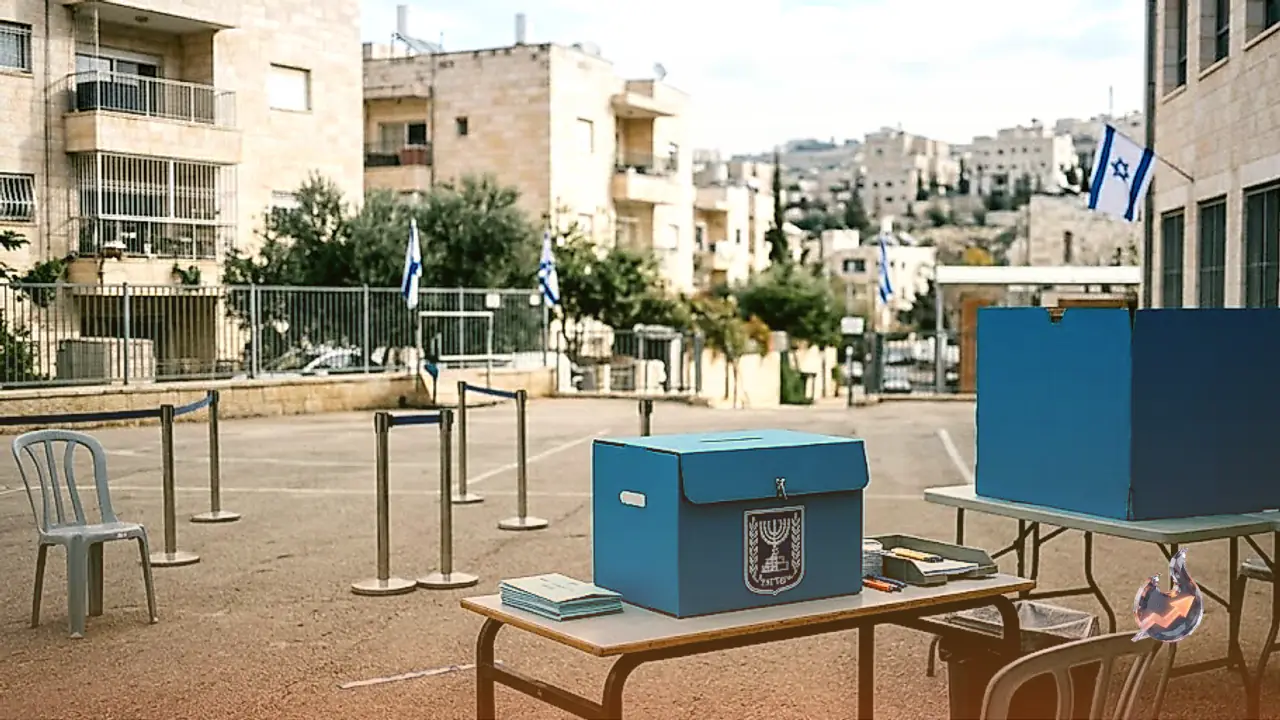

Israel entered a momentous political crossroads on 27 October as citizens headed to the polls to decide whether Prime Minister Benjamin Netanyahu will extend his nearly 19-year grip on power or yield to a new administration. His recent tenure has been dominated by multi-front warfare across Iran, Gaza and Lebanon over the past three years. The regional conflict erupted in the wake of the 7 October 2023 assault launched by Hamas, which resulted in the deaths of more than 1,200 people. Despite Israel maintaining one of the world's most formidable armed forces and extensive intelligence infrastructures, the cross-border operation went entirely undetected, triggering severe scrutiny over Netanyahu's governance. Grieving families of the victims have consistently demanded a formal inquiry, elevating institutional accountability to the forefront of the national ballot.
Subdued Street Campaigns and a Digital Battleground
In sharp contrast to vibrant election campaigns seen in nations such as India, the contest across Israel is playing out predominantly across social media platforms rather than public squares. On the ground, visible campaigning remains remarkably scarce, with public spaces largely devoid of political banners, placards or massive public gatherings. In the central city of Petah Tikva, situated near Tel Aviv with a population of 272,000, Netanyahu's Likud party secured 28% of the ballots during the 2022 general election. Even with polling day immediately at hand, the city's thoroughfares showed virtually no promotional material.
Local merchants in Petah Tikva noted that campaign activity has been noticeably quieter compared to previous cycles, while residents appeared hesitant to openly discuss their party allegiances. For resident Shelley Bolkovich, household expenditures and national defence form the core of her electoral priorities. She observed that standard groceries and daily public transit fares have climbed significantly, placing heavy pressure on domestic finances. Consequently, she is seeking a political leadership that presents a coherent strategy to revitalise economic stability, alleviate personal financial strain, and effectively confront external security pressures from adversaries like Iran.
Aspirations for International Ties and Strategic Realignment
Longtime residents are assessing the vote through varied lenses of diplomacy and domestic renewal. Shelley Abraham, who has lived in Israel for 25 years, stated her desire for the forthcoming administration to cultivate stronger diplomatic and trade connections with India. Noting that many Indian nationals travel to Israel for employment opportunities, she expressed hope that bilateral cooperation will continue to expand, while choosing not to endorse any specific domestic faction.
Taking a different perspective, Lauren Dagan Amos acknowledged the achievements of Netanyahu's past service but insisted that the country requires a change in course. She maintained that the electorate needs a government capable of delivering renewed hope, articulating an unambiguous roadmap for the future, and repairing working relationships with neighbouring countries and international partners worldwide.
The Math of 61 Seats and Arab Parties as Kingmakers
The legislative contest revolves around three primary political blocs: Netanyahu's right-wing and religious coalition, the broad opposition alliance, and the independent Arab parties. Pre-election surveys forecast an extraordinarily tight race, with neither major camp expected to independently reach the critical threshold of 61 seats required to command a majority in the parliament. Under these tight margins, smaller factions and Arab political organizations are positioned to wield decisive leverage over who forms the next cabinet.
A survey conducted by Channel 13 ahead of the vote assigned 54 projected seats to the anti-Netanyahu coalition, 50 seats to Netanyahu and his partners, and 16 seats across Arab parties. Although these projections do not constitute final outcomes, they illustrate how non-aligned blocs could act as ultimate kingmakers. Arab citizens constitute roughly 18% of Israel's total population, meaning their legislative influence hinges directly on voter turnout and internal political cohesion. The United Arab List, known as Ra'am and led by Mansour Abbas, has previously demonstrated this dynamic by supplying outside legislative support to an anti-Netanyahu governing coalition. Furthermore, Israel's electoral framework mandates that any running list must capture at least 3.25% of the total vote to cross the electoral threshold and enter parliament. Formations that fall below this minimum mark fail to win representation entirely, a factor that could drastically shift the final distribution of seats.
The Legacy of 7 October and Conscription Tensions
Senior journalist Harinder Mishra, a long-term resident of Israel, explained that the lingering memories of the conflict have deeply split the electorate. While Netanyahu's core loyalists underline his decisive leadership during hostilities, political critics persistently ask why national security apparatuses collapsed during the initial Hamas assault, ensuring that wartime sentiment does not sway all voters in an identical direction. Mishra added that Netanyahu faces the twin challenge of repelling the opposition while preventing his delicate alliance of right-wing and religious partners from fracturing.
A critical point of friction within the coalition is the contentious issue of military conscription. Mandatory service applies to the vast majority of Israeli citizens from age 18. However, ultra-Orthodox religious students, representing roughly 10% of the country's population, have historically benefited from blanket exemptions, a privilege that has drawn widespread civic resentment. In the aftermath of prolonged fighting against Hamas, public demands for equitable military burden-sharing have intensified dramatically. This dispute is particularly precarious for Netanyahu, whose governing longevity depends heavily on ultra-Orthodox parties like United Torah Judaism and Shas.
Opposition Ambitions and the Rise of Gadi Eisenkot
Leading the charge against the incumbent prime minister is opposition figure Gadi Eisenkot, a former army chief of staff viewed as a serious contender for the premiership. Following a 41-year military career, Eisenkot established his own political party one year ago. His personal life was touched directly by the regional warfare when his son was killed in combat just two months after operations in Gaza commenced. Originating from the Mizrahi Jewish community, Eisenkot advocates strongly for standardized, shared civic obligations across Israeli society.
Harinder Mishra highlighted that Eisenkot's personal reputation could prove decisive among undecided voters, given his extensive defence background and unambiguous stance on universal military enlistment. However, Mishra pointed out that the opposition's path to victory involves two distinct hurdles: it must first persuade citizens dissatisfied with Netanyahu's tenure to cast their votes for the bloc, and subsequently assemble an array of disparate parties into a functioning coalition. Pure public resentment against Netanyahu, he warned, will not automatically yield a stable parliamentary majority.