



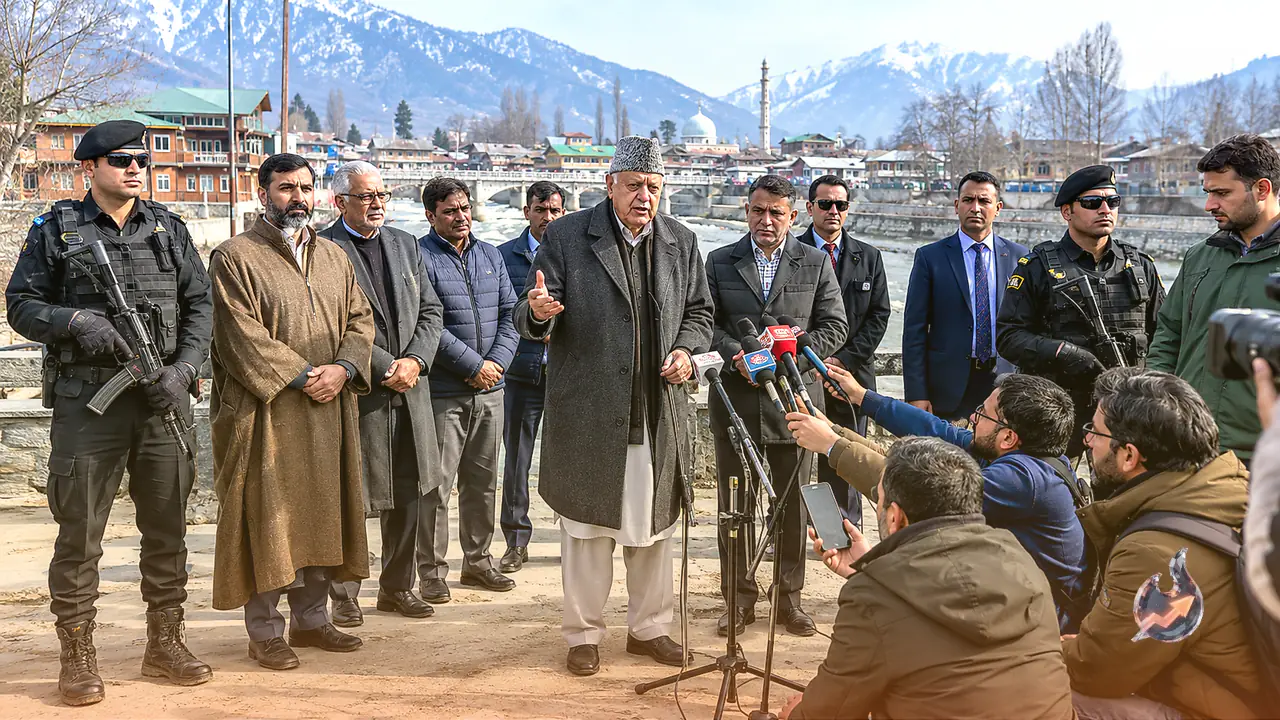
















A sharp political debate has erupted across Jammu and Kashmir following remarks by National Conference president Farooq Abdullah concerning the role of neighbouring Pakistan in regional security. Addressing a gathering of party workers in the historic town of Baramulla, Abdullah credited Pakistan's persistent efforts on international forums with providing a protective shield for Kashmiris. Given Baramulla's turbulent past, marked by invasions, civilian suffering, and prolonged militant violence, the remark has drawn intense scrutiny and renewed attention to the historical record of cross-border involvement in the region.
Farooq Abdullah's Address and the Political Fallout
The controversy originated during a National Conference workers' convention convened in Baramulla on 24 October 2026. Speaking before party cadres, Farooq Abdullah argued that sustained diplomatic agitation by the neighbouring country keeps external scrutiny alive. Elaborating on this theme, Abdullah stated that silence prevails among adversaries primarily because the neighbouring nation constantly agitates the issue globally, asserting that Kashmir remains an unresolved dispute, and suggesting that this posture is what would ultimately preserve Kashmiris. The statement sought to frame diplomatic lobbying from across the border as an asset for local security, yet critics quickly pointed out that the actual lived experience of Baramulla stands in stark contradiction to any notion of protection emanating from that quarter.
The Traumatic October 1947 Invasion of Baramulla
Evaluating the historical context of cross-border involvement requires examining the events of October 1947, immediately following the partition of the subcontinent. Armed tribal raiders, predominantly composed of Pashtun fighters from the North-West Frontier Province, an area that became part of Pakistan and is currently known as Khyber Pakhtunkhwa, swept into Jammu and Kashmir. Moving rapidly along the Jhelum valley road, they entered Baramulla and unleashed widespread devastation. Archival records and survivor testimonies confirm that the raiders ransacked residential neighbourhoods, pillaged local commercial markets, executed defenceless inhabitants, and subjected numerous local women to abduction.
The Carnage at St Joseph's Hospital and Convent
One of the darkest episodes of that campaign took place on 27 October 1947, when tribal fighters attacked the St Joseph's Hospital and Catholic mission convent in Baramulla. Documentation compiled by historian and author Andrew Whitehead shows that six individuals were murdered inside the mission compound. The victims included Sister Teresalina, a Spanish nun, Tom Dykes, a British national, and his wife Biddy Dykes, a healthcare nurse named Philomena, Jose Barretto, and Motia Devi Kapoor, a patient recuperating at the medical facility. The attackers plundered sacred property, tore through the dispensary, and held priests, nuns, medical staff, and terrified townspeople hostage. Father George Shanks documented these atrocities in his personal diary, capturing the panic and lawlessness that engulfed the civilian population during those fateful days.
Looting Delay and the Instrument of Accession
The raiders' fixation on pillaging Baramulla inadvertently altered the geopolitical destiny of the entire subcontinent. Rather than pressing forward swiftly toward Srinagar, groups of fighters paused to divide stolen property and ransack residences. This hesitation afforded crucial time to the regional administration and the central leadership in New Delhi. On 26 October 1947, Maharaja Hari Singh executed the Instrument of Accession, integrating the princely state of Jammu and Kashmir into the Union of India. By the morning of 27 October, Indian Army infantry units were airlifted directly into Srinagar airfield, establishing defensive perimeters and pushing back the advancing incursions. Indian military forces methodically reclaimed Baramulla by November. While Pakistan officially maintained that the tribal assault was a spontaneous uprising, independent historical research has extensively corroborated logistical, operational, and military support sanctioned by elements within Pakistan's political and military command.
Cross-Border Evidence and Terrorist Attacks
Baramulla's encounter with violence did not conclude in 1947. In contemporary times, the district has repeatedly borne the brunt of cross-border militancy. On 18 September 2016, four heavily armed militants infiltrated and ambushed the Indian Army's 12 Infantry Brigade headquarters located in Uri, within Baramulla district. The dawn attack resulted in the deaths of 17 Indian soldiers, according to detailed court filings by the National Investigation Agency. Forensic investigators recovered handheld GPS equipment, sophisticated rifles, ammunition, and rations marked with packaging from Pakistani manufacturers. Technical analysis of the stored waypoints inside the GPS units demonstrated that the infiltration route originated from an operational staging base across the border. Pakistan-based militant formation Lashkar-e-Taiba claimed responsibility for the assault. The United States government maintains formal designations against both Lashkar-e-Taiba and Jaish-e-Mohammed as foreign terrorist organisations rooted in Pakistan.
The Pahalgam Investigation and Ongoing Security Challenges
The pattern of cross-border facilitation emerged again following the devastating attack in Pahalgam in April 2025, which claimed the lives of 26 people. By December 2025, the National Investigation Agency submitted a comprehensive chargesheet implicating Lashkar-e-Taiba, its front organisation The Resistance Front, and several logistical collaborators. The prosecutorial documents detailed how tactical planning, funding transfers, and tactical commands originated from handlers stationed in Pakistan. Intercepted digital messaging, recovered satellite navigational records, forensic ballistics, and witness statements provided substantial evidentiary backing linking regional bloodshed directly to external networks. These formal judicial submissions stand alongside earlier academic surveys, including a comprehensive 2009 to 2010 public opinion study by Chatham House, which explored the nuanced and evolving perspectives held by Baramulla residents regarding regional administration.
The Devastating Human Toll on Baramulla's Families
Beyond military engagements and casualty rosters lies an enduring human catastrophe that has fundamentally reshaped social life in Baramulla. According to a landmark survey titled Dead But Not Forgotten, conducted by the Jammu Kashmir Coalition of Civil Society covering the years between 1989 and 2006, 3,634 individuals aged between 18 and 35 were killed in Baramulla district alone during that period. Each statistic represents fractured families and shattered domestic livelihoods. In Zogiyar village, Atiqa Begum was left completely destitute, tasked with raising four young children after her husband went missing in February 1990. She joined the ranks of the valley's half-widows, women whose missing spouses leave them trapped in enduring legal limbo, unable to inherit property easily or attain emotional closure.
Artillery Shelling, Disrupted Education, and Psychological Scars
Life along the Line of Control remains precarious for ordinary villagers. In June 2025, intense cross-border mortar and artillery shelling targeting the Uri sector forced local schools to shut down, throwing children's educational routines into disarray. A 12-year-old local student recounted hearing continuous shelling explosions during recurring nightmares, capturing the deep trauma inflicted upon the youngest residents. Medical research into conflict-affected populations across Baramulla and Pulwama districts has consistently revealed elevated levels of chronic depression, severe anxiety, and post-traumatic stress disorders. Decades of unprovoked violence, cross-border incursions, and continuous insecurity reveal that the community has paid a staggering human price, challenging any narrative that portrays external interference as a protective force.