























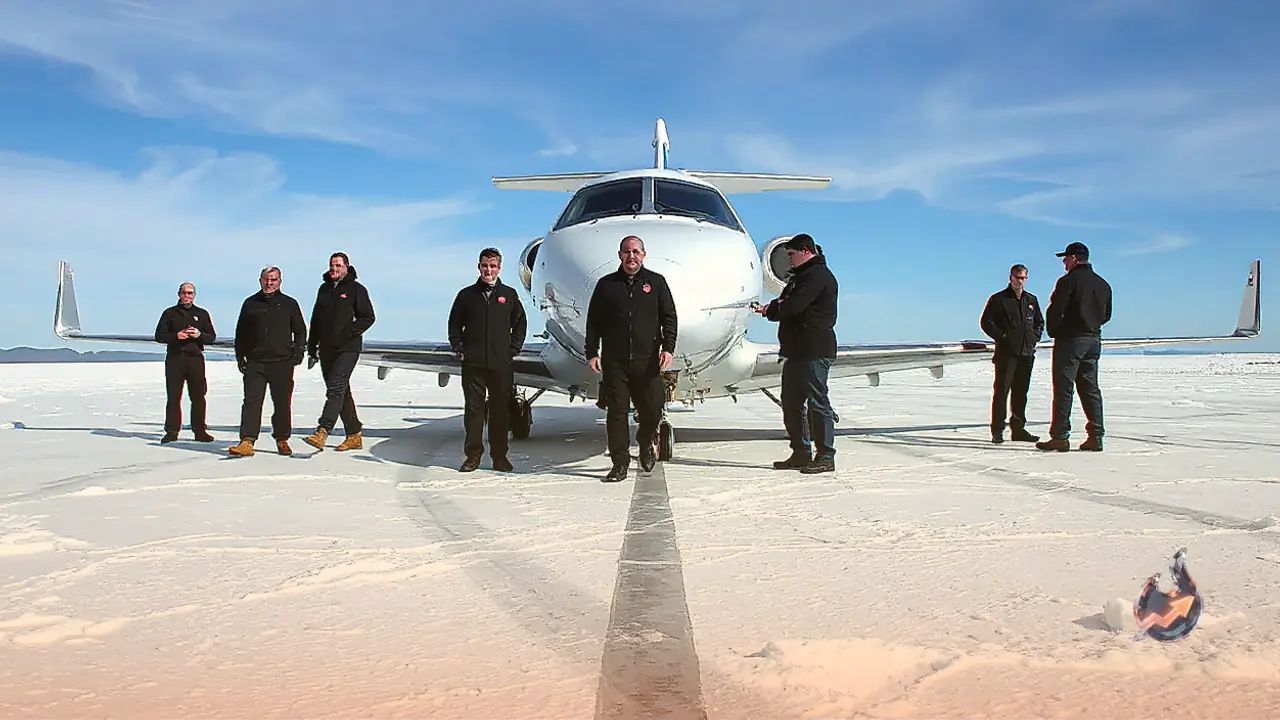

A private business jet plummeted vertically from the sky on the afternoon of 1 November in Florida, striking the ground with catastrophic force and exploding into flames. The aircraft reached such extreme speeds during its uncontrolled dive that structural components began breaking apart in mid-air prior to impact. Both flight crew members and all seven passengers, including two young children, were killed. Transmissions between the cockpit and air traffic controllers captured the final moments of panic as co-pilot Natalia warned that the aircraft was in an irreversible dive and running out of time.
The Flight Route from Texas to the Bahamas
The Learjet 60 departed from Texas at approximately 10:37 a.m. local time on 1 November, operating on an itinerary to Freeport in the Bahamas. The direct flight path covered 2,079 km with an estimated flight time of roughly 3 hours and 20 minutes. At the controls were 55-year-old Captain Jeff Gregory and 20-year-old co-pilot Natalia. For the initial two hours of the journey, cruise operations proceeded normally without reported malfunctions.
Conditions deteriorated as the plane continued eastward. At 12:40 p.m., Natalia sent a text message to her pilot boyfriend stating that the flight was encountering turbulence and ice. Roughly seven minutes later, at 12:47 p.m., Natalia established radio contact with the Miami Air Route Traffic Control Centre. She reported that the jet was maintaining an altitude of 35,000 feet while fluctuating vertically by 600 to 700 feet due to atmospheric conditions. When controllers queried the outside air temperature, Natalia confirmed it was -47 degrees Celsius.
Atmospheric Icing and Altitude Requests
During the transmission, Natalia explained that the crew was managing airframe ice while navigating through moderate turbulence, maintaining a direct heading toward Freeport without deviating. The controller asked whether the crew required any assistance, to which Natalia replied asking if a smoother ride was available at a different flight level. In aviation terminology, a better ride signifies an altitude with less convective activity, reduced chop, and minimal icing hazards.
The Miami controller stated that conditions might improve deeper within the airspace ahead, though the jet was still some distance away. Natalia then reported visual ice accumulation on the wings of the Learjet and requested clearance to climb to 37,000 feet. The controller cleared the aircraft to climb while instructing the crew not to deviate further to the right. Seconds after receiving the clearance, the jet suffered a catastrophic upset and began dropping out of the sky.
A 30-Second Descent into Disaster
At approximately 12:49 p.m., Natalia placed an urgent MAYDAY call to Miami controllers in a distressed voice, stating that the aircraft was descending at 8,000 feet per minute. Moments later, she updated the descent rate to 10,000 feet per minute before officially declaring an emergency due to an overspeed condition. An overspeed state indicates that the aircraft has exceeded its maximum design velocity, rendering flight controls ineffective and placing immense stress on the airframe.
As the dive steepened, Natalia shouted over the radio that the jet was descending at 20,000 feet per minute. The air traffic controller instructed her to select any altitude necessary and advise of immediate requirements. Two seconds later, she warned that the jet was headed straight into the ground, to which the controller urged her to keep talking. Natalia then stated that the vertical speed had climbed to 22,000 feet per minute with the nose pitched downward at a 60-degree angle. Half of the cruise altitude had been lost in just 30 seconds. In the final audio transmissions, cries were heard inside the cockpit before she said that time had run out. By 12:50 p.m., the aircraft impacted a roadway nose-first and erupted in fire, leaving no survivors.
Missile-Like Descent Velocity and Structural Overload
A standard passenger jet descent during the approach phase rarely exceeds 2,000 feet per minute. By contrast, the 22,000 feet per minute descent rate reported by the co-pilot equates to a downward speed of approximately 402 km/h. Tracking figures from Flightradar24 recorded the aircraft's final captured position at approximately 8,750 feet, reflecting a vertical velocity of 32,000 feet per minute, or 585 km/h. By way of comparison, India's Nag anti-tank guided missile travels at roughly 800 km/h.
Miami aviation attorney Zachary Gorwitz noted that typical engine flameouts or mechanical power failures allow an aircraft to glide forward gradually rather than drop vertically. While forced landings occur near takeoff or approach, a sudden loss of control at an altitude of 35,000 feet is uncommon in civil aviation. Earlier in the year, on 28 January, a Learjet 45 carrying former Maharashtra Deputy Chief Minister Ajit Pawar also crashed during a landing attempt near Baramati Airport.
Gorwitz suggested that the primary catalyst for the Florida crash was severe icing rather than engine malfunction. At high altitudes with sub-zero moisture, ice can coat the horizontal stabilizer located at the empennage of the jet. The horizontal stabilizer provides essential pitch balance, keeping the nose level. If ice fouls the control surfaces or disrupts airflow sensors, the tail loses downforce, pitching the nose violently downward into an unrecoverable dive. While some initial assertions suggested the stabilizer separated from the fuselage in flight, aviation analyst Anant Sethi indicated that dashcam footage from a nearby vehicle showed the stabilizer intact on the airframe, pointing toward aerodynamic stall from iced surfaces rather than pre-impact detachment.
Recovery Challenges and Safety Investigations
Once a high-performance jet assumes a steep nose-down attitude, gravity rapidly accelerates the descent, leaving pilots with negligible time to pull out of the dive. When airspeeds exceed operational limits, aerodynamic pressure mounts against the tailplane and wing roots. This intense stress frequently tears away control surfaces and exterior panels, turning the aircraft into a projectile.
The National Transportation Safety Board confirmed that preliminary evidence indicates the airframe began coming apart prior to ground impact, a finding subject to ongoing wreckage reconstruction. Safety investigators are examining weather models, cloud water content, and temperature profiles along the flight path alongside physical debris. Additionally, the NTSB is reviewing the Learjet 60 design for any latent defects, although the airframe type maintains an established operational record without prior fatal dive incidents of this nature.
Profiles of the Victims
The charter carried Texas technology entrepreneur Adam Robinson, his wife Helen Sharp, and their two young children, four-year-old Emma and two-year-old Charlie. Robinson was the founder and chief executive officer of business platforms RB2B and Retention.com, having also developed Moltsets, a specialized dataset resource for artificial intelligence organizations. Earlier in his career, he worked with investment bank Lehman Brothers and financial institution Barclays. His partner, Helen Sharp, was a working artist.
In the cockpit, Captain Jeff Gregory, 55, was a veteran aviator holding an Airline Transport Pilot certificate, representing the highest commercial qualification awarded by aviation authorities in the United States. During the final moments recorded in the cockpit voice recorder, Gregory was heard reciting the Lord's Prayer as the jet descended.