
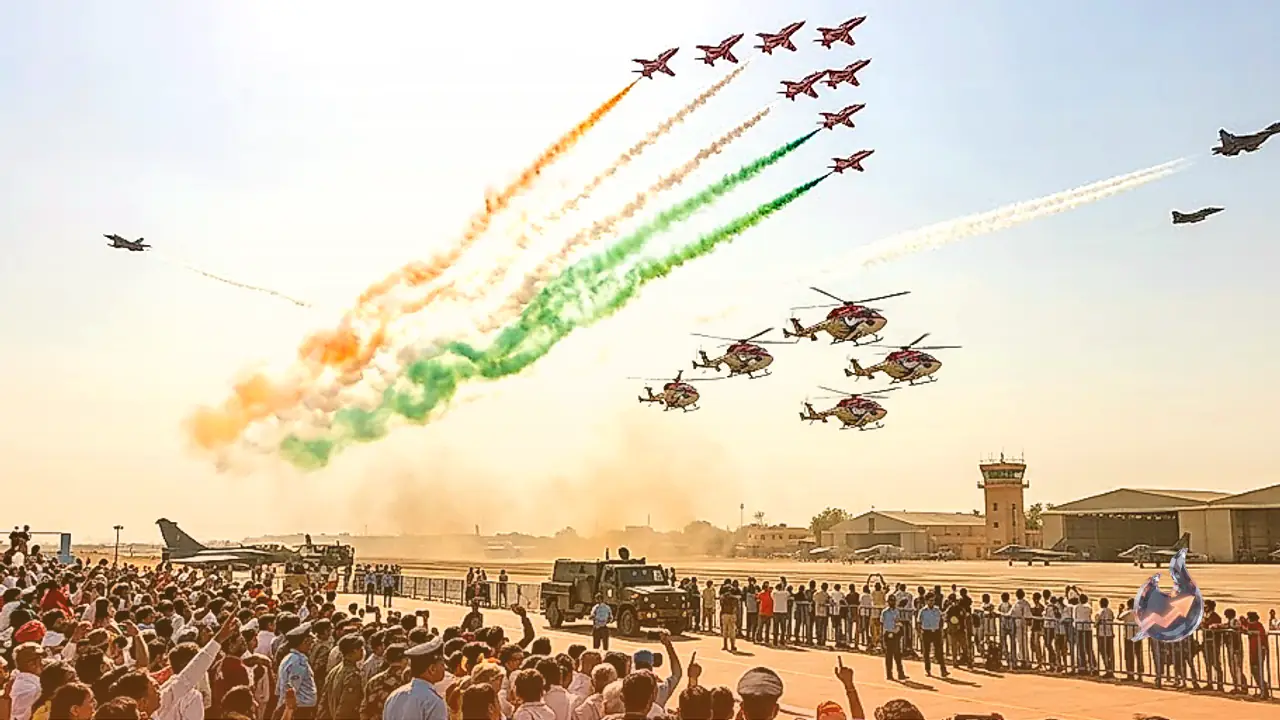
















Entering its 94th year of distinguished service, the Indian Air Force has repeatedly demonstrated that its operational reach, strategic boldness, and tactical precision extend well beyond national frontiers. Throughout its storied history, the air arm has been called upon to execute high-stakes missions across South Asia, turning the tide of conflicts, preserving regional democracy, providing crucial humanitarian lifelines, and establishing undisputed aerial superiority. From delivering precision strikes guided by civilian maps to staging rapid trans-oceanic interventions and flying untouched over adversarial capitals, these four defining overseas operations highlight the technical mastery and sheer daring of India's air warriors.
1. The 128-Rocket Precision Strike on Dhaka's Governor House in 1971
By 14 December 1971, the Indo-Pakistani war had reached its tenth day, with Indian ground formations closing in rapidly around Dhaka on the eastern front. Indian Army Chief General Sam Manekshaw had broadcast an open offer urging the Pakistani military leadership to lay down its arms, but no formal response had emerged from the command in the east.
Early that morning, a crucial communication was intercepted at the United Nations office inside Dhaka's InterContinental Hotel. Dr AM Malik, the Governor of East Pakistan, had placed a telephone call to UN representative John Kelly, summoning him to a high-level emergency Cabinet session scheduled for 12 noon at the official Governor House. Indian military intelligence intercepted the transmission, uncovering vital details: the meeting would be attended not only by the provincial cabinet, but also by the martial law administrator and the commanding air chief of East Pakistan. Strategic planners immediately recognized that shattering this leadership conclave would deal an irreparable psychological blow to the adversary's command structure, compelling an immediate cessation of hostilities.
Less than sixty minutes before the scheduled assembly, operational directives were flashed to Indian Air Force stations at Guwahati and Hashimara. The strike packages were tasked with arriving over Dhaka airspace precisely at 11:50 am to neutralise the meeting venue with surgical precision while preventing unnecessary casualties. However, in the frantic rush of pre-flight planning, the pilots were initially briefed with incorrect coordinates designating the Circuit House instead of the Governor House.
The strike force comprised four MiG-21 fighters from Guwahati's 28 Squadron, known as the 'First Supersonics', alongside two Hawker Hunter jets drawn from Hashimara's 37 Squadron, the 'Black Panthers'. Wing Commander BK Bishnoi commanded the Guwahati formation, while Wing Commander RV Singh headed the Hashimara detachment. As wingman Harish Masand later recounted, the aircrew carried no formal military target folders; instead, they tucked commercial tourist street maps of Dhaka, produced by the Burmah Shell Company, into their flight suit pockets.
Flight time to the target area was barely twenty minutes. By 11:26 am, the jets were lined up on the tarmac with engines spooling up. Just as Wing Commander Bishnoi was preparing to release the brakes, an airman sprinted across the concrete waving an urgent dispatch. The message conveyed the critical target revision: the executive gathering was taking place at the Governor House, not the Circuit House. With zero margin on the clock, the pilots had no opportunity to consult their tourist maps for the updated coordinates before launching into the sky.
Arriving over Dhaka at 11:55 am, the strike leaders quickly scanned the city layout. A line of official limousines parked outside a sprawling colonial-style administrative estate confirmed the exact venue of the ongoing conference. Identifying the building's prominent central dome, Wing Commander Bishnoi rolled into a steep dive, initiating the attack run. A salvo of 128 rockets was fired in rapid sequence directly into the structure, followed immediately by strafing runs from the trailing Hunters. Dense smoke and masonry dust enveloped the compound. While no lives were lost, the structural impact caused absolute pandemonium, sending Governor Malik, UN representative Kelly, and senior commanders scrambling for cover.
In his historical account 'India-Pakistan in War and Peace', JN Dixit, who served as India's first Deputy High Commissioner in Bangladesh, observed that the rocket salvo destroyed the conference chamber and split the meeting table in two, completely unhinging the resolve of the East Pakistani administration. Shaken to the core, Governor Malik immediately took a scrap of paper and drafted his formal resignation with trembling hands, marking the total collapse of civilian governance in East Pakistan. Malik and his ministers promptly evacuated to the InterContinental Hotel, seeking refuge under the UN flag.
Just forty-eight hours later, on 16 December 1971, Pakistani Lieutenant General AAK Niazi surrendered unconditionally along with 90,000 personnel before Indian Eastern Commander Lieutenant General Jagjit Singh Aurora. The historic surrender gave birth to the sovereign nation of Bangladesh. The bombed Governor House stands today as Bangabhaban, the official residence of the President of Bangladesh.
2. Operation Poomalai: Delivering Parachute Relief Over Besieged Jaffna
In 1987, northern Sri Lanka was engulfed in heavy fighting as the Liberation Tigers of Tamil Eelam (LTTE) waged an armed insurgency demanding an independent homeland. The strategic Jaffna Peninsula remained firmly under rebel control, prompting the Sri Lankan armed forces to launch 'Operation Liberation' to encircle the entire sector.
The resulting military cordon completely severed the supply of essentials, leaving hundreds of thousands of Tamil civilians without food, kerosene, or medical aid. Widespread public anger swept through India over the looming humanitarian catastrophe. While the government led by Prime Minister Rajiv Gandhi urged Colombo to halt military operations, the diplomatic pleas went unheeded.
On 2 June 1987, India resolved to dispatch direct relief. A flotilla of nineteen civilian fishing vessels, escorted by an Indian Coast Guard cutter and laden with 38 tonnes of food grains, fuel, and medical provisions, set sail toward Jaffna. However, the convoy was intercepted near Katchatheevu island by Sri Lankan naval gunboats. Following an intense four-hour standoff, the unarmed Indian vessels were forced to abort the mission and turn back.
Viewing the naval blockade as an unacceptable rebuff, New Delhi decided to deliver the aid directly from the air. Under the overall direction of Deputy Air Chief Marshal S Raghavendran, the Indian Air Force mounted 'Operation Poomalai' (translating to 'Garland of Flowers' in Tamil), also designated internally as 'Eagle Mission 4'.
The air armada was assembled by staging Mirage-2000H multirole fighters from Gwalior and five Antonov AN-32 transport aircraft from Agra at the airbase in Bengaluru. At 3:00 pm on 4 June, Sri Lankan High Commissioner Bernard Tilakaratna was summoned to the Ministry of External Affairs in New Delhi. He was formally notified that Indian transport aircraft would enter Sri Lankan airspace within the hour to execute an airdrop, with an explicit warning that any hostile interference would invite immediate retaliation from the escorting Mirage-2000H fighters.
The escorting Mirage-2000Hs were armed with Matra Magic II air-to-air missiles, 250 rounds of internal cannon ammunition, and three external drop tanks for extended loiter time. The five AN-32 transports carried roughly 25 tonnes of supplies, consisting of packaged rice, powdered milk, fresh vegetables, kerosene containers, and essential pharmaceuticals, with individual cargo parachutes rigged to every pallet.
At 3:55 pm, the transport formation took off from Bengaluru under the protective screen of the combat fighters. Group Captain BK Sundar commanded the AN-32 transport stream, while Wing Commander Ajit Bhavnani led the Mirage fighter element. To ensure global transparency, thirty-five domestic and international correspondents were accommodated aboard the lead transport aircraft.
At 4:47 pm, as the aircraft approached the island, Group Captain Sundar attempted radio contact with Colombo Air Traffic Control, receiving no response. By 5:00 pm, the formation was overhead the Jaffna sector. Descending from an initial cruising altitude of 12,000 feet to an operational drop height of 1,500 feet, the AN-32s released their entire cargo payload over a designated drop zone situated 7 kilometres outside Jaffna city. Having accomplished the delivery without a single shot fired, the aircraft turned back, touching down safely in Bengaluru at 6:13 pm.
While Colombo protested the mission as a breach of its territorial airspace, New Delhi maintained that the flight was an unavoidable humanitarian imperative. The decisive show of force altered the strategic calculation: Sri Lankan President JR Jayewardene agreed to open formal talks with Prime Minister Rajiv Gandhi, leading to a de-escalation of the Jaffna blockade. On 29 July 1987, the landmark Indo-Sri Lanka Accord was signed, paving the way for the induction of the Indian Peace Keeping Force. Tragically, this intervention provoked deep hostility from the LTTE, culminating in the assassination of Rajiv Gandhi on 21 May 1991.
3. Operation Cactus: A 16-Hour Blitz That Foiled a Coup in the Maldives
The Republic of Maldives spans an archipelago of roughly 1,200 coral atolls scattered across the central Indian Ocean. Its compact capital, Malé, occupies an island so small it can be traversed on foot within an hour. Crucially, the country's primary international airport is located on the adjacent island of Hulhulé, requiring water transport to access the seat of government.
In November 1988, a disgruntled Maldivian businessman named Abdullah Luthufi orchestrated a violent conspiracy to overthrow the democratically elected government of President Maumoon Abdul Gayoom. To execute the coup, Luthufi hired roughly eighty heavily armed mercenaries from the People's Liberation Organisation of Tamil Eelam (PLOTE), a Sri Lankan militant outfit.
At 3:30 am on 3 November, the armed cadres landed on Malé's shores from sea craft. The insurgents overran the state broadcasting stations, assaulted the headquarters of the National Security Service, and laid siege to the presidential complex. Several government ministers were captured as hostages, while President Gayoom managed to evade capture by retreating into a secure safe house.
Throughout the early morning, President Gayoom broadcast urgent SOS appeals to international capitals including New Delhi, Colombo, Singapore, Islamabad, Washington, and London. Sri Lanka and Pakistan expressed inability to intervene, while the United States, Britain, and Singapore indicated that any logistical mobilization would take considerable time.
In New Delhi, Prime Minister Rajiv Gandhi recognized that the crisis represented an urgent regional security challenge and an attempt by external non-state elements to destabilize India's immediate maritime perimeter. He ordered the immediate execution of a tri-service rescue mission under the banner of 'Operation Cactus'.
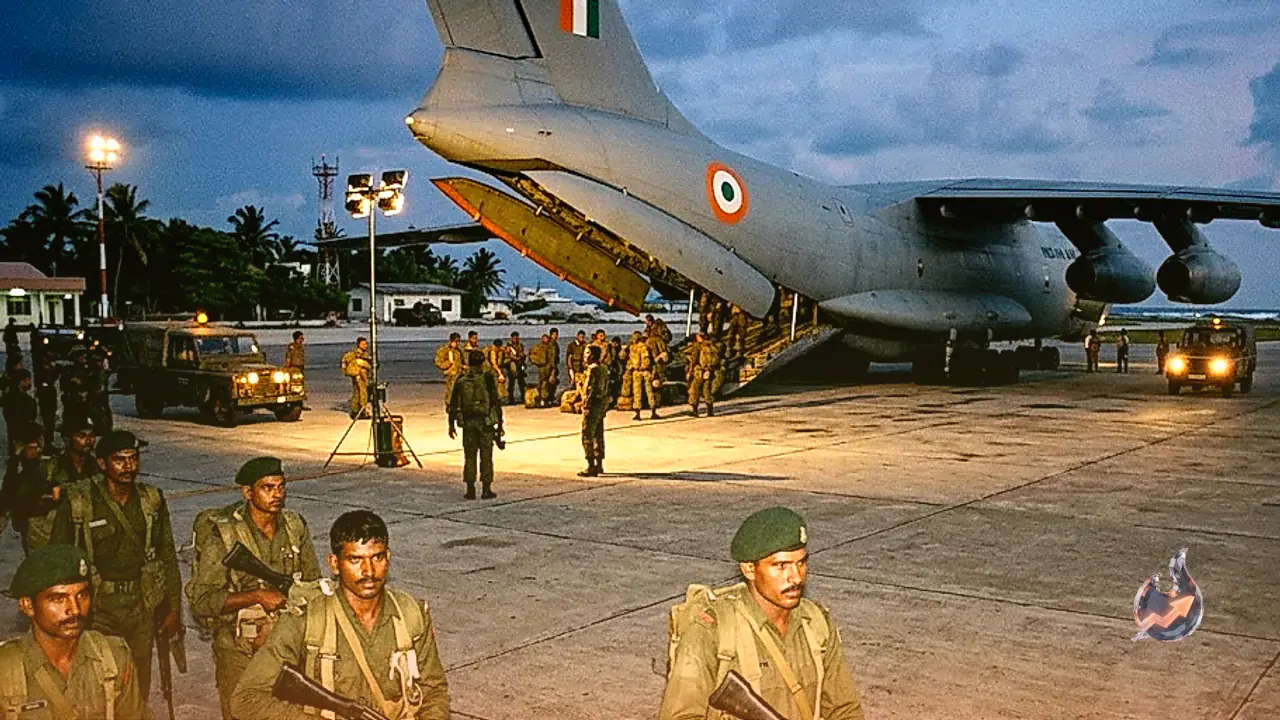
The air force received its initial tasking at 7:00 am. At Agra Air Force Station, three massive Ilyushin Il-76 heavy-lift transport aircraft belonging to 44 Squadron, the 'Mighty Jets', were placed under the command of Group Captain Anant Gopal Bevur. Simultaneously, the Indian Army's 50th Independent Parachute Brigade was mobilized at 10:00 am, with the 6th Battalion, Parachute Regiment (6 Para) designated as the primary spearhead.
Tactical planners initially debated a combat parachute drop over the capital. However, aerial surveys revealed that the islands possessed so little landmass that nearly 60 percent of the parachuting soldiers would drift directly into open ocean waters. Consequently, the mission commanders decided on a high-risk airland operation: flying the giant transports straight onto the darkened runway of Hulhulé airport, from where troops would assault Malé via sea vessels.
At 6:00 pm, two Il-76 aircraft took off from Agra carrying paratroopers, combat gear, and Indian High Commissioner Arun Banerjee, shielded by an escort of six Mirage-2000H fighters. Covering an overseas route exceeding 2,500 kilometres over four continuous hours, the aircraft arrived near the Maldivian atolls late at night. Hulhulé's airstrip was notoriously short for handling a fully laden strategic airlifter like the Il-76.
Establishing radio contact using the pre-assigned operational codeword 'Hadiya', Group Captain Bevur coordinated a fleeting ten-second illumination of the runway approach lights. Flying on night-vision instruments, the first Il-76 touched down smoothly at 9:48 pm, followed by the second transport ten minutes later.
Moving with exceptional speed, the paratroopers secured the entire airfield within 45 minutes. Commandeering seven civilian speedboats, the assault teams crossed the channel to Malé, engaging the mercenary forces in sharp firefights. By 2:00 am, President Gayoom was safely located and secured under Indian protection. At 4:30 am, the Maldivian leader spoke directly with Prime Minister Rajiv Gandhi to confirm the restoration of authority. By 11:00 am on 4 November, Indian troops had established full tactical control over the capital, completely crushing the coup within sixteen hours of the first transport's landing.
As surviving mercenaries attempted to escape toward Sri Lanka aboard a hijacked merchant freighter, the 'MV Progress Light', holding hostages, Indian Navy frigates INS Godavari and INS Betwa intercepted the vessel on the high seas. Following warning rocket fire, Indian naval commandos boarded the ship and successfully liberated all 68 hostages. Back at Hulhulé, 44 Squadron flew three additional sorties throughout 4 November to deliver secondary reinforcements.
With constitutional order restored, Indian forces completed their withdrawal. The flawless execution drew widespread global acclaim: US President Ronald Reagan hailed the operation as a vital contribution to regional peace, while British Prime Minister Margaret Thatcher expressed admiration, remarking with gratitude on India's swift intervention.
4. Sonic Boom Over Islamabad: The Untouchable MiG-25 Reconnaissance Flight
In May 1997, Amit Baruah had recently arrived in Islamabad to take up his assignment as the diplomatic correspondent for 'The Hindu'. On the morning of 27 May, a sudden, thunderous double explosion shattered the quiet of the Pakistani capital. In his memoir 'Dateline Islamabad', Baruah recounted rushing out into the street alongside neighbors after hearing what sounded like massive bomb detonations.
Immediate inquiries to local police stations and municipal emergency services yielded no explanation for the unexplained blast.
By evening, the Pakistan Air Force issued a formal acknowledgment, revealing that an Indian Air Force MiG-25R strategic reconnaissance jet had breached Pakistani airspace, creating multiple sonic booms directly above Islamabad. A sonic boom is an intense, thunder-like acoustic shockwave generated when an aircraft accelerates beyond the speed of sound, compressing air molecules into high-energy pressure waves.
Pakistani military officials confided to Baruah that the Indian aircraft was cruising at an extraordinary altitude of approximately 60,000 feet. At that extreme operating ceiling, no interceptor in the Pakistan Air Force inventory, including its frontline American-built F-16 fighters, possessed the aerodynamic capability or climb rate to reach or challenge the intruder.
Pakistani defense analyst Dr Samina Ahmed confirmed that the country's air defense network lacked any operational interceptor capable of engaging the high-flying Indian jet. For its part, the Indian Air Force maintained its customary official silence, never issuing a public statement regarding the sortie.
Subsequent accounts indicated that the reconnaissance mission was tasked with photographing key strategic and military installations across the Islamabad sector. Baruah noted in his writings that sources indicated the supersonic dash had been deliberately executed to demonstrate absolute aerial dominance.
At the time, the wider public remained largely unaware that the Indian Air Force possessed the formidable Soviet-built Mikoyan-Gurevich MiG-25. The Indian government had quietly inducted the specialized reconnaissance variant sixteen years prior, on 17 August 1981. Operated exclusively by 102 Squadron, the 'Trisonics', based at Bareilly Air Force Station, the fleet comprised eight single-seat MiG-25R reconnaissance platforms and two dual-seat conversion trainers.
Within the Indian Air Force, the aircraft was christened 'Garuda', while NATO designated it the 'Foxbat'. The Soviet Union had originally engineered the massive twin-engine titan as a dedicated counter to high-altitude American supersonic bombers and strategic reconnaissance platforms. Retired Air Marshal Sumit Mukherjee, a veteran MiG-25 pilot, noted that while the aircraft was not designed for tight dogfighting maneuvers, its ceiling and sustained speed were unmatched by any contemporary fighter in the world.
The MiG-25 routinely operated between 65,000 and 85,000 feet, with the capability to exceed 90,000 feet during high-altitude profiles. Powered by massive Tumansky turbojets, it could maintain speeds approaching Mach 3, roughly three times the velocity of sound, burning through an astonishing 23,000 litres of aviation fuel on a single extended sortie.
Mounted inside its nose and fuselage bays were massive 1,200 mm focal length reconnaissance cameras. The optical resolution of these sensors was so exceptional that an aircraft flying at high altitude over Bareilly could capture high-definition imagery of New Delhi. Retired Group Captain Alok Chauhan, another decorated Foxbat aviator, observed that the platform possessed the technical capability to map the entire territory of an adversary like Pakistan in just a handful of sorties. After twenty-five years of unmatched service as India's premier strategic eye in the sky, the legendary MiG-25 fleet was formally retired in 2006.