















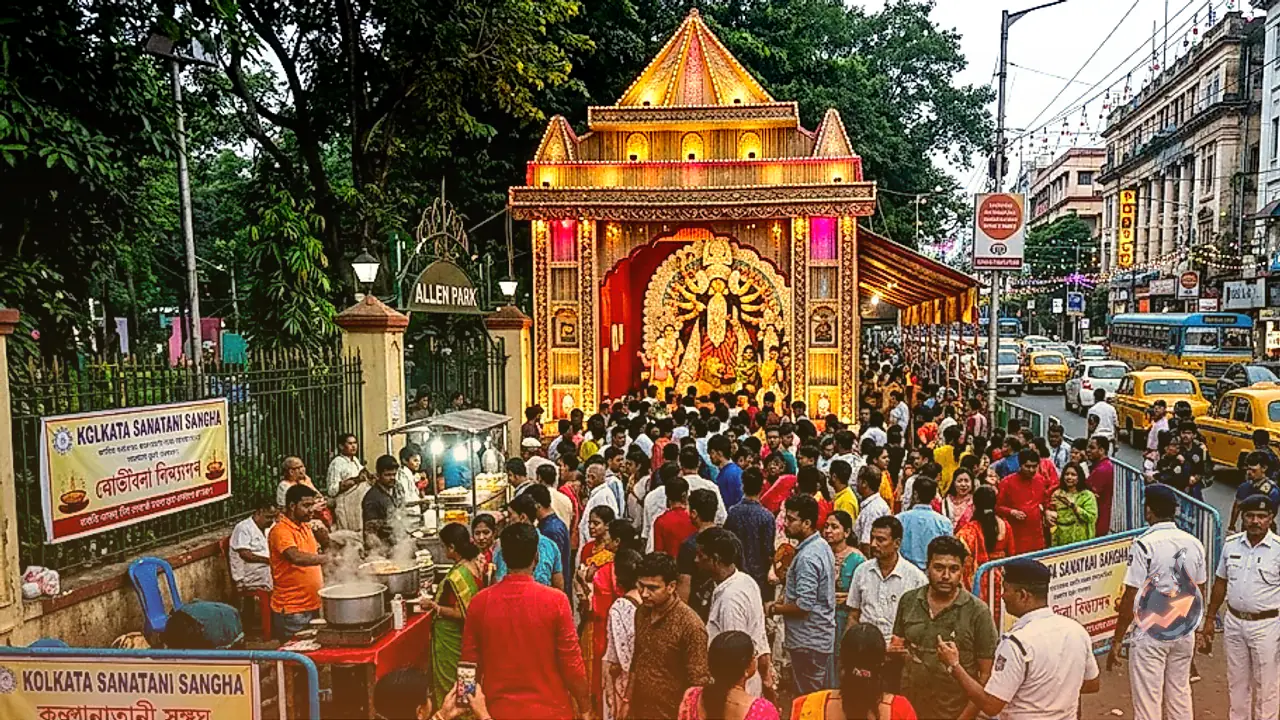

Kolkata’s upscale Park Street has long been celebrated for its lively nightlife, iconic heritage restaurants, bustling pubs, and streets glowing with festive lights to the sounds of jazz and pop. Traditionally recognised as the epicentre of Christmas and New Year gatherings, the cultural character of the boulevard is undergoing a major shift. Following the change of power in West Bengal that brought the BJP to office, Durga Puja is being organised in this commercial district for the first time. Allen Park has become the centrepiece of this development, hosting a pandal designed around a Tandav theme. Alongside the physical construction, several administrative changes have come into force, including a complete restriction on DJ sound setups, an order closing liquor vends on Maha Ashtami, and the deployment of 20,000 civic volunteers for crowd management.
The Tandav Pandal at Allen Park and Scrutiny of Music Bans
The site chosen for the pandal inside Allen Park sits directly between a busy retail market and Bishop House, within a neighbourhood historically inhabited by Anglo-Indian, Jewish, and Muslim residents. Sculptors have already completed the idol of the goddess for the ceremonies. Konika Goswami, a fashion design student visiting the site, observed that because Christmas has always been celebrated across the avenue with great enthusiasm, organising Durga Puja there is entirely natural. However, she expressed frustration over the administration’s ban on DJ sound systems during the festival. Goswami pointed out that Durga Puja represents Bengal's most prominent cultural and religious occasion, arguing that placing limits on its expression is unwarranted. She questioned why DJ setups should be barred during Durga Puja when they are routinely permitted during Ganesh Puja and Vishwakarma Puja processions.
A 370-Year Wait and Past Hurdles for Organisers
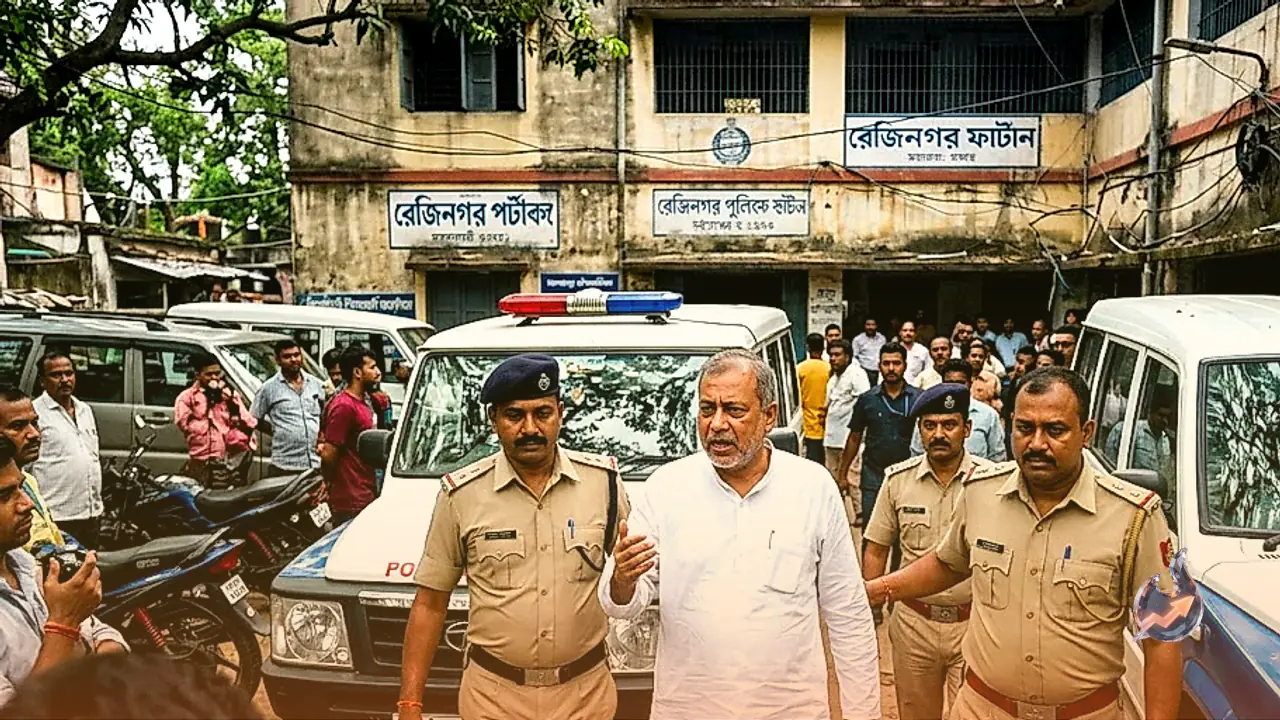
The celebrations at Allen Park are being led by the Kolkata Sanatani Sangh committee. General secretary Naveen Mishra stated that while approximately 95% of the local population in the Park Street vicinity is Hindu, the committee was repeatedly denied administrative clearances in past years. Mishra explained that applications submitted to the local police station in 2016 and 2017 were turned down without approval. According to him, successive administrations led by the Congress, the Left Front, and Mamata Banerjee failed to allow Durga Puja at this venue. The repeated refusals during the Mamata Banerjee era led the organisers to decide that celebrations would take place once their preferred government assumed office. Mishra noted that it ultimately took 370 years for Durga Puja to reach Park Street, adding that Chief Minister Shubhendu Adhikari is expected to inaugurate the pandal on Chaturthi, after which rituals will follow customary traditions.
Debate Over Non-Vegetarian Cuisine and Maha Ashtami Liquor Closures
Culinary customs have emerged as another prominent point of contention following an appeal made last month by preacher Dhirendra Shastri, who urged residents in Bengal to forgo non-vegetarian dishes during Durga Puja. While the government has not imposed any formal prohibition on food choices, the VHP has requested that committees prevent non-vegetarian food counters from operating immediately adjacent to puja pandals. Compounding the issue, the government ordered all liquor establishments to remain shut on Maha Ashtami. Local professionals Dol Chakraborty and Sonal Gupta voiced strong disagreement with the liquor restrictions. They argued that those wishing to consume alcohol will simply purchase supplies beforehand, potentially fuelling illegal black-market sales. Furthermore, they emphasised that non-vegetarian dining remains an essential element of the festival for most Bengalis, who look forward to special dishes throughout the holiday. On the other hand, both welcomed the cancellation of the Red Road Carnival, noting that road blockages from the parade previously created significant commuting hurdles for office workers.
Cultural Importance of Mutton, Hilsa, and the Red Road Carnival
Amitabh Majumdar, a retired government employee, reflected that this year’s festive atmosphere carries a notably altered tone. He remarked that numerous citizens feel unhappy about the administrative interventions but hesitate to voice their concerns openly. Majumdar stressed that for Bengali households, the celebration is deeply linked to preparing mutton and ilish maach (hilsa), without which the festival feels fundamentally incomplete. He was also critical of the decision to scrap the annual Red Road Carnival, calling it a politically motivated move that ends a world-renowned showcase that carried Bengal’s heritage across global borders. Conversely, Sheila Dey, who works in the networking sector, maintained that festivals should remain entirely free from dietary constraints, explaining that the annual arrival of Goddess Durga is a joyous family occasion meant for open feasting. Dey did, however, praise the administration’s schedule granting four days, from 21 to 24 October, for idol immersion, observing that it provides adequate time for respectful send-offs.
Vendor Uncertainty and RSS Volunteer Presence
Historically, craftspeople and traders from multiple communities collaborate to construct pandals, sculpt idols, and staff retail stalls. When approached for their perspective on the evolving atmosphere, members of the local Muslim community declined to offer comments. An operator of a non-vegetarian food stall, speaking on condition of anonymity, revealed that he had originally prepared to set up a counter near the venue but abandoned his plans once public debates intensified, choosing to avoid potential controversy. An RSS source explained the organisation’s perspective, stating that having alcohol and meat in close proximity to consecrated idols is considered inappropriate, though he stressed that no compulsion is being exerted on anyone. Volunteers will be stationed across areas to prevent friction surrounding food and beverages. In addition, the RSS plans to operate book counters outside pandal sites to present literature highlighting its social work and cadre.
Financial Grants for 45,000 Clubs and Structural Shifts at Sri Bhumi
Approximately 45,000 neighbourhood para clubs organise community pujas throughout West Bengal, including 3,000 clubs operating within Kolkata alone. For the current festive season, the BJP government has disbursed financial assistance of ₹1 lakh to each club along with free electricity supplies. Meanwhile, leadership changes have taken place at prominent venues such as Kolkata’s Sri Bhumi Sporting Club, famed for its extravagant architectural pandals replicating landmarks like the Burj Khalifa and Hawa Mahal. The club’s former patron, former TMC minister Sujit Bose, is presently incarcerated in connection with the municipal recruitment scam investigation, leading to BJP members stepping into administrative responsibilities. This year, the Sri Bhumi pandal will open its doors starting on Chaturthi, and the central idol will not feature gold or silver ornaments. Club president Kanak Debnath stated that simplifying the ornamentation aims to ensure ordinary worshippers can obtain darshan and offer pushpanjali without facing the overwhelming crowd bottlenecks of previous years.
Municipal Safety Distance for Hawkers and the Nomenclature Dispute
In a separate regulatory development, the Kolkata Municipal Corporation has directed food, snack, and toy vendors to set up their stalls at least 100 metres away from pandal structures to satisfy fire safety protocols. This directive poses a challenge for small-scale merchants selling items like golgappas, jhalmuri, and children's toys, as being pushed 100 to 200 metres from entrance gates could dramatically decrease pedestrian footfall. Jadavpur University economics professor Vikas Dixit noted that Durga Puja serves as an indispensable seasonal earning window for street vendors. He explained that visitors routinely purchase snacks and drinking water while touring pandals, and forcing vendors further away may prompt crowds to dine at home or visit restaurants instead. Nonetheless, the practical enforcement of this spacing mandate remains uncertain.
The naming of the festival has also ignited partisan exchanges across the state. BJP spokesperson Debjit Sarkar contended that organisers were forced to approach the High Court for permissions before every puja under the previous Mamata Banerjee administration, whereas the current celebrations are occurring on a far larger and unhindered scale. Chief Minister Shubhendu Adhikari has urged organisers to identify the event strictly as “Durga Puja” rather than using the secular term “Sharadotsav”. Sarkar maintained that since festivals of other faiths are not designated merely as general celebrations, Durga Puja should not be labelled an ‘utsav’ either. Rejecting this stance, CPM leader Srijan Bhattacharya argued that Bengalis celebrate the festival collectively across communities, making Sharadotsav an enduring reflection of Bengal’s pluralistic heritage. He added that because Sharada is an established name for Goddess Durga, using Sharadotsav simply means the celebration of Goddess Sharada herself.