
















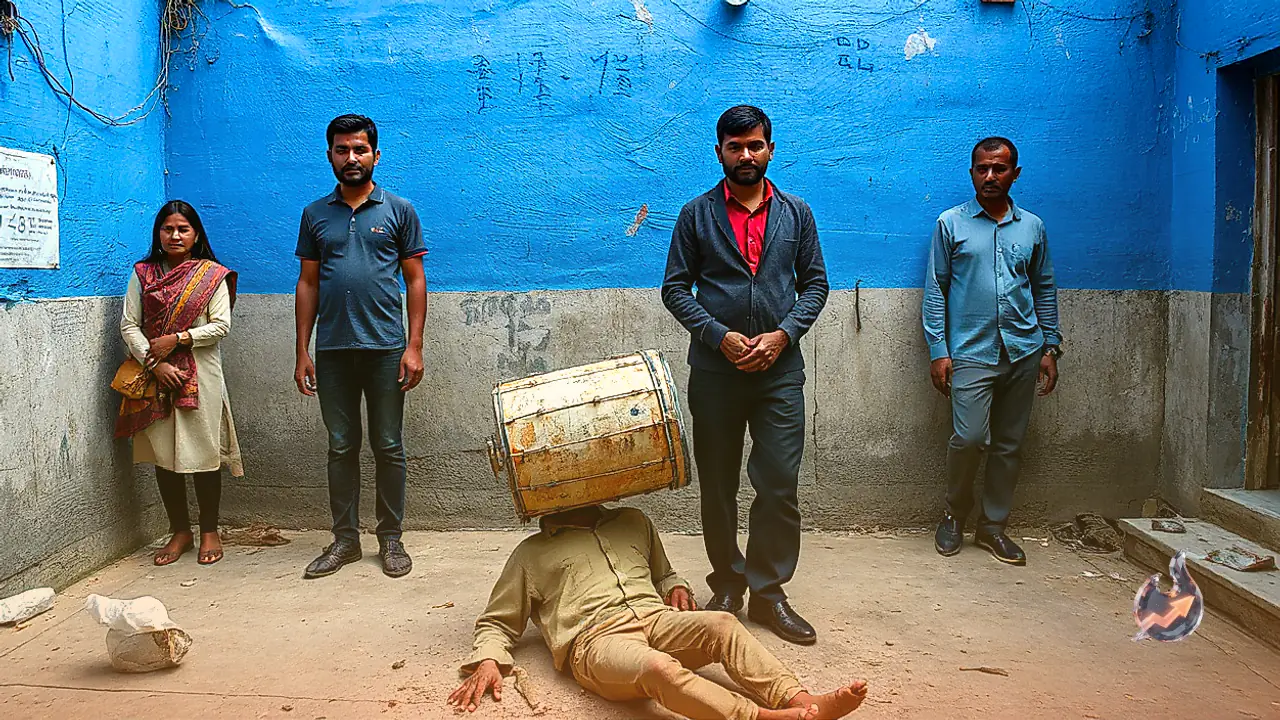

A local court in Meerut, Uttar Pradesh, has sentenced Muskan Rastogi and her schoolmate Sahil Shukla, also known as Mohit, to death for the gruesome murder of Muskan's husband, Saurabh Rajput. The murder, which came to light in March 2025, involved chopping the victim's body into pieces and packing the remains into a blue plastic drum sealed with concrete. The court convicted both individuals on 30 September 2026 for murder and destruction of evidence, handing down the capital sentence on 14 October 2026 alongside fines of ₹50,000 each for murder and ₹20,000 each for concealing evidence.
A Childhood Romance That Strained Family Ties
The events leading up to the crime trace back more than a decade. Muskan's association with Saurabh began around 2011–2012, when she was roughly 11 years old. At the time, she was residing with her grandfather, who practiced astrology in the Brahmpuri locality of Meerut. Saurabh frequently accompanied his mother to the residence for astrological consultations, leading to a bond between the two children. As the years progressed, their relationship faced fierce resistance from both households, prompting repeated elopements.
In 2016, while Muskan was studying in Class 9, the pair eloped again. Her mother, Kavita, approached the police with an allegation that Saurabh's relatives had abducted a minor girl. The families eventually reached an understanding that marriage would only be considered once Muskan attained adulthood. Kavita later recounted that Muskan had once vanished in the afternoon and remained untraceable for two days before police located the couple and brought them back. Despite warnings that Saurabh's family would never welcome her, Muskan remained adamant.
As soon as both reached the age of 18, Muskan slipped out of her house at 5 am while her family slept, and the two married. Saurabh's relatives disowned him immediately following the wedding, forcing the newlyweds into rented accommodations. Seeing that Saurabh had abandoned his own household to stand by Muskan, her maternal family gradually warmed to him. During the disruptions of the COVID-19 pandemic, when Saurabh lost his employment, Muskan's family stepped in to provide financial relief.
Reconnection With a Classmate and Marital Discord
Saurabh eventually secured employment with the Merchant Navy and relocated to London. During his absence, Muskan crossed paths again with Sahil Shukla. The two had been classmates up to Class 8 at Vivekanand School in Brahmpuri before drifting apart. In 2019, Sahil initiated contact through a school alumni WhatsApp group. With Saurabh working overseas, the former classmates rekindled their connection.
Muskan had grown resentful over Saurabh's alcohol consumption. As her intimacy with Sahil deepened, Sahil sought greater involvement with her and introduced her to intoxicants. The couple's young daughter, Pihu, spent considerable time living with her maternal grandparents, affording Muskan extended periods to host Sahil at the residence without her family's knowledge. Saurabh eventually became aware of the extramarital relationship upon returning from London to Meerut in February 2025.
The Night of 3 March: Poisoning, Assault, and the Cement Drum
The prosecution established that the murder was carried out on the night of 3 March 2025. Muskan laced Saurabh's dinner with a sedative. Once he lapsed into unconsciousness, Sahil entered the house. The pair assaulted Saurabh using edged weapons, inflicted fatal injuries, and proceeded to sever his body into parts. To contain decomposition odors and prevent discovery, they stuffed the dismembered remains into a blue plastic drum and filled the interior with a heavy mixture of cement, sand, and water.
Following the crime, Muskan and Sahil fled the city, travelling to tourist destinations in Himachal Pradesh, including the Shimla-Manali belt. To delay suspicion, Muskan operated Saurabh's mobile handset to dispatch messages to his relatives, creating the illusion that he was alive and occupied with professional duties elsewhere.
Uncovering the Crime: 'Papa Is in the Drum'
Growing anxious over their inability to contact Saurabh directly, his relatives approached the house on 17 March 2025 alongside local officials. Inside the premises, authorities discovered the sealed plastic drum. Upon forcing it open, investigators uncovered Saurabh's preserved remains. Acting on a complaint from the victim's brother, law enforcement apprehended Muskan and Sahil on 18 March 2025.
A chilling detail emerged from Saurabh's mother, Renu Devi, who noted that the couple's six-year-old daughter, Pihu, had repeatedly told neighborhood residents, 'Papa drum mein hai' (Papa is in the drum). Prior to the police discovery, the landlord had dispatched laborers to clear the room for planned renovation work; the workers found the drum too heavy to budge, at which point Muskan had claimed it contained useless scrap.
Forensic Proof, 22 Witnesses, and 126 Hearings
Because the homicide lacked direct eyewitnesses, prosecutors assembled a chain of circumstantial evidence to establish culpability. Crucial testimony came from local merchants who identified selling the blue drum, cement, masonry sand, and cutting implements to the accused. Autopsy findings confirmed extensive trauma inflicted by sharp-edged instruments.
Investigators corroborated the timeline using call detail records and cell tower location data, placing Sahil at the residence during the hours of the assault. Travel documentation and hotel records from Himachal Pradesh confirmed the movements of both individuals immediately post-incident. The police submitted a chargesheet exceeding 1,000 pages. Over the course of 126 courtroom hearings, 22 prosecution witnesses testified. While defense attorneys argued the absence of direct eyewitnesses rendered the charges unproven, the bench determined that the physical and electronic evidence formed an unbroken chain of guilt.
Mother's Unanswered Question and Legal Recourse
Speaking after the sentence was handed down, Saurabh's mother, Renu Rajput, expressed lingering grief, stating that while the court had established guilt, she remained tormented by why Muskan had chosen to kill her son. During sentencing, the judge touched upon concepts of dharma and references from the Mahabharata to outline the gravity of the punishment.
Under Indian criminal procedure, a trial court's death sentence cannot be executed without confirmation from the High Court. Both convicts intend to file appeals challenging the ruling before the Allahabad High Court. The appellate bench will review the trial records and findings before determining whether to uphold, reduce, or overturn the capital punishment.
Custody Dilemma Over Child Born in Prison
The tragedy leaves complicated questions regarding Muskan's children. On 24 November 2025, Muskan gave birth to a second daughter, Radha, while incarcerated. The infant remains with her inside the Meerut district jail. Saurabh's family has declined to take custody of Radha, with his mother questioning the child's paternity and maintaining that the family holds no relation to her, though no formal DNA test outcome has been documented. While Saurabh's brother had initially indicated a willingness to accept Radha if paternity were scientifically proven, the household subsequently refused responsibility.
Muskan's maternal relatives have similarly expressed an inability to look after Radha. On 22 October 2026, Faizan Ansari, a social media influencer based in Mumbai, filed an application before a Meerut court offering to assume financial and parental responsibility for the child's upbringing, medical care, and schooling. District government counsel K.K. Chaubey observed that any custodial determination requires adherence to legal statutes and consideration of the mother's consent. Meanwhile, Muskan has requested visitation with her elder daughter, Pihu, who remains in the care of her maternal grandparents. As of 23 October 2026, no conclusive legal determination on Radha's permanent placement had been finalised.