























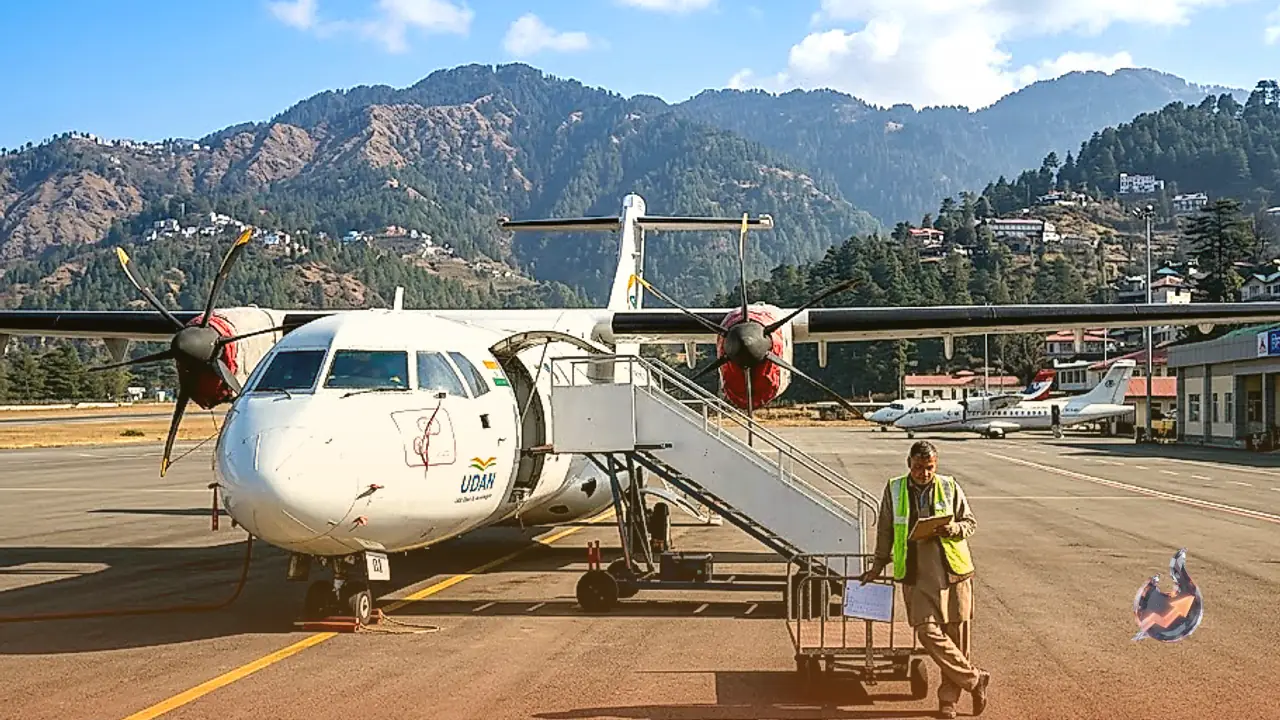

At Jubbarhatti Airport, set among the pine forests some 22 km outside Shimla, the whine of jet engines has given way to complete stillness. The final aircraft took off on 27 August, after which dense fog and adverse weather forced a complete suspension of services. Carved directly out of the hills, the mountain airfield currently sees only security and operational staff walking its grounds. The sight contrasts sharply with the founding vision shared by Prime Minister Narendra Modi when he introduced the regional connectivity initiative on 21 October 2016, stating, 'I want even a person wearing slippers to be able to travel by aeroplane.' That ambition became reality when the very first commercial service under the UDAN programme lifted off from Shimla on 27 April 2017. Ten years on, however, the drive to link India's interior towns to the national grid is contending with harsh economic and operational realities.
Ten Years of Regional Wings: 1.68 Crore Passengers Carried
Designed under the banner of Ude Desh Ka Aam Nagrik, the initiative sought to stitch under-served and unserved regional towns into the commercial aviation map where scheduled connectivity was nonexistent or strictly limited. Central government records show that by 30 June 2026, the project had integrated 95 aerodromes into its network, comprising 76 conventional airports, 17 heliports, and 2 water aerodromes. Authorities earmarked 677 sectors for subsidised operations, carrying 1.68 crore travellers across 3.58 lakh individual flights.
The underlying economic framework relied on bridging revenue gaps for commercial operators willing to deploy aircraft on thin regional sectors, allowing carriers to offer capped tariffs while offsetting operating shortfalls through public funds. Under this structure, 9 separate airlines commenced operations, drawing an aggregate governmental disbursement of ₹4,881 crore. A decade after rollout, 15 of the 95 designated facilities are either completely non-operational or have witnessed the total withdrawal of their regional scheme flights. Field assessments across airfields including Datia in Madhya Pradesh, Bhavnagar in Gujarat, and Shimla in Himachal Pradesh reveal the underlying strains.
Datia Airfield: Service Grounded Within Five Months
In Datia, widely known for the sacred Maa Pitambara Shaktipeeth, a newly constructed airport was inaugurated with significant local fanfare on 31 May 2025. Located approximately 4 km from the town railway station, the approach road reveals the project's troubled maintenance: an initial 200-metre stretch turning off the arterial highway is well-paved and clean, but the road quickly deteriorates into potholes where stray cattle congregate unchecked. Local sanitation staff observe that while regular sweeps occurred during the operational phase, the grounds are largely neglected now that flights have stopped.
The facility has since been officially classified as non-operational by civil aviation authorities, activated only for occasional VIP charters. The immediate two-kilometre perimeter around the terminal remains largely vacant scrubland dotted with a handful of small retail outlets. Anurag Gagauria, who manages Hotel Sanskriti Palace, recalls the initial local optimism: business owners anticipated a steady influx of commercial guests and religious pilgrims once the runway was opened, but the scheduled link collapsed within a few short months.
The flights assigned to Datia connected the town to Bhopal and Khajuraho. However, local commuters already enjoyed frequent, affordable rail and bus links to Bhopal. The primary trading nexus for local merchants is Indore, yet no direct aerial connection was established to that commercial hub. The infrastructure was completed, but route planners failed to tailor destination schedules to organic commercial patterns.
Air Traffic Controller Nitin Thakaran explains that regional operator Flybig launched services on 31 May 2025, but sustained the operation for only around five months before pulling out. Passenger loads failed to materialize; the 19-seater aircraft regularly departed with half its cabin empty, flying just 1,050 total passengers throughout its entire tenure. The carrier abruptly halted departures without detailed explanation to field officers. While contract rights were slated for transfer to Skyhop Airline with an expected relaunch on 7 August, flights have yet to resume.
Bhavnagar: ₹18 Crore in Outlays Yields ₹4 Crore in Receipts
Across the western state of Gujarat, Bhavnagar presents a contrasting symptom of commercial distress. While the civil terminal remains technically open, subsidized regional services have vanished entirely. Airport Director Tapan Kumar Nayak notes that SpiceJet previously provided scheduled connectivity under the regional banner, operating its final sector on 10 June 2025.
Government subsidies were structured strictly for the inaugural three-year window. Once that financial bridge expired, the commercial carrier withdrew its schedule. While a single commercial flight continues to use Bhavnagar outside the government scheme, the facility's balance sheet reflects severe structural losses. During the previous financial year, terminal upkeep and routine operations consumed roughly ₹18 crore, while overall facility revenues stood at just ₹4 crore.
Shimla: Complex Terrain Trumps Passenger Appetite
Shimla's Jubbarhatti terminal underlines the environmental barriers confronting mountain aviation. Even after staging the scheme's inaugural departure on 27 April 2017, the hill station remained cut off from scheduled commercial services for an intervening six-year span. An Alliance Air regional aircraft finally touched down from Delhi on 26 September 2022, yet flight consistency remained elusive.
During 2025, torrential rains and landslides forced an operational shutdown that stretched across nearly 10 months. Direct intervention and judicial directives from the Himachal High Court prompted a resumption of flights on 10 May 2026. However, seasonal monsoon conditions quickly intervened, leading to a renewed suspension on 24 July due to blinding cloud cover. The last incoming flight landed on 27 August. Airport Director Lalit Kumar emphasizes that the terminal itself remains open for operations whenever atmospheric visibility permits safe navigation.
The fundamental constraint at Shimla is topographical rather than commercial demand. The airport features a tabletop runway, constructed by excavating mountain ridges and leveling high ground, surrounded on its perimeters by steep valleys and gorges. The layout precludes the landing of standard narrow-body passenger jets and demands stringent landing margins from turboprop flight crews.
Commercial aviation first arrived at Jubbarhatti back in 1998, with infrastructure capital outlays reaching approximately ₹116 crore to date as facility retrofitting continues. Local resident Mohan Verma points out that relying on a single daily flight yielded minimal local economic momentum, sustaining only four or five roadside eateries and an association of 8 to 10 taxi drivers whose livelihoods vanish whenever bad weather grounds the single rotation. Monsoonal weather regularly halts flights here for two and a half to three months every year.
The Prayagraj Counter-Narrative: Traffic Crosses 10 Lakh
The operational picture is not uniformly bleak across regional hubs, with Prayagraj in Uttar Pradesh demonstrating sustained commercial expansion. Across the 2024-25 reporting cycle, Prayagraj Airport handled 10.77 lakh passengers. That throughput represented a 76.4 percent annual jump compared to the 6.10 lakh travelers recorded during 2023-24.
Airport Director Ganesh Yadav attributes this sustained momentum to three institutional drivers
- Religious Pilgrimage: The Sangam confluence attracts continuous pilgrimage traffic throughout the calendar year, supplemented by the massive recurring congregations of the annual Magh Mela, the six-yearly Ardh Kumbh, and the 12-yearly Maha Kumbh.
- Judicial Operations: As the seat of the Allahabad High Court, the city generates sustained business travel from legal practitioners, judicial officers, litigants, and senior civil servants traversing the country.
- Administrative Presence: Prayagraj's standing as a major regional political and governance centre ensures steady travel by party functionaries, government delegations, and public figures.
Building Terminals Versus Sustaining Scheduled Wings
India's operational aviation network has expanded rapidly in physical scope. The nation maintained 74 operational airports in 2014, a figure that climbed to 165 by 2026 on the back of more than ₹1.4 lakh crore committed to national aviation infrastructure.
Nevertheless, parliamentary submissions made by the government in February 2026 confirmed that 15 air terminals inaugurated under the regional banner had slipped into non-operational status. The list spans regional locations including Datia, Shimla, Bhavnagar, Pathankot, Ludhiana, Pakyong, Kushinagar, Aligarh, Azamgarh, Chitrakoot, Shravasti, and Moradabad. Total capital expenditure absorbed across these 15 idle facilities stands at approximately ₹880 crore.
Route survival statistics mirror this terminal attrition. Participating operators, including Alliance Air, SpiceJet, IndiGo, Star Air, Flybig, Fly91, and IndiaOne, inaugurated services across a cumulative 669 domestic routes over the lifetime of the scheme. Active flying takes place across only 336 of those sectors today, meaning 333 routes, nearly half of the entire planned route map, have been terminated.
Earlier parliamentary disclosures from December 2025 noted that 151 individual regional sectors collapsed prior to fulfilling their initial three-year commitment. Regulators pointed to poor seat occupancy, localized aircraft shortages, chronic low-visibility challenges, and corporate distress among operators as primary catalysts for route cancellations.
Former commercial aviator and industry analyst Dr Vipul Saxena highlights two structural reasons behind the grounding of these regional stations. First, passenger demand across Tier-3 and Tier-4 towns consistently trailed official projections, making aircraft operations prohibitively expensive for private carriers. Second, government viability gap funding lasts strictly for the first three years of route commissioning. Once carriers must shoulder full operating expenses without state subsidies, thin passenger yields make continued operations financially unviable.
Despite these commercial realities, policy planners continue to expand the scheme's physical footprint. Civil Aviation Minister K. Ram Mohan Naidu has announced plans to construct 120 additional regional airports under the framework over the coming decade, with a projected capital commitment of ₹28,840 crore.
Global Precedents in Remote Aviation Support
Sustaining air connectivity across vast geographical territories is a shared challenge across large economies like the United States, Canada, Brazil, and Australia, all of which maintain targeted subsidy programmes. In the United States, the federal government instituted the Essential Air Service following the Airline Deregulation Act of 1978 to safeguard scheduled air links for outlying towns that would otherwise lose commercial services.
Canada operates its Air Service Support Programme to sustain Northern and remote routes. During the pandemic, Canadian authorities deployed 174 million Canadian dollars, approximately ₹1,199 crore, across an 18-month timeline to keep lifeline air bridges active. Australia provides targeted operational disbursements directly to flight companies serving sparsely populated desert and regional tracts through the Remote Air Service Subsidy scheme. Brazil maintains explicit statutory protections guaranteeing public subventions for regional passenger transport.
India's domestic model mirrors these global approaches by deploying tax waivers and operational relief from central and state governments to compress operating costs. Terminal operators forgo aircraft landing and parking fees, the Airports Authority of India waives navigation charges, and fiscal authorities offer concessions on aviation turbine fuel taxes.
Aviation analyst Vipul Saxena notes that sovereign infrastructure investments are rarely planned around immediate commercial profitability, just as public highways are built without expecting immediate capital recovery. However, he maintains that future capital outlays require tighter alignment between site selection, terrain feasibility, and the specific aircraft types deployed to ensure regional runways do not sit empty once state subsidies expire.