





















In the high-stakes theater of global espionage, the ability to completely shed one's true identity and integrate into the enemy's inner sanctum is the ultimate test of a spy. For Eli Cohen, a dedicated operative recruited by Israel's intelligence agency, Mossad, this meant leaving behind his wife Nadia under a fabric of lies to step into the shoes of Kamel Amin Thaabet. Positioned as a wealthy Syrian textile merchant returning from Argentina, Cohen built an impeccable cover story in Buenos Aires before making his move to Damascus. This is the detailed account of how he transformed from an expatriate businessman into the trusted confidant of the Syrian president, a journey of unprecedented infiltration that ultimately ended in a public square in Damascus.
Cultivating the Elite in Buenos Aires
In February 1961, Kamel Amin Thaabet arrived in Buenos Aires, the capital of Argentina, and established residency in a high-end apartment complex. This neighborhood was a hub for affluent Syrian immigrants, providing the perfect social ecosystem for Kamel to weave his network. Armed with charisma and seemingly limitless financial resources, he quickly integrated into the local Syrian expatriate community and began hosting lavish social gatherings that caught the attention of diplomats at the Syrian Embassy.
It was during these high-profile diplomatic interactions that Kamel befriended General Amin Hafiz, the Syrian military attaché in Argentina. General Amin was a prominent figure aligned with the Ba'ath Party, which was then the chief opposition movement in Syrian politics. Recognizing the general's immense ambition and political potential, Kamel systematically nurtured their association. He made generous financial contributions to the Ba'ath Party, positioning himself as a passionate nationalist eager to see his homeland prosper under strong leadership. The two men began exchanging frequent visits, cementing a friendship that would serve as Kamel's golden ticket to the upper echelons of Syrian power.
Establishing a Base in the Heart of Damascus
By 1962, the political tides in Syria were shifting, and Kamel made his calculated move to the Syrian capital, Damascus. General Amin Hafiz facilitated his transition by arranging a luxurious rented apartment for him in an exclusive neighborhood. This area was not just affluent; it was the residential quarter of choice for high-ranking military commanders and influential government officials, giving Kamel unprecedented proximity to the country's decision-makers.
Kamel lost no time in expanding his social circle. He targeted key media figures, recognizing the strategic value of communication channels. Among his new associates was Salem, the director of Radio Damascus. Salem was eager to align himself with a wealthy expatriate who could potentially inject massive advertising revenue into the broadcasting station. Kamel became a frequent guest at the radio studios and was eventually invited to host specialized programs aimed at Syrian immigrants living abroad. This broadcasting role provided Kamel with a perfect, highly secure platform to transmit coded intelligence directly to Israel, disguised as ordinary radio commentary, right from the heart of the Syrian state media apparatus.
The Social Web of Espionage
Kamel's espionage strategy relied heavily on high-society parties where alcohol flowed freely and tongues wagged. At a social gathering hosted at Salem's residence, Kamel was approached by a striking woman who introduced herself as Salem's sister-in-law. She took him by the hand and guided him into a crowded hall filled with military personnel, many of whom were already heavily intoxicated.
It was here that Kamel was introduced to Colonel Salim Khatoum. The colonel, already familiar with Kamel's highly publicized charitable acts and successful business ventures, greeted him with a warm embrace. Kamel steered their conversation toward politics, carefully probing the colonel's personal allegiances. He discovered that Colonel Salim was profoundly disillusioned with the incumbent government and was actively supportive of a Ba'ath Party-led coup. Seizing the opportunity, Kamel invited the colonel to a private party at his own residence scheduled for two days later, promising an exclusive gathering with beautiful women and premium spirits. Intrigued, the colonel readily accepted.
Unlocking Military Secrets Behind Closed Doors
Two days later, Kamel's apartment hosted a lavish, private party designed to break down the defenses of Syria's military elite. He had invited attractive female employees working within the Syrian Defence Ministry to act as hostesses. The venue was stocked with premium local and imported liquors, creating an atmosphere of uninhibited indulgence. When Colonel Salim arrived looking visibly exhausted from his military duties, Kamel offered him a change of comfortable, civilian clothes from his personal wardrobe, encouraging him to shed the literal and metaphorical weight of his uniform.
As the night progressed and the alcohol flowed, Colonel Salim relaxed completely. Mesmerized by one of the hostesses, who was employed as a typist at the Defence Ministry, the colonel began to boast about his military authority. He revealed that he was the regional commander of the highly strategic border zone facing Israel. In his drunken confidence, Salim boasted about the extensive network of highly secure, underground military bunkers constructed along the border, from which Israeli settlements were clearly visible. Kamel masterfully played the role of an interested but politically detached host, encouraging the colonel's boasts while ensuring the atmosphere remained focused on leisure, thereby avoiding any suspicion of interrogation.
The Strategic Border Invitation
The success of Kamel's hospitality bore fruit the very next morning. A military courier arrived at his apartment with an official telegram from Commander Maazi Zahir. Acting on the direct recommendation of Colonel Salim, the commander extended a formal invitation to Kamel to tour the highly restricted military installations along the Syrian-Israeli border. That evening, an official military transport vehicle escorted Kamel to the frontline defenses.
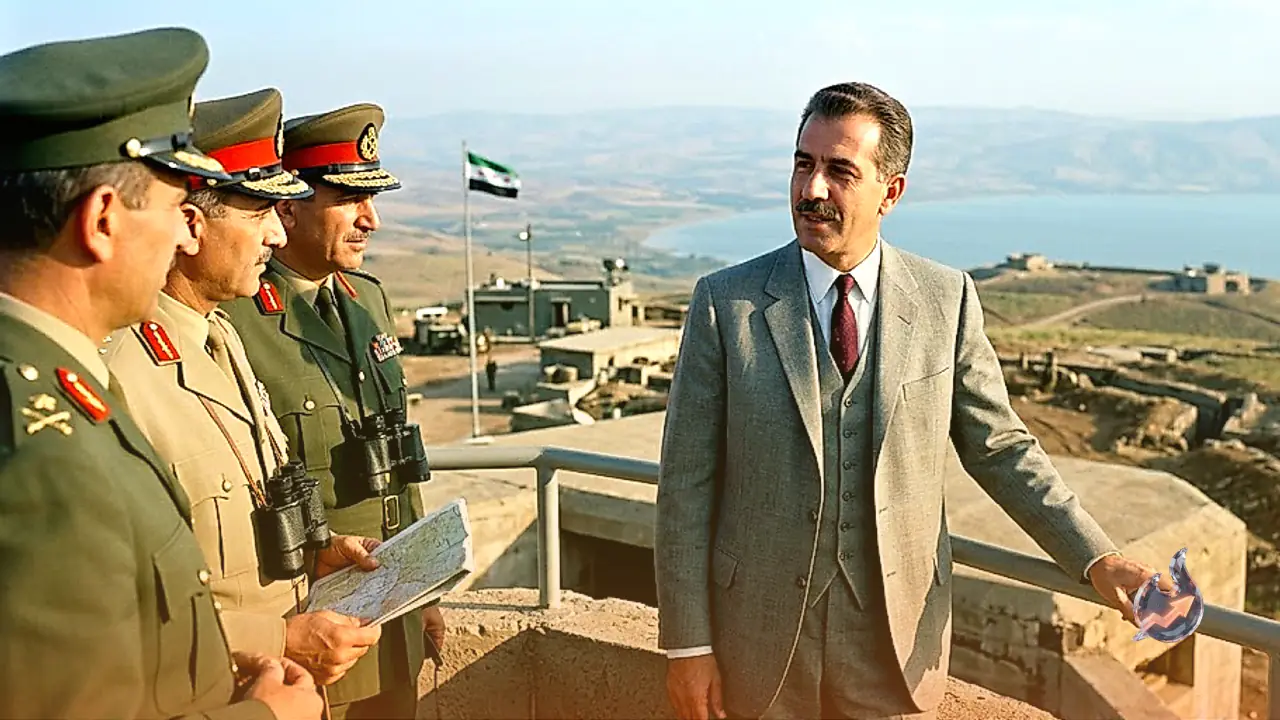
Commander Zahir accompanied Kamel to a high vantage point overlooking the Israeli landscape. The commander expressed his frustration over the geopolitical reality, noting that despite Syria's superior weaponry and numerical advantage, Israel was shielded by the diplomatic and military intervention of global superpowers. Kamel, maintaining his cover as a hardline Syrian nationalist, used binoculars to study the Israeli villages below. To solidify his disguise, he openly expressed disgust at the visible liberal lifestyle of Israeli women working in the fields, earning the deep respect of his military hosts. Upon returning to Damascus, Kamel immediately coded these firsthand observations of the border terrain and transmitted them to Mossad.
The Ba'athist Coup and the Rise of Amin Hafiz
Over the subsequent months, Kamel secured repeated access to the highly classified Syrian fortifications. He meticulously committed to memory the exact locations of weapons depots, defense plans, troop numbers, and artillery positions. However, the psychological strain of his double life was immense. Following a temporary recall to Tel Aviv, where he consulted with a Mossad handler named Yitzhak and spent precious, fleeting days with his wife Nadia and daughter, Kamel returned to a Damascus on the brink of revolution.
On March 8, 1963, the anticipated coup took place. Tanks rolled through the streets of Damascus, a strict curfew was imposed, and the Ba'ath Party seized total control of the state. This political upheaval catapulted Kamel into an unprecedented position of influence. His close friend, General Amin Hafiz, was installed as the President of Syria. Many of Kamel's close social contacts were appointed to key cabinet ministries and senior military commands. Kamel's access was now absolute; he was the only civilian permitted to accompany high-ranking military delegations, including the visiting Chief of the United Arab Command, General Ali Amer, to the highly sensitive border zones.
The Panic of Leaked Intelligence
As Kamel participated in the highest levels of military planning against Israel, highly sensitive strategic details began appearing in the Israeli media almost immediately after they were discussed in Damascus. Furious at this breach of national security, President Amin Hafiz ordered an immediate, intensive investigation by his counter-intelligence units. The leak was confirmed when the President personally tuned in to an Arabic broadcast of the Voice of Israel and heard precise details of a highly confidential military meeting that had occurred just hours prior.
The President realized that a sophisticated radio transmitter was operating within the capital. He ordered a relentless, round-the-clock dragnet to locate the spy. While Syrian counter-intelligence scrambled to detect the source of the transmissions, Kamel continued his work unabated. He traveled to the strategic Golan Heights with Colonel Salim, who proudly showed him the fortified mountain bunkers and introduced him to the frontline artillery crews.
The Eucalyptus Tree Deception
During his tour of the Golan Heights under a scorching sun, Kamel observed the Syrian artillery crews drenched in sweat, operating in highly exposed conditions. He pointed out to Colonel Salim that the extreme heat would exhaust the soldiers, leaving them unprepared in the event of a sudden Israeli attack. Kamel proposed a highly practical, seemingly humanitarian solution.
He suggested planting fast-growing eucalyptus trees around all the major artillery positions and bunker entrances. He argued that this would provide vital shade for the soldiers and simultaneously conceal the military hardware from Israeli reconnaissance aircraft, who would view the sites as harmless groves. The colonel praised Kamel's tactical ingenuity, and within weeks, the Syrian military began planting eucalyptus saplings at every critical defensive installation across the Golan Heights. Unbeknownst to the Syrian high command, Kamel had just systematically marked the exact coordinates of every hidden bunker for the Israeli air force.
The Net Closes on Kamel
By November 1964, Kamel's influence had grown so profound that President Amin Hafiz offered him the prestigious government post of Deputy Defence Minister. Kamel accepted the offer with feigned humility but requested a temporary delay, citing urgent personal matters that required his presence in Argentina. During this period, on November 13, a violent border skirmish erupted between Syrian and Israeli forces. Thanks to the highly precise coordinates provided by Kamel, Israeli artillery and aircraft neutralized key Syrian positions and destroyed multiple fighter aircraft with devastating accuracy.
Kamel made a final, brief visit to Tel Aviv, where Nadia gave birth to their second child, a son. Despite his desire to remain with his growing family, the call of duty pulled him back to Damascus for what would be his final mission. By January 1965, certain factions within the Syrian military bureaucracy had become deeply suspicious of Kamel's rapid ascent and absolute access. Syrian security forces, utilizing advanced Soviet tracking equipment, managed to pinpoint a rogue radio signal originating from Kamel's apartment. They breached his doors and caught him red-handed with a transmitter and coded messages laid out on his bed.
A Public Execution and a Lasting Legacy
Following his arrest, Eli Cohen was subjected to brutal, systematic torture as his true identity was uncovered. A military tribunal sentenced him to death for espionage. In the early morning hours of May 19, 1965, after writing a final, moving letter to Nadia urging her to rebuild her life and focus on their children, Eli Cohen was escorted to a public square in Damascus and hanged before a crowd of thousands. The execution was broadcast live on Syrian radio, a transmission that his wife Nadia listened to in agony from their home in Tel Aviv.
Two years later, in June 1967, the Six-Day War erupted, pitting Israel against six Arab nations, including Egypt, Syria, Jordan, Iraq, Saudi Arabia, and Kuwait. As Israeli forces launched their assault to secure the strategic Golan Heights, pilots and ground commanders targeted the distinctive, mature eucalyptus trees that lined the barren ridges. Each tree marked the exact location of a hidden Syrian bunker or artillery nest. Using the living landmarks established by Eli Cohen, the Israeli military systematically dismantled the Syrian defenses, securing a decisive victory and seizing control of the Golan Heights in just six days.