



















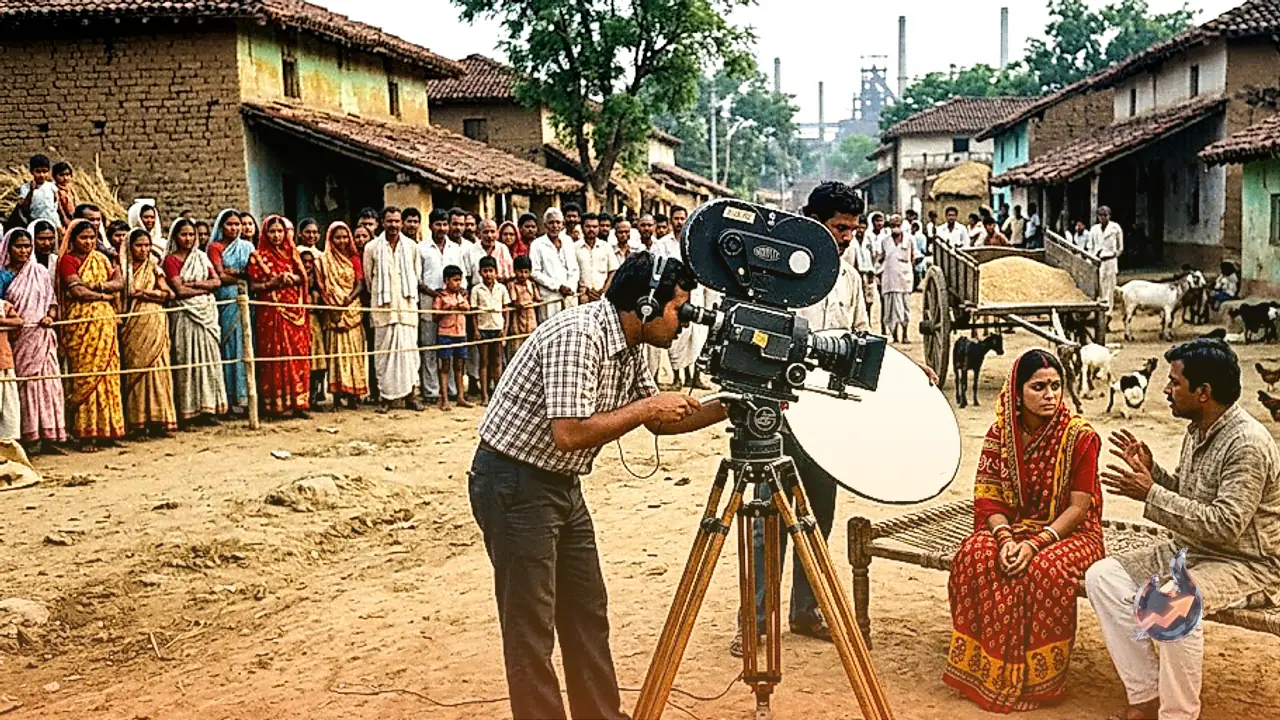

When people hear the name Bokaro, their minds immediately conjure images of towering steel production facilities, industrial furnaces, and the heavy machinery of coal mines. However, four decades ago, this prominent industrial belt etched an entirely distinct and romantic chapter in the cultural annals of regional cinema. In 1985, the widely celebrated Bhojpuri film Piya Ke Gaon was brought to life against the serene rural backdrop of this very district. Decorated with evergreen tracks like Ye Doctor Babu and Jug-Jug Jiyo Lalanwa, roughly eighty percent of this emotional family drama was filmed across rural tracts including Bahragora, Angwali, and adjoining hamlets. Featuring actor Danish and actress Meera Madhuri in the lead roles, the arrival of filming crews transformed the quiet village landscape into an open-air celebration.
Filming of the Celebrated Sohar Song at the Residence of Krishna Murari Pandey
The iconic traditional sohar track Jug-Jug Jiyo Lalanwa was filmed directly inside the ancestral courtyard and residence of Krishna Murari Pandey, father of former parliamentarian Ravindra Kumar Pandey. Far from remaining merely a hospitable host, Krishna Murari Pandey was personally invested in the creative execution of the motion picture and even portrayed a featured character on screen. During that era, the sight of a bustling production unit setting up massive lighting rigs and navigating heavy film equipment within a traditional rural home became the talk of the entire countryside. Residents from neighbouring localities arrived in steady streams to catch a glimpse of the filmmaking process taking place inside a familiar household.
Dramatic Action and Melodies Captured Along the Tenughat-Bokaro Canal
Another beloved song from the movie, Hath Me Suratiya Tohri, Mathe Par Bipatiya, was lensed against the picturesque backdrop of the Tenughat-Bokaro canal. The streaming waters and lush canal banks added raw emotional depth to the narrative. Furthermore, several critical sequences comprising the film's climax were staged and shot around the open grounds and paths lining this same canal network. Viraj, a resident of Bahragora village, recalls that the filming schedule spanned nearly an entire month across the vicinity. According to Viraj, locals were captivated by the sight of actors delivering dialogue in person, willingly braving hours under the sun just to witness the scenes unfold. The entire countryside remained gripped by rare festivity throughout that period.
Community Hospitality and Local Screen Debuts in Angwali
During their extensive production schedule, the film unit established a prominent base within Angwali village. Ikram Ul Haq, who was employed with a Central Coalfields Limited (CCL) project at the time, hosted numerous crew members and artists at his residence. His home accommodated members of the visiting unit for around fifteen days, with catered meals specially arranged from outside locations to support the production staff. In a memorable milestone for community talent, homegrown individuals from Angwali shared screen space with seasoned actors who had journeyed from Mumbai. Local residents such as Pappu Hajam, Ishwar Mishra, and Paras Mishra took on acting roles in the project, securing a once-in-a-lifetime opportunity to demonstrate their creative abilities before professional movie cameras.
Massive Crowds and Enduring Enthusiasm at Meghdoot Cinema
The release of the completed film created unprecedented excitement among local communities. At Meghdoot Cinema, a local theatre owned by Kailash Singh of Angwali, massive crowds gathered from morning until late into the night to secure admission. In an era predating modern home video and digital entertainment, visiting a cinema hall was a premier public event. For the residents of Bokaro, purchasing a ticket to Piya Ke Gaon was far more than watching a standard cinematic drama. It represented the thrilling novelty of seeing their everyday village lanes, local water canals, surrounding fields, and fellow villagers projected on the silver screen in full theatrical glory.
A Lasting Testament to Bokaro Beyond Steel and Coal
The legacy of Piya Ke Gaon remains an integral cultural milestone for Bokaro, spotlighting its tranquil nature alongside its industrial prominence. While the mid-1980s firmly established the region as a titan of steel manufacturing and mineral excavation, the film documented the scenic beauty and warm community spirit dwelling within its rural corners. Even after forty years, elders and residents across Bahragora and Angwali recount stories from those four weeks with vivid nostalgia. The production remains an enduring reminder of the moment cinematic cameras entered rural courtyards, offering local artists a national stage and preserving their home landscapes on celluloid forever.