























The beauty and personal grooming industry continues to emerge as a viable avenue for self-employment and small-scale entrepreneurship among women. According to Palamu-based makeup artist Riddhima, establishing an independent enterprise does not necessarily require massive financial outlays. With systematic planning, proper technical training, consistent effort, and client service, a modest venture can gradually scale into a full-fledged commercial studio. A functional parlor offering standard services can be launched with an initial capital of around one lakh rupees.
From Classroom Teaching to a Professional Beauty Studio
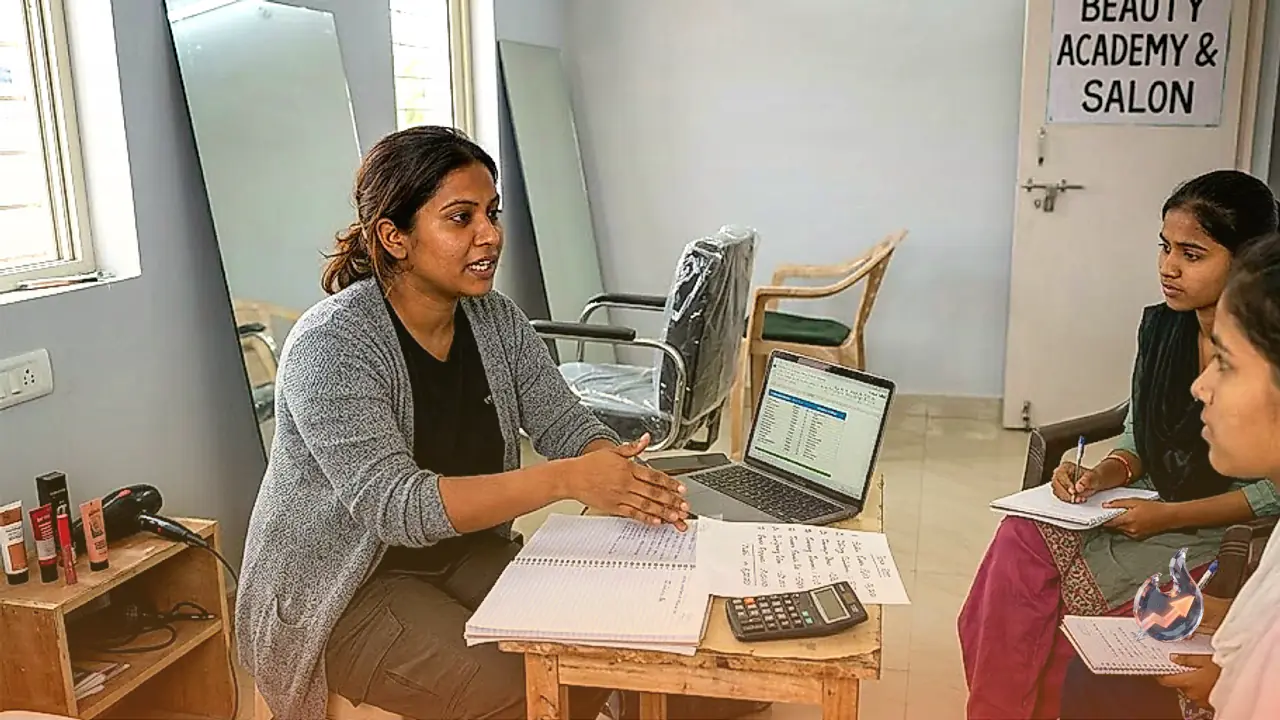
Riddhima's entry into the grooming sector came after a complete career shift. Before stepping into cosmetics and skincare, she was employed as a teacher at a private school. Seeking financial independence and personal growth, she took formal training in makeup and beauty techniques before committing to the sector full-time. The transition was not without skepticism, as she encountered unsolicited advice and critical comments from people around her during the initial phase. Maintaining steady commitment, she eventually advanced her operations to establish a makeup academy and studio in Chainpur, which combines theoretical instruction with hands-on practical work.
Alongside client-facing appointments, training has become an integral pillar of her business model. She is currently conducting her fifth instructional batch. Her academy draws local learners as well as students commuting from distant localities seeking training in cosmetic and salon techniques. Offering these modules enables her to generate robust additional earnings while expanding her brand footprint.
Core Equipment and Consumables for an Initial Setup
Allocating capital toward essential fixtures is critical when setting up a budget-conscious salon. Within an estimated limit of one lakh rupees, an operator can secure the bare minimum infrastructure necessary to service incoming walk-in clients. The basic structural foundation starts with two parlor chairs, two expansive mirrors, and a dedicated hair wash station.
For hair care and technical styling, equipment includes basic dryers, straighteners, curling irons, scissors, and combs. Skincare treatments require a dedicated facial bed, a facial steamer, and a wax heater. Consumables and accessories required on day one include manicure and pedicure supplies, facial treatment kits, depilatory wax, bleach preparations, shampoos, conditioners, hair serums, salon towels, and an entry-level cosmetic kit.
Detailed Expense Breakdown Across Operational Categories
Riddhima outlines that after acquiring the required technical skills, entrepreneurs can procure essential hardware systematically. In her financial breakdown, purchasing two parlor styling chairs and two wall mirrors requires an estimated outlay of 16,000 rupees. The installation of a hair wash basin and plumbing assembly costs around 8,000 rupees.
Styling electrical appliances, including dryers and straighteners, account for approximately 9,000 rupees. Procuring the facial bed alongside a steamer calls for an allocation between 9,000 and 10,000 rupees. Initial treatment supplies, encompassing facial creams, wax stock, and fundamental makeup goods, require an outlay of 18,000 to 20,000 rupees. Adding complementary fixtures such as storage racks, small tables, salon linen, and basic utility items brings the core physical setup cost to roughly 78,000 to 80,000 rupees.
Retaining Working Capital for Inventory and Contingencies
Maintaining liquidity is vital when starting on a tight budget. When operating with an overall allocation of one lakh rupees, roughly 20,000 rupees remains after setting up the physical workspace. Riddhima recommends preserving this reserve strictly for replenishing fast-moving inventory and managing unexpected operational contingencies. Rather than overspending on elaborate salon decor early on, the enterprise can function on lean operational costs. Once client footfall stabilizes and revenue cycles mature, the parlor can reinvest retained profits to introduce advanced tools and premium treatments.
Pathways to Scale and Key Determinants of Revenue
The salon trade offers a flexible entry point for aspiring women entrepreneurs, allowing them to initiate services from a small residential space before moving to commercial marketplaces. As expertise deepens, the setup can expand into a specialized studio or an accredited training center. Service diversification spanning makeup, hair styling, facials, waxing, and threading provides multiple complementary revenue streams.
At the same time, earning six-figure incomes is not an automated or guaranteed outcome. Business revenue varies significantly depending on physical location, daily client volume, service pricing structures, technical expertise, and overhead management.