






















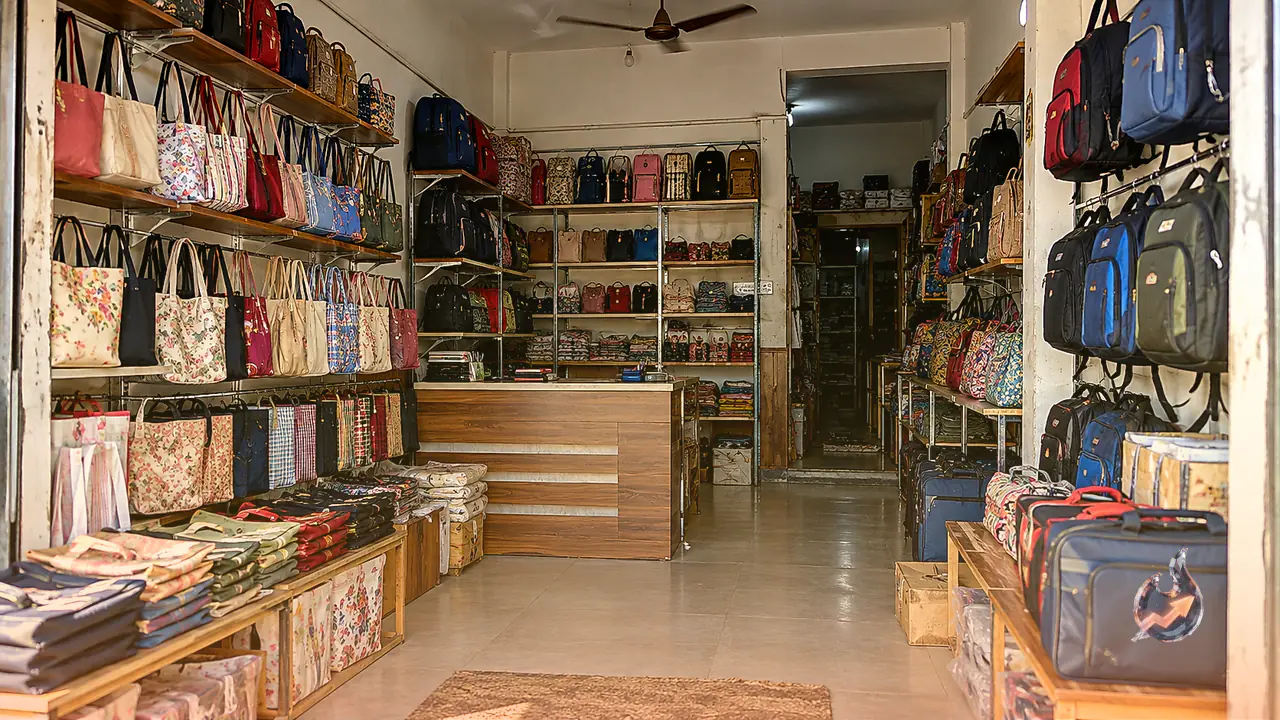

A bag retail business is emerging as a practical and secure venture for individuals seeking self employment opportunities on a modest budget. One of the chief advantages of entering this trade is the complete absence of inventory spoilage or product expiration concerns, which traditionally plague food or cosmetic businesses. Furthermore, store owners can showcase an extensive assortment of products even within compact floor spaces. Mantu Kesri, who operates Sonu Bag Store located on Station Road in Koderma, Jharkhand, provided a detailed breakdown of the capital required, monthly expenses, and projected returns involved in launching this enterprise.
Starting With An Initial Stock Investment Of 20,000 Rupees
Explaining the initial steps required to launch the business, Mantu Kesri noted that individuals who already own or lease a suitable commercial space do not need massive capital upfront. An aspiring retailer can begin operations with a primary stock inventory worth approximately 20,000 rupees. In the early stages, the shopkeeper can stock various bag types tailored to local customer demand and working capital limits. Starting with a modest inventory allows the owner to gauge local buying habits before expanding inventory volumes.
Regarding inventory diversity, he highlighted that the product range typically encompasses ladies purses, gents wallets, school backpacks, college bags, and trolley bags. Because customers of varying demographics require bags for distinct daily and travel needs, retail sales remain consistent throughout the year. Shop owners have the flexibility to adjust inventory categories and order quantities based on their financial capacity.
Total Setup Outlay Ranges Between 1.5 Lakh To 2 Lakh Rupees
Addressing overall capital requirements, Mantu Kesri clarified that buying inventory represents only one component of the total launch expense. For entrepreneurs opening an entirely new outlet, physical interior development is essential. This setup involves installing wooden or metal racks, display units, lighting, interior decor, and basic counter furniture.
Establishing a new retail space from scratch and filling it with initial stock involves a total investment ranging between 1.5 lakh and 2 lakh rupees. However, the final figure varies depending on shop dimensions, prime commercial location, interior design choices, and initial stock volume. If a suitable premises with existing infrastructure is already available, entry costs decrease significantly.
Shop Rent Variations Based On Commercial Locations
Highlighting the impact of store positioning, Mantu Kesri emphasized that location plays a vital role in retail sales volume. In the main commercial market of Koderma, monthly shop rent averages around 10,000 rupees. Conversely, securing a commercial space in residential lanes or inner neighborhood streets reduces monthly rental expenses to approximately 5,000 rupees.
Wholesale Sourcing Starts From 80 Rupees Per Piece
Detailing wholesale economics, Mantu Kesri mentioned that operating his own manufacturing facility enables him to supply goods to retailers and buyers at competitive wholesale rates. In his wholesale catalogue, bag prices begin at an entry level rate of 80 rupees per unit. The pricing structure scales depending on material durability, bag dimensions, structural design, and utility type.
Profit Margins Expected Between 20 To 30 Percent
Outlining profitability expectations, Mantu Kesri indicated that the bag retail sector generally yields gross profit margins between 20 percent and 30 percent. A retailer's actual net earnings depend heavily on daily turnover volume, wholesale acquisition pricing, and monthly overhead costs. Building a consistent customer base, procuring stock at competitive wholesale rates, and aligning inventory with seasonal demand remain key strategies for expanding the business.