























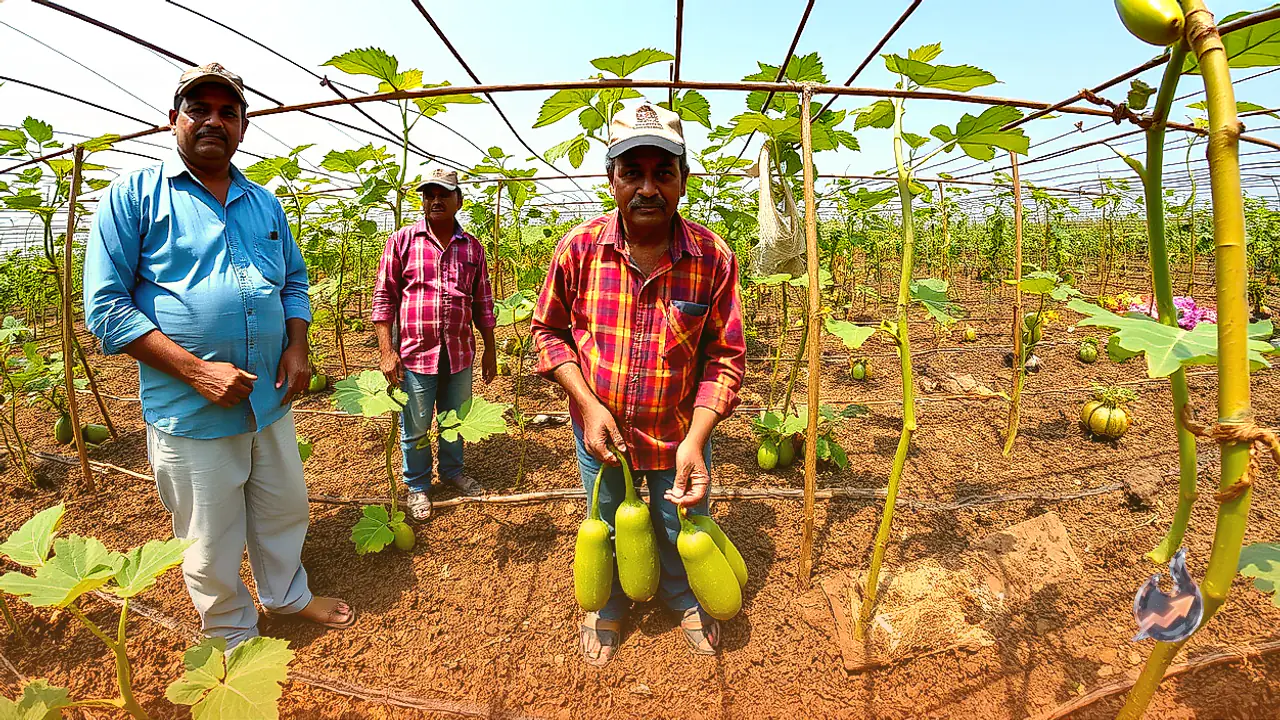

Adopting advanced agricultural practices is helping smallholders transform horticulture into a rewarding commercial venture. In Jharkhand's Bokaro district, a farmer named Shivnath from Peterwar block has demonstrated how scientific methods can unlock strong financial returns from limited land. By deploying a combination of trellis structures and plastic mulching across an area of approximately 70 decimals, he has substantially enhanced the quality and output of his bitter gourd crop. His success has turned into an instructive example for local cultivators seeking ways to move away from conventional, low-yielding routines.
Digital Learning and Practical Field Observation
Belonging to an agrarian family, Shivnath spent years watching conventional seasonal practices yield mediocre returns. His decision to shift directions came after observing other progressive growers in the region who had adopted modern horticultural methods. Complementing these observations with instructional farming videos on his smartphone, he studied how structural crop support and soil covering work in tandem. Convinced of the potential benefits, he decided to implement these techniques on his own 70-decimal plot, setting up raised bamboo scaffolding and protective mulch sheets specifically for bitter gourd.
Planting Cycle and Sequential Harvest Schedule
The crop cycle began with planting in the month of August. Depending on the specific variety selected, bitter gourd vines generally mature to allow their first harvest within 60 to 70 days after planting. Once the harvesting phase commences, the produce can be gathered at regular intervals over an extended timeframe, ensuring a steady flow of fresh vegetables to local wholesale markets. The trellis method keeps the hanging gourds completely elevated above the damp soil, preventing fungal rotting, reducing pest contact, and producing uniformly shaped, unblemished vegetables that attract favorable buyer interest.
Detailed Breakdown of Input Costs, Yield and Profit
Setting up and maintaining the crop over 70 decimals involved a total expenditure of around Rs 30,000, covering trellising materials, mulching film, seeds, and initial cultivation tasks. From this plot, the total harvest ranges between 90 and 100 quintals of bitter gourd. In wholesale vegetable mandis, the crop generally commands an average rate between Rs 20 and Rs 25 per kilogram. Calculated at a conservative wholesale price of Rs 20 per kilogram, an output of 90 quintals generates approximately Rs 1,80,000 in gross revenue. After accounting for the initial operational cost of Rs 30,000 along with logistics and transportation expenses, the net profit comfortably reaches roughly Rs 1,40,000.
Nutrient Management and Vigilant Pest Control
Sustaining such high yields requires disciplined crop health monitoring. Shivnath emphasized that nutrient starvation and early pest infestations often manifest as yellowing foliage, which severely retards vegetative growth and limits flowering. To counter this vulnerability, growers must administer balanced fertilizers matched strictly to soil conditions and the nutritional demands of the crop. Regular field inspections are equally vital to spot insect activity early. At the first sign of trouble, farmers should seek guidance from agricultural experts to apply targeted, approved pest management measures, thereby safeguarding plant health and preserving overall commercial profitability.