



















In Gumo village, located in the Koderma district of Jharkhand, the annual Sarvajanik Durga Puja stands as far more than a seasonal religious celebration. It serves as a living emblem of more than five centuries of historical legacy, deep-seated faith, and unbroken cultural identity. While modern trends have transformed festivities across many regions, Gumo preserves ancient rituals with complete devotion. Among its most distinctive hallmarks are sacred ceremonial chants guided by a 150-year-old handwritten Sanskrit manuscript and a massive traditional goat offering carried out on Mahanavami.
From Royal Patronage to Brahmin Stewardship
The origins of the Sarvajanik Durga Puja Committee in Gumo trace back over 500 years. According to Dashrath Pandey, the head priest of the puja committee, the worship was initially instituted by the local royal lineage. The royal family oversaw, financed, and nurtured this holy festival for approximately 300 years, establishing a solid spiritual foundation that united the village community.
With the passage of time and historical transitions, the stewardship of the sacred rites was formally passed to the Satgharwa Brahmin family. This lineage has faithfully shouldered the responsibility of organizing and conducting the religious ceremonies for roughly 250 years. Blending three centuries of royal heritage with two and a half centuries of priestly continuity, the puja remains a revered focal point of faith for residents across the district.
Rituals Guided by an Ancient Sanskrit Text
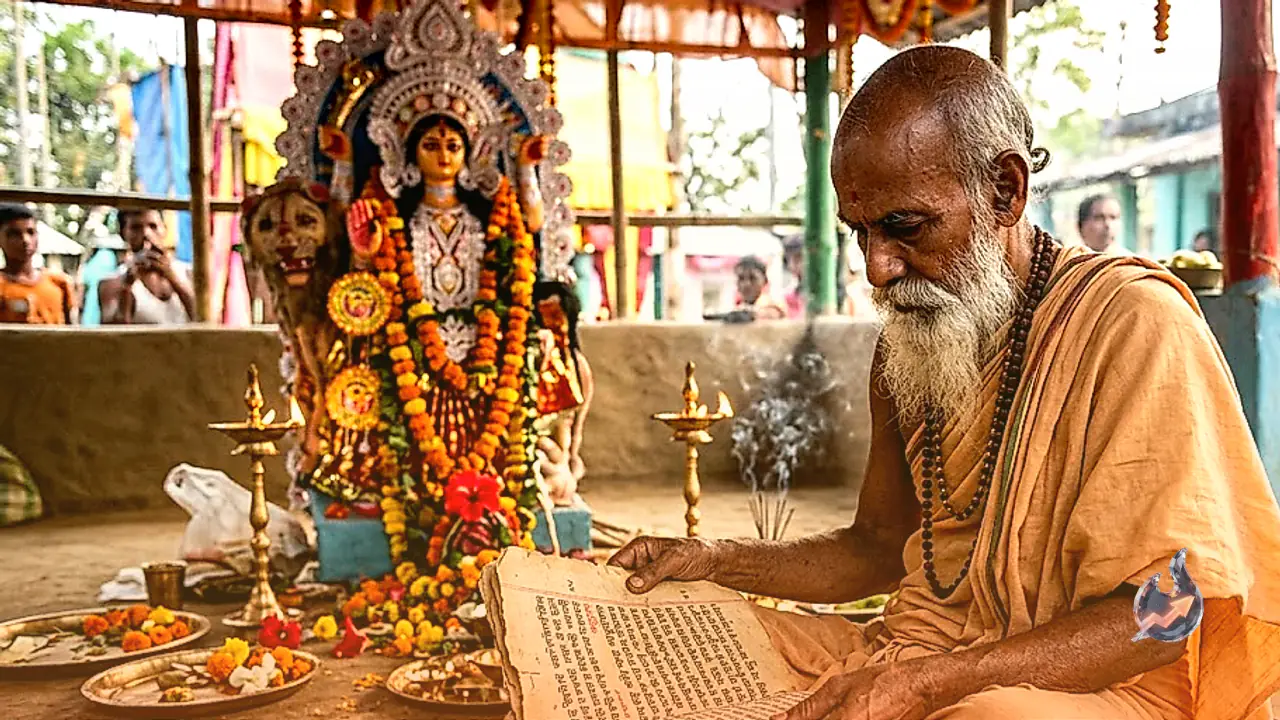
A truly exceptional facet of the Gumo festival is the careful preservation and active liturgical use of an antique handwritten manuscript in Sanskrit. Dashrath Pandey shared that the text was composed nearly 150 years ago by late Baleshwar Pandey. The manuscript meticulously records elaborate mantras, invocation chants, and precise procedures designated for worshiping Goddess Durga.
From Mahasaptami through Vijayadashami, every critical rite is conducted strictly adhering to the formulas documented in this ancient volume. Following Baleshwar Pandey, his son, the late Narsingh Pandey, carried this family duty forward and performed the worship through the very same pages for many decades. The present generation of priests continues to consult this fragile, invaluable manuscript, ensuring the sacred phonetics and ceremonial traditions remain free from dilution.
The Tradition of Animal Offerings from Day One to Navami
Another deeply ingrained custom observed during the Gumo festival is the ritual sacrifice of goats, known locally as patha bali. Dashrath Pandey explained that this practice commences on the very first day of Navratra alongside the ceremonial Kalash Sthapana. Daily sacrifices are performed right from the opening day and continue consistently through the festival period.
On Mahanavami, the observance reaches an immense scale. Villagers gather together at the historic site of Gumo Garh to participate in the collective ritual. On this single day, approximately 2,400 goats are offered as part of the community observance. The sheer participation of every household transforms this solemn rite into an expansive village-wide congregation that honors ancient vows.
Mandap Grounds Host the First Mundan of Married Daughters' Children
Beyond theology and ritual structure, the festival at Gumo reinforces deep familial bonds within the local community. A cherished tradition links the festival directly to the village daughters who have married and moved away. Priest Dashrath Pandey noted that whenever a married daughter gives birth, her child's first tonsure ceremony, or mundan sanskar, must be solemnized exclusively within the premises of the village Durga Mandap.
Because of this enduring custom, married daughters make it a point to return to their parental homes during the Navratra season alongside their families. Performing the child's initial haircut on the holy precincts of the temple connects the new generation to their ancestral roots and maternal village deity. This heartwarming practice infuses the solemn festival grounds with joyful family reunions, ensuring that ancient traditions remain vibrant across generations.