


















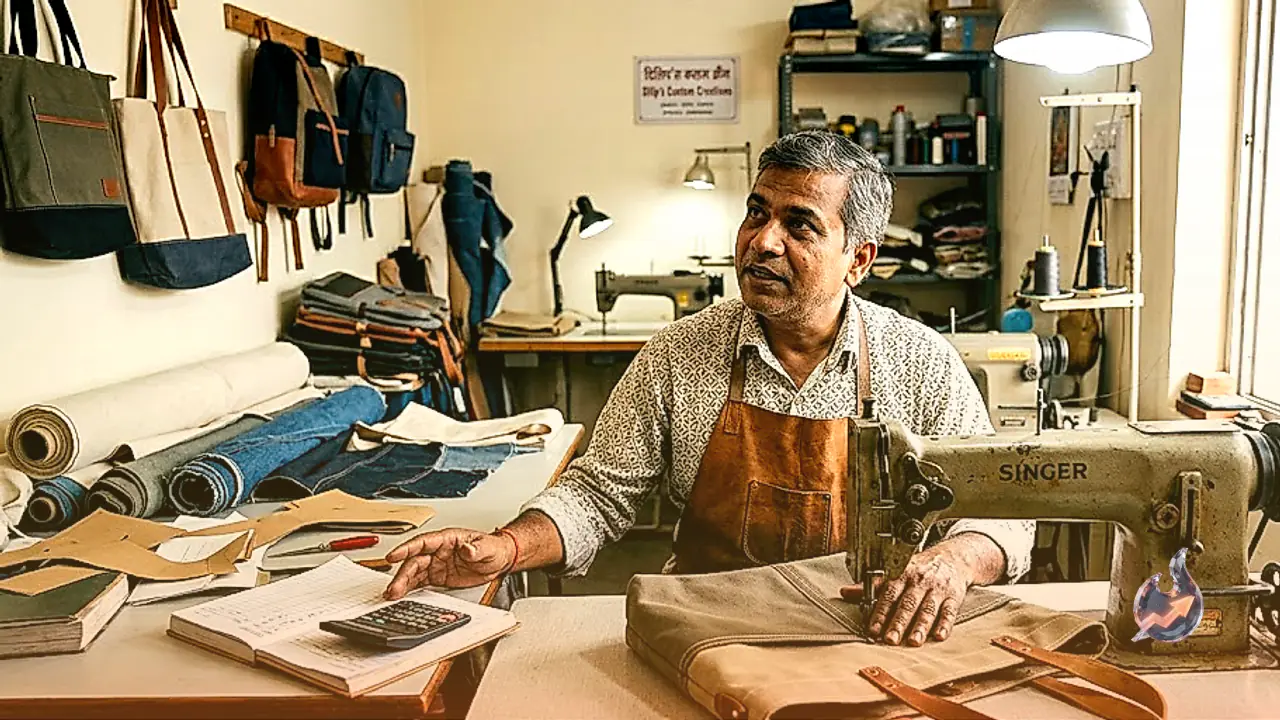

For skilled individuals seeking self-reliance on a tight budget, bag tailoring presents a durable and profitable commercial avenue. Dilip, who has been operating in the bag manufacturing trade for 30 years in Bokaro, explains that an enterprise in this sector can be launched with an initial seed capital of approximately Rs 20,000. This modest threshold allows aspiring micro-entrepreneurs to secure physical workspace and basic manufacturing essentials without incurring heavy financial burdens.
Initial Capital Allocation and Equipment
Deploying the foundational funds prudently determines how smoothly operations begin. According to Dilip, roughly Rs 5,000 of the total budget can be allocated toward renting a modest workshop space. Around Rs 10,000 covers the purchase of a standard stitching machine capable of handling dense fabrics. The remaining balance of Rs 5,000 is sufficient to procure essential consumables, including scissors, fabric, zippers, buckles, and thread. Production can initially commence with just a single machine, with additional units brought in progressively as customer demand and incoming order volumes expand.
Skill Training and Product Selection
Mastering mechanical craftsmanship is central to delivering durable merchandise. Dilip notes that gaining proficiency in bag stitching generally requires around 3 to 6 months of hands-on practical training. During this learning cycle, an operator learns pattern cutting, assembly stitching, zipper and buckle attachment, and professional finishing techniques. As technical familiarity deepens, artisans can venture into varied dimensions and modern patterns. The retail marketplace consistently maintains steady demand for everyday product categories, including shopping bags, lunch carriers, school bags, fitness gym bags, and compact travel pouches.
Unit Costs, Margins, and Monthly Earnings
The profitability model rests on tight input cost controls balanced against steady production output. Fabricating a standard school bag typically entails an expense ranging between Rs 100 and Rs 200, fluctuating depending on textile grades, hardware quality, and structural complexity. Dilip estimates that setting a profit margin of Rs 100 to Rs 150 per finished bag, combined with a daily throughput of 10 units over a standard 26-day working month, yields dependable returns. Operating at the lower margin baseline of Rs 100 results in monthly earnings of Rs 26,000, whereas sustaining a margin of Rs 150 lifts monthly income to Rs 39,000.
Scaling Through Customized Institutional Contracts
Beyond off-the-shelf retail sales, custom manufacturing provides a direct path toward scaling volume. Entrepreneurs can establish direct business relationships with regional retail merchants, schools, colleges, preschools, and corporate offices. Pitching custom-made bags adorned with institutional branding, specific colorways, or printed emblems opens doors to bulk contracts. Securing consolidated institutional orders facilitates large-batch production runs, which lowers per-unit overheads and substantially accelerates total enterprise turnover.