






















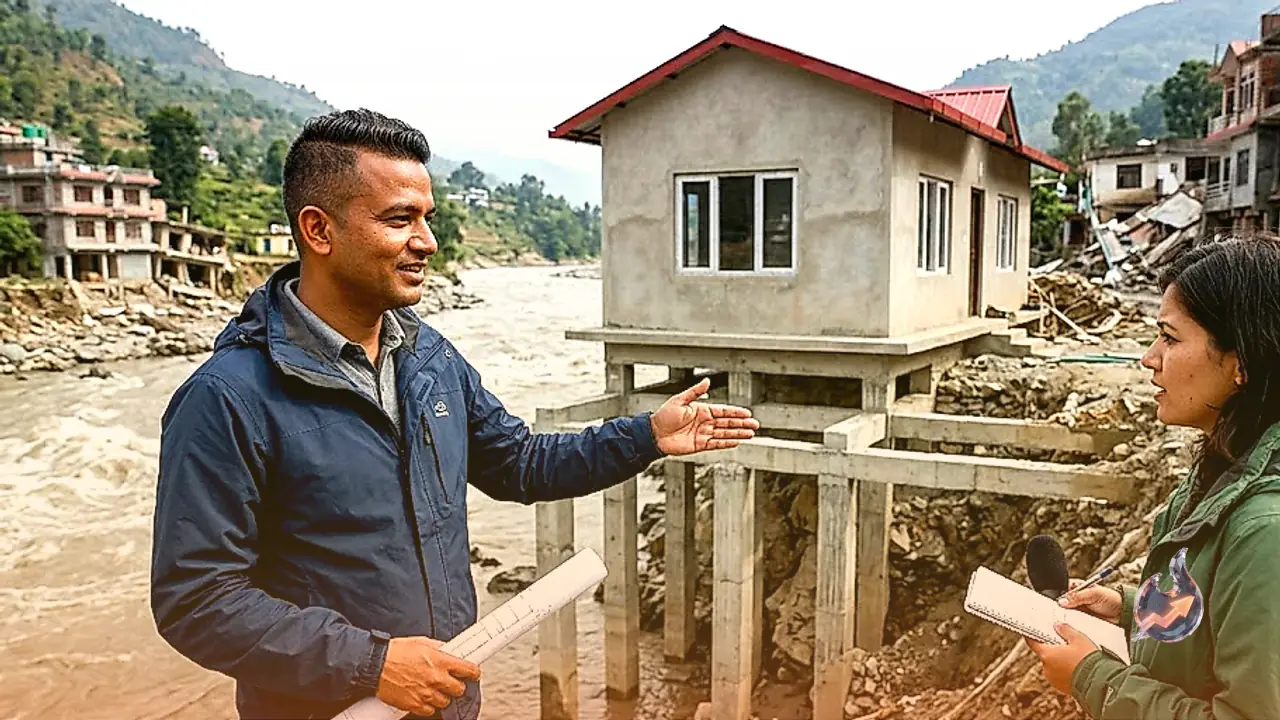

A catastrophic flood unleashed by the swelling Trishuli River in Nepal wreaked widespread havoc, leaving numerous families displaced within hours. The sheer force of the surging torrent washed away solid two-story and three-story concrete structures like paper toys. Yet amid the wreckage, images of a solitary residential building went viral across the world because it refused to budge or collapse. The fact that this structure remained perfectly intact against ferocious currents and safeguarded its occupants immediately triggered curiosity about the engineering behind its survival.
Exposed Cross Columns Reveal Robust Structural Design
Offering a detailed engineering perspective on the incident, Darbhanga based structural engineer Rajesh Kumar highlighted that the home had been engineered on an advanced cross column configuration. Once the raging floodwaters swept away the loose surrounding topsoil, the internal cross columns beneath the plinth level became distinctly visible. Standard vertical pillars frequently snap under violent lateral hydrological thrust, but cross column framing distributes moving water resistance across multiple stress points, keeping the building anchored to its base.
Deep Pile Foundations Counteracted Destructive Diagonal Forces
According to Rajesh Kumar, the structural resilience stemmed primarily from the choice of a deep pile foundation. Unlike shallow spread footings, pile foundations transfer structural weight into the dense, subterranean bedrock layers far below the riverbed. Crucially, the engineering design integrated internal cross beams explicitly intended to counteract dynamic diagonal force. By bridging the support columns across all four corners with crossed reinforcements, the builder established an interconnected structural web.
When severe weather disasters hit, turbulence from fast currents combined with heavy atmospheric wind pressure exerts enormous diagonal stress against building walls. In this case, that diagonal load failed to fracture the superstructure because the cross beams absorbed and redistributed the dynamic impact. The continuous support provided by these diagonal braces held the frame rigidly together, preventing structural drift even after the base soil washed away.
Essential Building Guidelines for Flood Zones and Riverfronts
Addressing structural safety for construction near active waterways and vulnerable drainage zones, engineer Rajesh Kumar advised builders to follow stringent precautions. For any structure being erected along a riverbank, the foundation depth should be deepened to at least 1.5 times the standard building depth. Furthermore, he emphasized that pairing deep pile foundations with comprehensive cross bracing techniques is vital to withstand extreme water pressure, unexpected erosion, and sudden natural calamities.