




















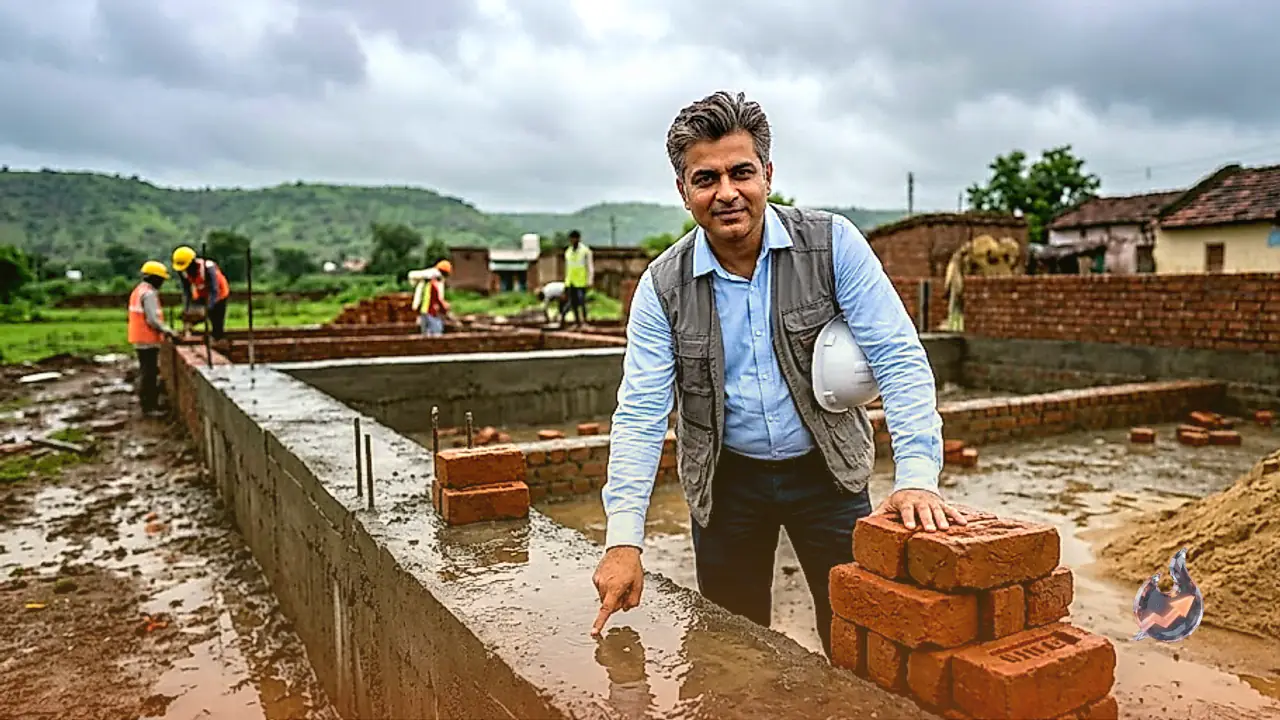

When planning to build a new home, prospective homeowners often prefer summer or winter months under the assumption that rainy weather will complicate construction. In the Chambal region, a widespread misconception persists that digging foundations or casting concrete during the monsoon leads to financial loss and structural flaws. However, civil engineering principles suggest quite the opposite. Civil construction expert Surendra Srivastava points out that among all twelve months of the year, the monsoon season actually provides the ideal environment to maximize building durability and structural strength.
Natural Curing and Optimal Concrete Hydration
Following brickwork or slab casting, curing is the most critical phase of building construction. Cement develops its full chemical bonding strength only when hydrated continuously over an extended period. During peak summer, water applied in the morning evaporates rapidly before afternoon. Direct sunlight and dry winds strip moisture from concrete, significantly increasing the risk of fine hairline cracks across roof slabs and plastered walls. Even with thrice-daily manual watering during summer, achieving the required internal moisture balance remains difficult.
Conversely, atmospheric humidity remains consistently high throughout the rainy season. Combined with routine manual watering, periodic rain showers provide continuous 24-hour hydration to all concrete surfaces. Without incurring extra labor costs or water expenses, concrete cures deeply from within. This constant natural moisture allows the cement matrix to harden completely, achieving a level of structural integrity that is rarely possible during drier months.
Enhanced Masonry Grip from Clean Washed River Sand
A building's durability depends not only on cement quality but also on the grade of sand mixed into the mortar. During dry seasons, commercially supplied sand often contains significant amounts of clay, silt, and fine dust particles. When mortar is prepared with contaminated sand, clay impurities weaken the adhesive bond between cement particles and bricks, compromising long-term stability.
During the monsoon, swelling rivers and swift water currents naturally wash away silt and clay deposits from riverbeds. Consequently, sand extracted during this season is exceptionally clean and well-washed. Mixing this purified sand with cement produces a high-strength mortar that creates an exceptionally tight bond during bricklaying and wall plastering. Masonry executed with this clean aggregate resists weathering and cracking for decades.
Soil Saturation and Foundation Stability
Rainwater thoroughly saturates the ground, softening the topsoil and facilitating deep, precise foundation excavation with less mechanical friction. Furthermore, when concrete is poured into foundation trenches during monsoon, the pre-saturated earth beneath does not absorb water out of the wet concrete mix.
Surendra Srivastava emphasizes that while winter also offers mild humidity, it lacks the dual advantage of continuous natural rain-curing and pristine river-washed sand. As a result, structures erected during the rainy season outperform those built in other weather conditions across key structural metrics.
Essential Precautions for Moisture-Safe Cement Storage
To fully capitalize on the advantages of monsoon construction, builders must observe one crucial safeguard: protecting cement inventory from ambient moisture and direct rain. Cement bags should be stored in a completely dry, elevated, and well-ventilated enclosure to prevent premature setting. As long as cement quality is preserved prior to mixing, a structure built during the monsoon will prove noticeably stronger and more durable than one built in any other season.