


















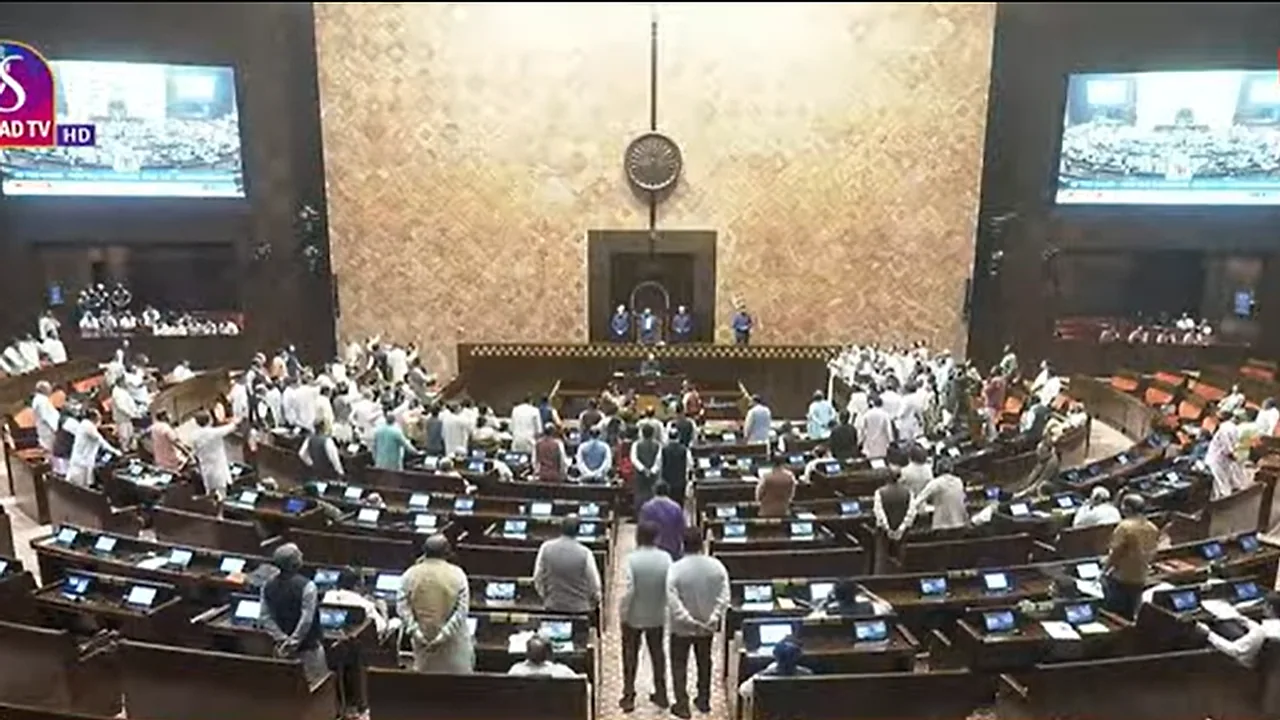

The twelfth day of the Parliament Monsoon Session witnessed intense political friction as opposition lawmakers clashed with the ruling benches over multiple issues. Rowdy scenes unfolded across both Houses over allegations surrounding Ram Temple donation funds and demands for student-related ministerial statements, alongside fresh legislative calls to reform anti-defection guidelines. Amidst repeated procedural interruptions, the government managed to advance its legislative agenda, securing passage for an important financial measure in the lower house and a major administrative amendment bill in the upper house.
Congress MP Moves Adjournment Motion for Reform of Anti-Defection Provisions
Legislative business in the Lok Sabha opened with a push for structural electoral reforms. Congress MP Manish Tiwari formally submitted an adjournment motion notice to the Lok Sabha Secretary General. He urged the Chair to suspend all scheduled business of the day, including the customary Question Hour and Zero Hour, to initiate an immediate debate on the necessity of introducing a stringent anti-defection framework.
In his official communication, Tiwari highlighted that the current legal framework contains gaps that allow opportunistic collective floor-crossing among elected representatives without genuine ideological differences. He stressed that Parliament must deliberate on crafting a robust law that halts calculated party switching while simultaneously protecting space for constructive dissent and independent legislative thought within Parliament and state assemblies.
NDA Leaders Gather for Strategic Parliamentary Group Meeting
Prior to the commencement of parliamentary proceedings, the ruling alliance convened its internal strategy session within the complex. The NDA parliamentary party held its weekly 'Mangal Milan' gathering at the GMC Balayogi Auditorium inside the Parliament Library Building. Prime Minister Narendra Modi attended the session alongside Union Home Minister Amit Shah, Defence Minister Rajnath Singh, and BJP National President Nitin Nabin.
The meeting focused on bolstering inter-party coordination and reviewing pending legislative priorities for the remainder of the session. Senior leaders from alliance partners were also in attendance, with Nationalist Citizens Party of India (NCPI) MP Sudip Bandyopadhyay arriving at the library building early to participate in the joint deliberations.
Sloganeering Prompts Early Adjournment in Lower House
As soon as the Lok Sabha assembled for the morning session, opposition members created a stir by demanding the presence of Home Minister Amit Shah on the floor of the House to address ongoing public concerns. Lawmakers trooped into the well of the House, raising slogans against the government and insisting on immediate ministerial intervention.
Faced with persistent noise and unwillingness to restore order, Lok Sabha Speaker Om Birla appealed for calm. As opposition members continued their protests, the Speaker adjourned the lower house until 2:00 PM.
Fiery Exchanges in Upper House Over Ram Temple Fund Allegations
The Rajya Sabha witnessed similar friction during Zero Hour when Congress President and Leader of Opposition in the upper house Mallikarjun Kharge raised allegations regarding the misappropriation of Ram Temple donation funds. Kharge's remarks immediately drew fierce pushback from treasury bench members, leading to chaotic scenes on the floor.
Both sides traded sharp accusations during the session. Treasury members accused the opposition of disrespecting Lord Ram through unfounded claims, while opposition members demanded accountability regarding public donations. With both sides demanding public apologies and refusing to yield, the Chair suspended Rajya Sabha proceedings until 12:00 PM.
Repeated Suspensions in Rajya Sabha Amid Opposition Demands
When the Rajya Sabha reconvened at 12:00 PM, the Chair attempted to conduct Question Hour. However, opposition members persisted with their slogan-shouting, insisting that the Union Home Minister address the House directly. Consequently, the proceedings on August 4 were adjourned for a second time until 2:00 PM.
Speaking on the opposition's stance, Leader of Opposition Mallikarjun Kharge clarified, "We are only demanding a discussion in both Houses." He urged the Lok Sabha Speaker and Rajya Sabha Chairman to allow structured debates on allegations surrounding the Ram Janmabhoomi Trust as well as issues facing students. Kharge asserted that the Prime Minister himself should offer an explanation regarding the temple fund corruption charges.
Adding to the criticism, Congress MP Pawan Khera targeted the administration over student welfare. He demanded that the Union Home Minister issue a formal statement in Parliament regarding recent developments affecting students, accusing the government of dodging debates on both youth concerns and donation transparency.
Appropriation Bill Cleared in Lok Sabha Before Daylong Adjournment
Upon resuming at 2:00 PM, the Lok Sabha continued to experience heavy opposition sloganeering. Despite the din, essential parliamentary papers and reports were laid on the table of the House by ministers.
Amidst the shouting, the lower house passed the Appropriation (No. 3) Bill, 2026 by voice vote. Given the sustained disruption by opposition parties, the Chair subsequently adjourned the Lok Sabha for the entire day. Proceedings in the lower house will resume on Wednesday at 11:00 AM.
Rajya Sabha Debates Registration of Births and Deaths Amendment Bill
In contrast to the lower house, the Rajya Sabha proceeded with legislative business after 2:00 PM, taking up the Registration of Births and Deaths (Amendment) Bill, 2026, which had already received approval from the Lok Sabha. Union Minister of State for Home Affairs Nityanand Rai presented the key elements of the legislation amidst background slogans from opposition benches.
Rai informed the House that the bill, approved by the Union Cabinet on July 20, modifies Section 13(3) of the Registration of Births and Deaths Act, 1969 (previously amended in 2023). The primary objective of the new measure is to enforce stricter judicial checks on delayed registrations of births and deaths that occur more than two years after the event.
Shift of Regulatory Authority to Judicial Magistrates for Delayed Filings
The newly passed legislation establishes a clear two-tier structure for delayed registrations. Under the existing framework of the 1969/2023 Act, any registration delayed by more than one year required approval from a District Magistrate (DM), Sub-Divisional Magistrate (SDM), or an Executive Magistrate.
Under the amended law, cases involving delays between one year and two years will continue to follow the existing procedure, requiring permission from a DM, SDM, or jurisdiction-specific Executive Magistrate. However, for delays exceeding two years, the requirements become far more rigorous. Such late entries will now mandate an explicit order from a First Class Judicial Magistrate, thereby transferring the approval authority from executive officials to the judiciary for long-overdue registrations.
Following detailed explanations by the Minister, the Rajya Sabha passed the Registration of Births and Deaths (Amendment) Bill, 2026 by voice vote, concluding its parliamentary passage.